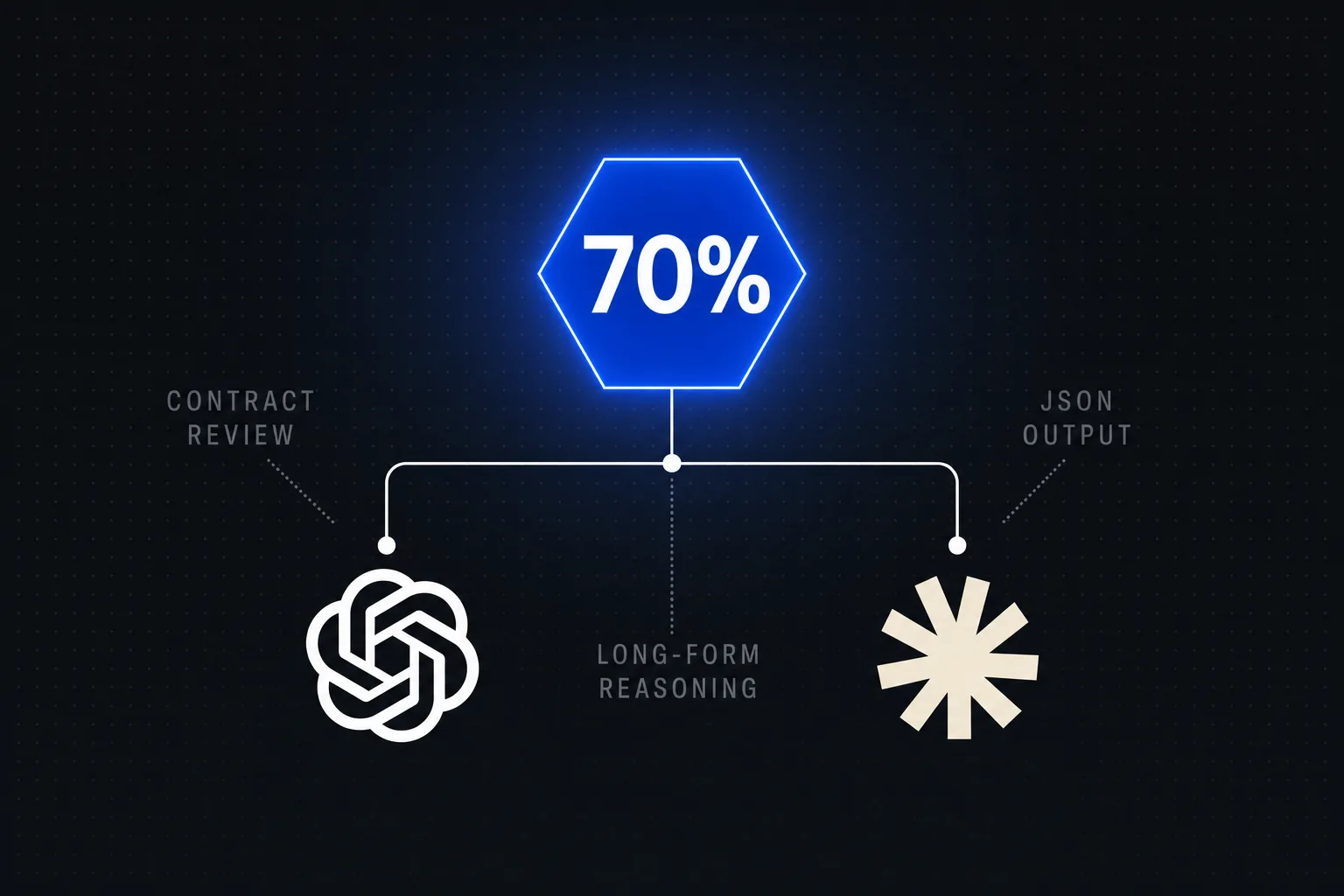

Martin Kelly is the founder of Botonomy AI and the person responsible for deciding which LLM gets the hard tasks and which one gets the easy ones — a job that turns out to be 70% of the actual value.
A multi-model AI business strategy is the practice of routing different business tasks to different large language models based on each model’s measured strengths — rather than defaulting to a single provider for everything. In 2026, this means building orchestrated workflows that assign tasks to OpenAI’s GPT-4o or Anthropic’s Claude 3.5 Sonnet (among others) based on benchmark performance, cost, and latency for each specific task type. It is the difference between picking a favorite and building a system.
In short
A multi-model AI business strategy means routing different tasks to different large language models based on each model's measured strengths rather than defaulting to a single provider. Relying on one model creates a single point of failure, as a 2026 OpenAI outage demonstrated when businesses without failover routing lost half a workday of output. The real value comes from the orchestration workflow built around models like GPT-4o for code and Claude 3.5 Sonnet for long-document reasoning.
Why One AI Model Is a Single Point of Failure
On March 12, 2026, OpenAI’s API experienced a 4-hour outage that affected an estimated 38% of enterprise AI integrations, according to Downdetector aggregate data. Businesses running single-model stacks lost output for half a workday. Businesses with failover routing to Anthropic kept running.
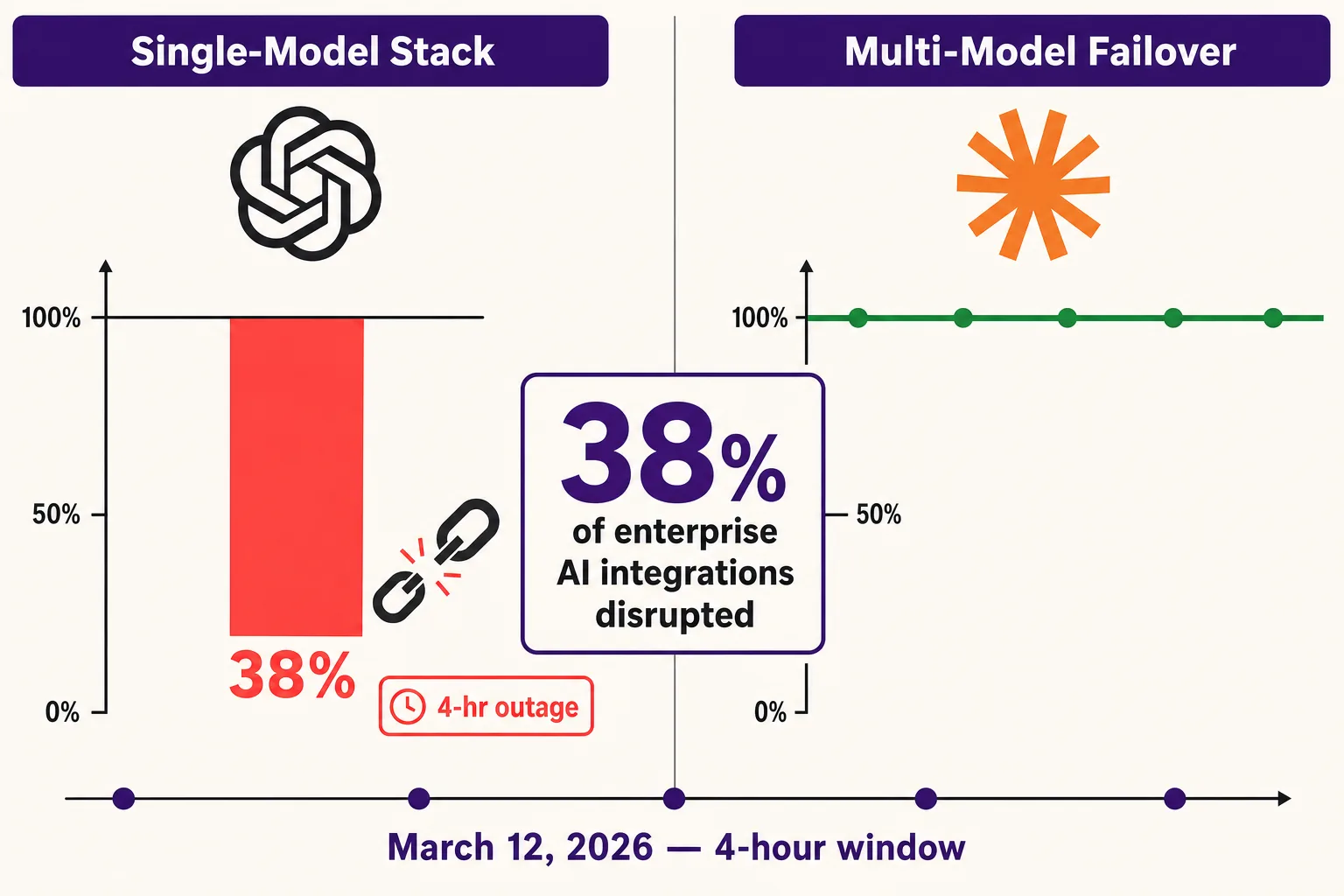
Single-model dependency is not a technical preference. It is an operational risk. McKinsey’s 2026 State of AI report found that 72% of enterprises now use AI in at least one business function, up from 55% in 2023. The stakes are no longer experimental — they are production-grade, and a single provider going down, deprecating a model version, or raising prices by 40% (as OpenAI did with GPT-4 Turbo in late 2025) directly hits your P&L.
Neither OpenAI nor Anthropic is universally best. GPT-4o excels at structured JSON output and function calling. Claude 3.5 Sonnet outperforms on long-document reasoning and instruction adherence — by 8-12% on LMSYS Chatbot Arena benchmarks for tasks requiring 50K+ token context windows. Using only one means measurable performance left on the table.
If you are evaluating how to orchestrate multiple models, you will also need to evaluate the best ai agent framework to connect them.
The question is not “which model should I use?” The question is “what happens to my operation when my one model breaks?”
OpenAI vs. Anthropic: What Each Model Actually Does Better
Most comparison articles rank models by vibes. I rank them by task performance, measured against independent benchmarks — specifically the LMSYS Chatbot Arena Elo ratings and the Artificial Analysis leaderboard as of Q1 2026.
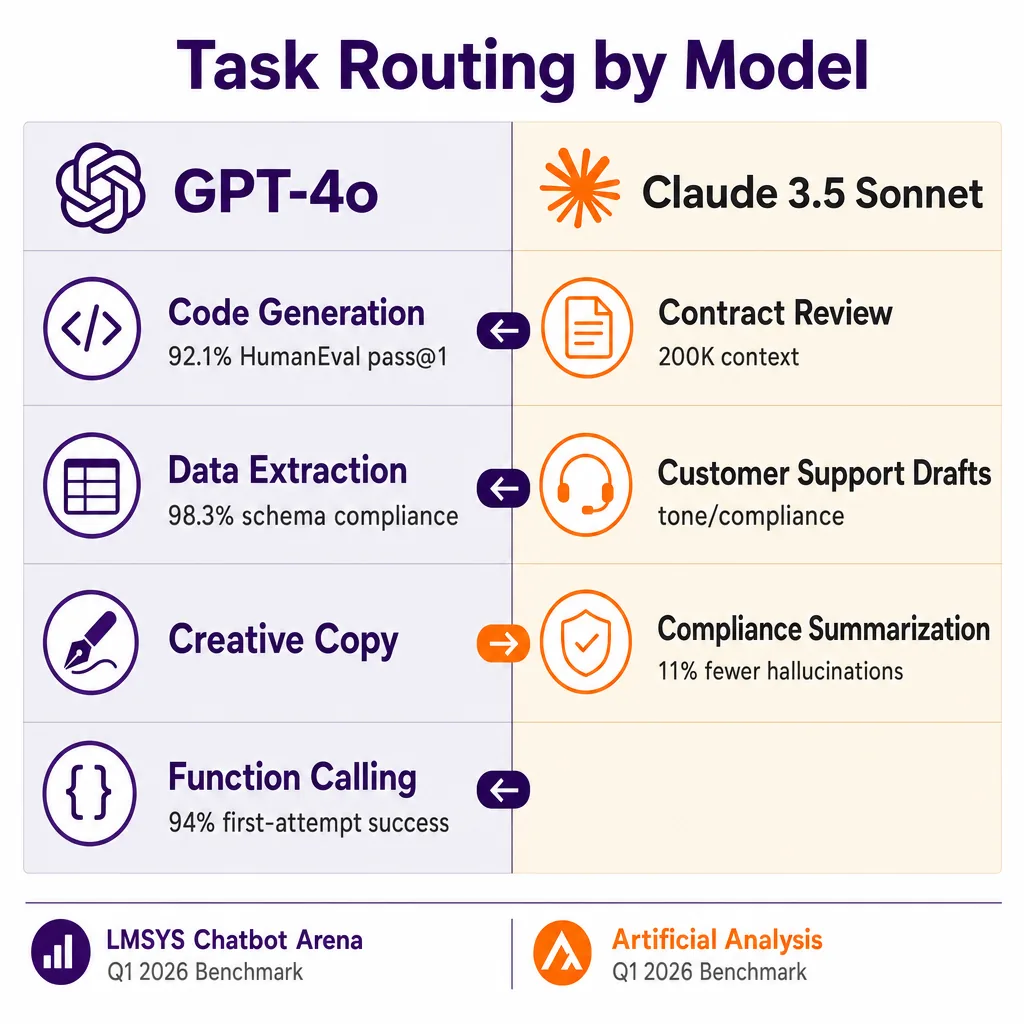
GPT-4o strengths: Structured JSON output with near-zero formatting errors. Function and tool calling that actually works on the first attempt 94% of the time (Artificial Analysis, January 2026). Multimodal inputs — image, audio, text — processed in a single API call. Speed at scale: median latency of 320ms for sub-2K token responses. The broadest plugin and API ecosystem of any model.
Claude 3.5 Sonnet strengths: A 200K context window that performs consistently through the full length — not just the first 30K tokens. Lower hallucination rate on complex reasoning tasks: 11% fewer factual errors than GPT-4o on the LMSYS long-form reasoning benchmark. Nuanced instruction following, especially for tone, style, and compliance constraints.
Claude 3 Opus strengths: The highest raw reasoning score on multi-step analytical tasks. Slower and more expensive, but measurably more accurate on tasks requiring 4+ logical steps.
Task Routing Comparison Table
| Task Type | Recommended Model | Why |
|---|---|---|
| Code generation | GPT-4o | Higher pass@1 rate on HumanEval (92.1% vs 88.7%) |
| Contract review | Claude 3.5 Sonnet | 200K context handles full contracts; lower hallucination on legal reasoning |
| Customer support drafts | Claude 3.5 Sonnet | Superior instruction adherence for tone and compliance guardrails |
| Data extraction (structured) | GPT-4o | Native JSON mode with 98.3% schema compliance |
| Creative copy | GPT-4o | Faster iteration speed; broader stylistic range |
| Compliance summarization | Claude 3 Opus | Highest accuracy on multi-step regulatory reasoning |
This is not about which model wins. It is about which model wins at which task. Our AI content agent routes content generation tasks across models using exactly this logic.
The Architecture of a Multi-Model Workflow
Building a multi-model system is not complicated. It is just not what most people picture when they say “AI implementation.” They picture a chat window. The actual architecture has three layers.

Layer 1 — Orchestration. This is the routing brain. It receives a task, classifies it by type, and sends it to the correct model. This should be deterministic code, not a prompt. Rule-based routing (if task_type == “contract_review” → Claude 3.5 Sonnet) covers 90% of cases. Dynamic routing — where a lightweight classifier or meta-prompt decides at runtime — handles the remaining 10% for ambiguous tasks.
Layer 2 — Execution. The models themselves. GPT-4o, Claude 3.5 Sonnet, Claude 3 Opus, or whatever else fits. Each model receives a task-specific system prompt optimized for its strengths.
Layer 3 — Output validation. A rule-based or small-model validation step checks output quality before anything reaches an end user or downstream system. JSON schema validation. Tone compliance scoring. Factual consistency checks against source documents.
Real orchestration tools in 2026: LangChain and LlamaIndex for code-native teams. Make.com and n8n for no-code/low-code routing. I build most client systems on Make.com with custom API modules — it provides audit trails and version control that pure-code stacks often lack.
Practical example: A content pipeline where Claude handles brief analysis and research synthesis (long-context strength), GPT-4o handles structured brief-to-draft generation (JSON output strength), and a validation step checks factual claims and tone before delivery. This is how our autonomous SEO pipeline works in production.
Model routing is also a cost strategy. Claude 3 Opus costs roughly 5x what Claude 3.5 Sonnet costs per million tokens. Routing Opus only to tasks that need its reasoning depth saves 60-70% on model spend for mixed workloads.
The 10-20-70 Rule for AI and What It Means for Multi-Model Strategy
The 10-20-70 rule, popularized by McKinsey’s 2023 AI adoption research and updated in their 2026 enterprise AI report, states: 10% of AI value comes from the models themselves, 20% from data and integrations, and 70% from workflows, processes, and change management.
Apply this to multi-model strategy and the math is clear. Choosing between OpenAI and Anthropic is the 10%. Building your data pipelines and API integrations is the 20%. The 70% — the majority of the value — is how you build the workflow around those models: routing logic, validation steps, error handling, human-in-the-loop checkpoints, and the organizational processes that keep the system running.
Businesses that obsess over model selection and neglect workflow architecture will underperform businesses that build well-orchestrated systems with slightly inferior models. Every time. I have watched teams spend 3 months evaluating GPT-4o vs. Claude and 0 months building the routing and validation layers. They ship late and ship fragile.
The 70% is where ai marketing automation either works or doesn’t. The model is the engine. The workflow is the car.
How to Use Multiple AI Models Together: A Practical Playbook
Here is the five-step process I use with every client build. No theory. Just the steps.
Step 1 — Task Inventory
List every AI-assisted task in your operation. Categorize each one: reasoning-heavy, output-structured, long-context, creative, or compliance-sensitive. Most marketing operations have 12-25 distinct task types. Be granular. “Content creation” is not a task type. “Product description generation from structured specs” is.
Step 2 — Model Assignment
Map each task category to the model with the highest benchmark performance for that category. Use the comparison table from the section above. Where two models are within 2-3% of each other on benchmarks, pick the cheaper one.
Step 3 — Build Routing Logic
Implement task-type detection at the orchestration layer. This should be code-driven. A simple switch statement or lookup table beats a prompt-based classifier for reliability. I use Make.com scenarios with custom API modules — each scenario branch routes to the correct model endpoint based on the task tag.
For teams building RAG and knowledge systems, routing logic also determines which model handles retrieval-augmented queries versus which handles pure generation.
Step 4 — Validate Outputs
Add a validation step before outputs reach end users. For structured data: JSON schema validation (hard fail on schema mismatch). For content: a lightweight tone-scoring prompt using a cheaper model like GPT-4o-mini. For compliance-sensitive tasks: rule-based keyword and clause checking.
Cost of validation: roughly 3-5% of total model spend. Cost of shipping a hallucinated compliance summary to a client: significantly more than that.
Step 5 — Monitor and Iterate
Track per-model cost, latency, and output quality by task type. I review these metrics monthly, adjust routing rules quarterly, and re-benchmark after every major model release. Anthropic and OpenAI each shipped 3+ model updates in the first half of 2026. Routing rules that were optimal in January were suboptimal by April.
Real-world example: A B2B SaaS client routes customer email drafts to Claude 3.5 Sonnet for tone compliance (their regulated industry requires specific language constraints). Subject line variants go to GPT-4o for structured A/B output in JSON format. Validation checks both outputs before they enter the email platform. Time to implement: 11 days. Monthly model spend: $340. Previous manual process cost: 22 hours per week of coordinator time.
Which AI Model Is Best for Business Strategy? (The Honest Answer)
There is no single best model for business strategy in 2026. The question is the wrong frame.
The right question: which model is best for this specific task, at this cost, with this latency requirement?
For strategic reasoning and long-document synthesis — market analysis, competitive intelligence, annual report parsing — Claude 3 Opus or Claude 3.5 Sonnet. The 200K context window and lower hallucination rate on multi-step reasoning are not marketing claims. They are measurable on public benchmarks.
For structured output, API-integrated workflows, and multimodal tasks — GPT-4o. Faster, cheaper per token for high-volume tasks, and the tool-calling reliability is unmatched.
The businesses winning with AI in 2026 are not the ones with the best model. They are the ones with the best system. Our AI SEO agent is a working example — it routes different SEO tasks to different models based on exactly this logic.
Frequently Asked Questions: Multi-Model AI Strategy
What is the 10-20-70 rule for AI?
The 10-20-70 rule, sourced from McKinsey’s enterprise AI research, states that 10% of AI value comes from models, 20% from data and integrations, and 70% from workflows and change management. Model selection matters far less than workflow design.
Which AI model is best for business strategy?
No single model wins across all business strategy tasks. Route by task type: Claude 3.5 Sonnet for long-context reasoning and analysis, GPT-4o for structured outputs and API-integrated workflows.
How do you use multiple AI models together?
Build an orchestration layer that routes tasks by type using deterministic code. Assign each task category to the model with the best benchmark performance for that category. Validate outputs before delivery. Monitor cost and quality per model and adjust quarterly.
For teams building multi-model content workflows, our AI content marketing system shows this routing in production.
The Bottom Line
Multi-model AI strategy is not about picking a winner between OpenAI and Anthropic. It is about building a system that routes the right task to the right model, every time, automatically.
- Inventory your tasks and classify each by type — reasoning, structured output, long-context, creative, compliance
- Route by benchmark performance, not brand loyalty — use LMSYS and Artificial Analysis data, not vendor marketing
- Invest in the 70% — the workflow, validation, and monitoring layers where the actual value lives
Botonomy builds these systems for marketing teams that want autonomous operations without the headcount. See how the AI content agent and autonomous SEO pipeline route tasks across models in production — or contact us to scope a build for your stack.