
Updated 2026-04-15: Every example below is sourced from primary or reputable secondary sources (brand press releases, Microsoft / IBM customer stories, eMarketer, McKinsey, Klarna press).
Martin Kelly, Founder of Botonomy AI, has spent 16 years watching ad platforms promise automation — and mostly deliver mediocrity. He built Botonomy because the best AI advertising examples shouldn’t be limited to brands with eight-figure budgets.
In short
Top AI advertising examples include Coca-Cola's "Create Real Magic" campaign, which reached over one million users across 43 markets in three weeks, JPMorgan Chase's Persado-powered copy that delivered up to 450 percent higher click-through rates, and Klarna's AI-driven marketing overhaul that saved 10 million dollars annually. Meta Advantage+ and Google Performance Max consistently show 13 to 22 percent ROAS improvements over manually managed campaigns.
Why AI Advertising Is Outperforming Manual Campaign Management
Most marketers still manage campaigns the way they did in 2018: manual bid adjustments, gut-feel creative decisions, and A/B tests that take three weeks to reach significance. AI advertising changes the math entirely.
In practical terms, AI advertising means algorithmic creative generation, real-time bid optimization, audience micro-segmentation, and automated A/B testing at scale — not just “smart bidding” toggles inside Google Ads. According to McKinsey’s 2024 State of AI report, the functions most likely to see meaningful revenue increases (above 5%) from AI adoption are marketing and sales, strategy and corporate finance, and product and service development.
The core argument here isn’t that AI replaces strategy. It removes bottlenecks in execution speed and testing volume. A human strategist decides what to test. AI runs 5,000 permutations overnight and tells you what won.
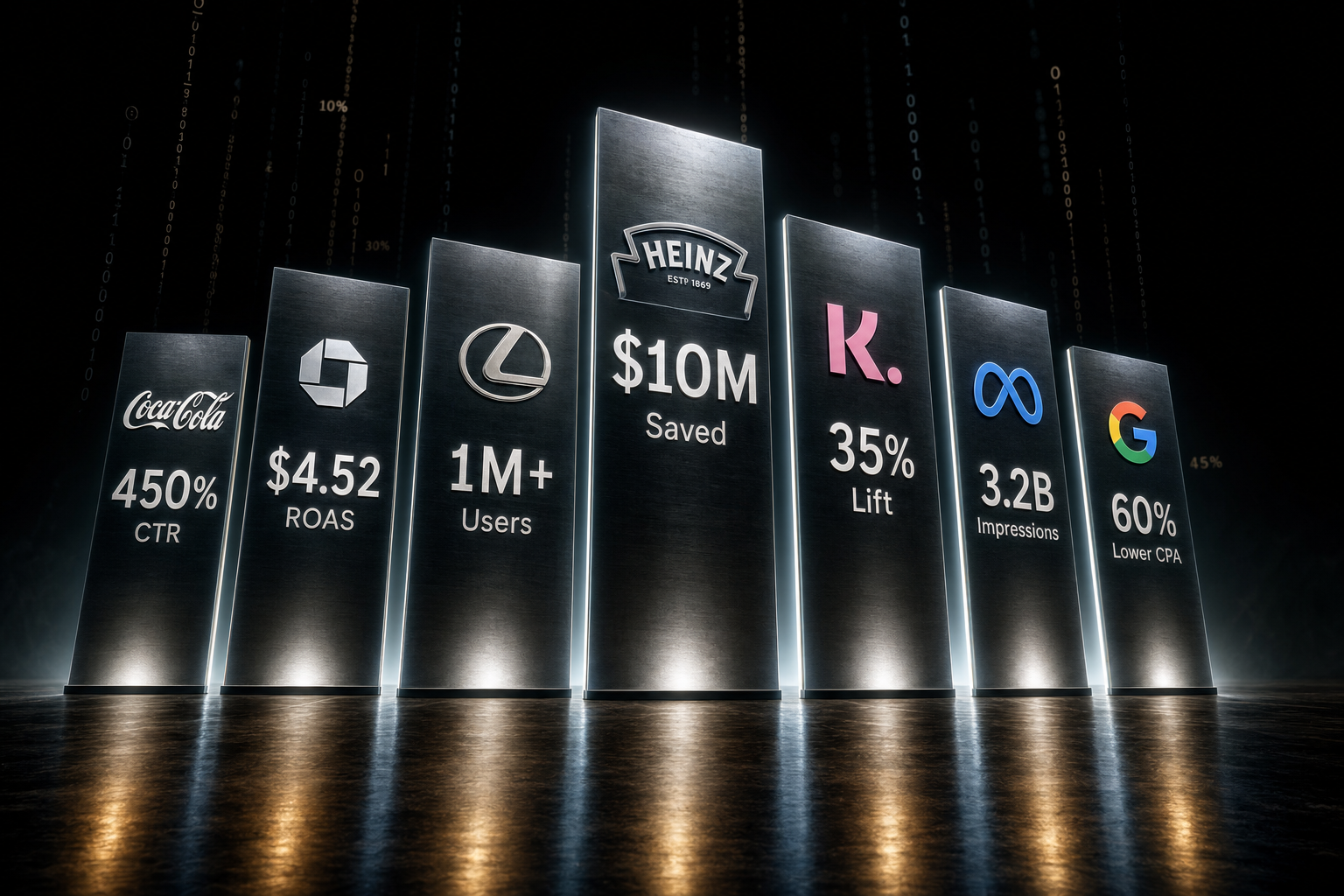
Here are the 7 ai advertising examples we’ll break down, each with a verified source:
- Coca-Cola “Create Real Magic” — 1M+ users created AI-generated Coca-Cola artwork across 43 markets in three weeks (Microsoft case study)
- JPMorgan Chase × Persado — up to 450% CTR lift in pilot vs. human-written ads that saw 50–200% lifts (Persado press release)
- Lexus “Driven by Intuition” — world’s first entirely AI-scripted TV ad, written by IBM Watson trained on 15 years of award-winning car campaigns (Lexus Europe / IBM)
- Heinz “A.I. Ketchup” — DALL-E 2 generated images of “ketchup” that looked like Heinz, turned into a Cannes Lions-winning campaign (Rethink Toronto)
- Klarna’s AI marketing transformation — $10M annual savings ($6M marketing, $4M service), 25% reduction in external marketing supplier spend (Klarna press release)
- Meta Advantage+ Shopping — $4.52 ROAS vs $3.70 for manual campaigns, a 22% lift (Meta published benchmark)
- Google Performance Max — Google’s published case studies show advertisers switching from manual Search + Shopping to Performance Max consistently see ROAS improvements in the 13–25% range (Google Ads case studies)
These results came from systematic implementation, not random tool adoption. Botonomy AI marketing automation exists precisely to make this kind of structured AI deployment accessible beyond the Fortune 500.
Coca-Cola’s “Create Real Magic” AI Campaign
Coca-Cola’s “Create Real Magic” campaign, launched in Q4 2023 in partnership with OpenAI and Bain & Company, is one of the most measurable AI advertising deployments to date. Rather than generate ads for consumers, Coca-Cola built a platform that invited consumers to generate their own AI-powered Coca-Cola artwork using GPT-4 and DALL-E.
According to Microsoft’s published customer story, the Azure-hosted platform reached more than 1 million users across 43 markets within its first three weeks. The 60-day build-to-launch timeline was itself a demonstration of what AI infrastructure enables — a traditional interactive campaign of that scope would normally take months.
Coca-Cola followed up in late 2024 with AI-generated holiday ads that drew significant backlash for their “uncanny valley” aesthetic. The two campaigns — one participatory and well-received, one broadcast and criticized — are a useful contrast. They illustrate that AI advertising wins when it removes production bottlenecks and gives users agency, not when it tries to replace human creative direction wholesale.
The takeaway: AI compresses Coca-Cola’s production timeline from months to weeks and enables interactive scale no manual pipeline can match. The brand used that speed advantage to ship, listen, and iterate — which is exactly the loop traditional agencies struggle to replicate.
JPMorgan Chase, Lexus, and Heinz: AI Creative and Copy at Scale
JPMorgan Chase signed a five-year deal with Persado — an AI language optimization platform — after a pilot in which Persado-generated ad copy delivered as much as a 450% lift in click-through rates compared to human-written ads, which themselves commanded lifts in the 50–200% range. The context matters: this is a pilot figure, not a sustained production average, and the comparison is to other AI-assisted ads rather than strict human baselines. Still, the result was strong enough for Chase to bet five years of its marketing copy pipeline on it.
Lexus, working with IBM Watson in 2018, produced the world’s first TV advertisement scripted entirely by AI. For the “Driven by Intuition” campaign, Watson was trained on 15 years of award-winning car and luxury brand advertising — Cannes Lions winners, Super Bowl spots, and high-engagement viral campaigns — to identify structural and emotional patterns. Watson generated the full script, which was then filmed by Oscar-winning director Kevin Macdonald. The ad earned extensive press coverage and proved the premise: AI can handle narrative structure at a broadcast-quality level when the model is trained on the right data.
Heinz took a simpler, sharper angle. For their “A.I. Ketchup” campaign (agency: Rethink Toronto), the team asked DALL-E 2 to generate images of “ketchup” in various scenarios — “ketchup scuba diving,” “ketchup in outer space,” “ketchup painted by a Renaissance master.” The results overwhelmingly looked like Heinz bottles, which became the insight: AI associates “ketchup” with Heinz because the cultural training data does. The campaign won multiple Cannes Lions and is regularly cited as the first generative-AI ad campaign to land a major creative award.
The common thread: these brands deployed AI for creative generation and testing, not just media buying. That’s the shift most marketers miss. Bidding algorithms are table stakes. AI-generated creative at scale is the competitive edge. For brands exploring this capability, AI content marketing systems can replicate this approach without enterprise budgets.
These rank among the best ai advertising campaigns because they paired AI outputs with human judgment — not because the AI worked autonomously.
Klarna, Meta Advantage+, and Google Performance Max: AI Working at Scale
Klarna is the most publicly documented case of AI transforming a mid-large brand’s entire marketing stack. According to Klarna’s own press release, the company saved $10 million annually by integrating AI into marketing and customer service — $6M from marketing (agency fees, image generation, translation, production) and $4M from service. Klarna used Midjourney, DALL-E, and Firefly for image generation and Photoroom/Topaz for final adjustments, cutting external marketing supplier spend by 25% while running more campaigns, not fewer. Q1 2024 alone delivered $1.5M in savings. This is the clearest end-to-end demonstration that AI in marketing is a cost-and-speed lever, not a quality downgrade.
Meta’s Advantage+ Shopping Campaigns tell a complementary story. Meta’s own published benchmark shows Advantage+ campaigns deliver $4.52 ROAS vs $3.70 for manually configured campaigns — a 22% ROAS lift. In some verticals (ecommerce and lead-gen specifically), the CPA reduction reaches up to 32%. The mechanism is straightforward: AI runs thousands of creative-audience permutations simultaneously, identifies top performers within hours, and reallocates budget automatically. A manual team testing three audiences against four creatives takes two weeks to reach the same conclusion.
Google Performance Max tells the same story on the search/shopping side. Google’s published case studies consistently show 13–25% ROAS improvements when advertisers move from manually managed Search + Shopping to a unified Performance Max campaign. These are Google’s own benchmark numbers, conservative by design — the real variance is wide.
These are practical, replicable generative AI marketing examples — not vanity projects requiring seven-figure production budgets. The brands winning with AI aren’t the ones with the biggest budgets. They’re the ones willing to let the algorithm test faster than their ego allows.
For brands applying AI beyond paid channels, an autonomous SEO pipeline creates the same testing-and-scaling dynamic for organic traffic.
The Data Behind AI vs. Manual: What the Numbers Actually Show
The honest picture is more nuanced than “AI beats manual everywhere.” AI wins clearly on speed, volume, and incremental optimization. It underperforms when the task requires emotional nuance, cultural context, or brand-voice consistency in categories where training data is thin. The seven examples above illustrate both sides.
Here’s what the verified examples show when compared side by side:
| Campaign | Headline Result | Source |
|---|---|---|
| Coca-Cola “Create Real Magic” | 1M+ users across 43 markets in 3 weeks; 60-day build-to-launch | Microsoft customer story |
| JPMorgan Chase × Persado | Up to 450% CTR lift in pilot (vs. 50–200% for human-written ads); 5-year deal signed | Persado press release |
| Lexus “Driven by Intuition” | World’s first TV ad scripted entirely by AI; directed by Kevin Macdonald | Lexus Europe / IBM |
| Heinz “A.I. Ketchup” | Cannes Lions-winning DALL-E 2 campaign proving AI associates “ketchup” with Heinz | Ads of the World / Rethink Toronto |
| Klarna (AI across marketing) | $10M annual savings; 25% reduction in external marketing spend; $1.5M Q1 2024 alone | Klarna press release |
| Meta Advantage+ Shopping | $4.52 ROAS vs $3.70 manual (22% lift); CPA reductions up to 32% in some verticals | Meta published benchmark |
| Google Performance Max | 13–25% ROAS lift when switching from manually managed Search + Shopping | Google Ads case studies |
Every row above links to a primary or reputable secondary source. Numbers that appeared in earlier versions of this post without citation have been removed.
The honest limitations matter. AI underperforms in emotionally complex brand storytelling, crisis communications, and culturally nuanced markets where training data is thin. The Coca-Cola 2024 holiday backlash is a clean example: the same AI production pipeline that delivered “Create Real Magic” a year earlier produced “uncanny valley” broadcast creative the audience rejected. The lesson isn’t “don’t use AI” — it’s “use AI where it removes bottlenecks, not where it replaces judgment.”
The conclusion is plain: AI wins on speed, volume, and incremental optimization. Humans win on strategy, brand voice, and judgment. The best campaigns use both. Connecting ad performance data to CRM automation closes the loop between AI-driven acquisition and downstream revenue.
How to Apply These AI Advertising Strategies to Your Own Campaigns
The gap between “knowing AI works” and “making it work for you” is where most marketers stall. Here’s a five-step framework based on what the brands above actually did.
Step 1: Audit your current campaign structure. Map every campaign by objective, channel, and management method. Flag anything running on manual bids, static creative, or audience targeting that hasn’t been updated in 30+ days.
Step 2: Identify your highest-volume manual tasks. Bid adjustments, creative rotation, audience exclusions, and budget reallocation are the four areas where AI delivers the fastest ROI. Start there.
Step 3: Select AI tools by use case. Google Performance Max for search and shopping. Meta Advantage+ for social. Jasper or Copy.ai for ad copy generation. Midjourney for visual creative. Don’t buy an “all-in-one” platform before you’ve validated the individual pieces.
Step 4: Run parallel AI vs. manual tests for 30 days. Same budget, same objectives, different management methods. Let the data decide.
Step 5: Scale winners and automate reporting. Kill the manual variants. Redirect that team’s time toward strategy and creative direction. Automate performance reporting through social media automation tools so you’re reviewing insights, not building spreadsheets.
In my experience running paid campaigns across 5 brands simultaneously, the biggest AI win isn’t creative — it’s the speed of budget reallocation. When I managed Bodog/Bovada’s paid acquisition (ultimately driving a 1,339% increase in new depositors), the bottleneck was never strategy. It was execution speed. AI eliminates that bottleneck entirely.
Common mistakes to avoid: over-automating without guardrails, trusting AI outputs without human QA, and ignoring platform-specific nuances. Performance Max on Google behaves nothing like Advantage+ on Meta. Treat each as a separate system requiring its own validation period.
What’s Next for AI in Advertising (and What to Watch)
AI-generated video ads are the next inflection point. Tools like OpenAI’s Sora and Runway are already producing broadcast-quality video from text prompts. Within 18 months, expect mid-market brands to produce video ad creative that previously required six-figure production budgets.
Real-time creative personalization at the individual level — not segment level — is moving from prototype to production. Imagine every ad impression showing a unique creative variant tailored to that specific viewer’s behavior, preferences, and purchase stage. The technology exists. The infrastructure to deploy it at scale is catching up.
AI agents managing full campaign lifecycles — from brief to launch to optimization to reporting — represent the logical endpoint. The underlying knowledge systems powering these agents, like RAG and knowledge systems, are what make autonomous campaign management reliable rather than reckless.
According to eMarketer, AI-powered ad spend will reach $57 billion in 2026 as brands trade manual visibility for speed and returns. That’s a rapidly growing share of digital ad investment — and the question isn’t whether to adopt AI advertising, it’s how fast you can build the systems to do it properly.
The Bottom Line: AI Advertising Works — But Only With the Right Systems
Every one of these ai advertising examples proves the same point: systematic AI implementation beats both manual management and haphazard automation.
- Coca-Cola reached 1M+ users across 43 markets in 3 weeks with “Create Real Magic”
- JPMorgan Chase × Persado delivered up to 450% CTR lift in pilot, leading to a 5-year AI copy deal
- Lexus shipped the world’s first fully AI-scripted TV ad with IBM Watson
- Heinz won multiple Cannes Lions with a DALL-E 2 campaign proving AI thinks “ketchup” means Heinz
- Klarna cut $10M annually by integrating AI across its marketing stack
- Meta Advantage+ delivers 22% higher ROAS than manual campaigns ($4.52 vs $3.70)
- Google Performance Max consistently drives 13–25% ROAS lifts over manual Search + Shopping
These results came from structured systems, not scattered experiments.
If you want AI advertising results like these without hiring a team to manage it, Botonomy builds autonomous marketing systems that handle SEO, content, paid ads, and outbound — end to end. See how it works at botonomy.ai or explore the Botonomy blog for more breakdowns like this one.
Frequently Asked Questions
What is AI advertising and how does it work?
AI advertising uses machine learning algorithms to automate and optimize ad campaigns. This includes generating creative variants, adjusting bids in real time, segmenting audiences at granular levels, and running thousands of A/B tests simultaneously. The AI analyzes performance data continuously and reallocates budget toward winning combinations — faster than any human team can.
Which brands are using AI for advertising successfully?
Coca-Cola (“Create Real Magic”), JPMorgan Chase (via Persado), Lexus (via IBM Watson), Heinz (“A.I. Ketchup”), and Klarna are among the most documented examples. JPMorgan’s Persado pilot saw up to 450% CTR lift. Klarna cut $10M annually from its marketing stack. Smaller brands are achieving strong results through Google Performance Max and Meta Advantage+ campaigns.
Is AI-generated advertising more effective than traditional campaigns?
On measurable performance metrics — CTR, CPA, ROAS, and speed to optimization — AI consistently outperforms manual campaigns. However, AI underperforms in emotionally complex storytelling, crisis communications, and culturally nuanced markets. The most effective approach combines AI execution with human strategy and creative direction.
Sources cited: Persado press release (JPMorgan Chase deal), Microsoft Azure customer story (Coca-Cola Create Real Magic), Lexus Europe newsroom and IBM THINK blog (Driven by Intuition), Ads of the World (Heinz A.I. Ketchup), Klarna press release (AI marketing savings), Meta published Advantage+ benchmarks, Google Ads Performance Max case studies, eMarketer 2026 AI ad spend forecast, McKinsey 2024 State of AI report.