
Martin Kelly is the founder of Botonomy AI and has spent 16 years in digital marketing — long enough to spot the difference between a company that’s actually pivoting to AI and one that just updated its LinkedIn banner.
AI company pivots describe the trend of established businesses restructuring their core product, revenue model, or operations around artificial intelligence. In 2026, this is happening at industrial scale — Reuters counted over 150 U.S. public companies formally repositioning as AI or tech businesses in Q1 alone. The gap between a genuine operational pivot and a branding exercise is simple: one changes the cost structure, the other changes the press release.
In short
An AI company pivot means restructuring a core product, revenue model, or operations around artificial intelligence. Goldman Sachs data shows a median 14% stock bump from such announcements, but 60% of that gain evaporates within 90 days unless a real product already exists. Winners like Klarna and Shopify automated internal processes first, then productized those systems. Failed pivots share one trait: announcements with no change in R&D spending or engineering hires.
What an AI Company Pivot Actually Means in 2026
Most companies that announce an AI pivot haven’t actually pivoted anything. They’ve added two letters to a tagline.
A genuine company pivot to AI means the core product or revenue model got rebuilt. Not supplemented. Rebuilt. Allbirds — the shoe company — announced in April 2026 that it was repositioning as an AI-driven business. The stock spiked 582%. The product? Still shoes. The AI integration? A recommendation engine and supply chain forecasting tool. That’s a product enhancement, not a pivot.
I use a simple taxonomy throughout my work, and it applies here:
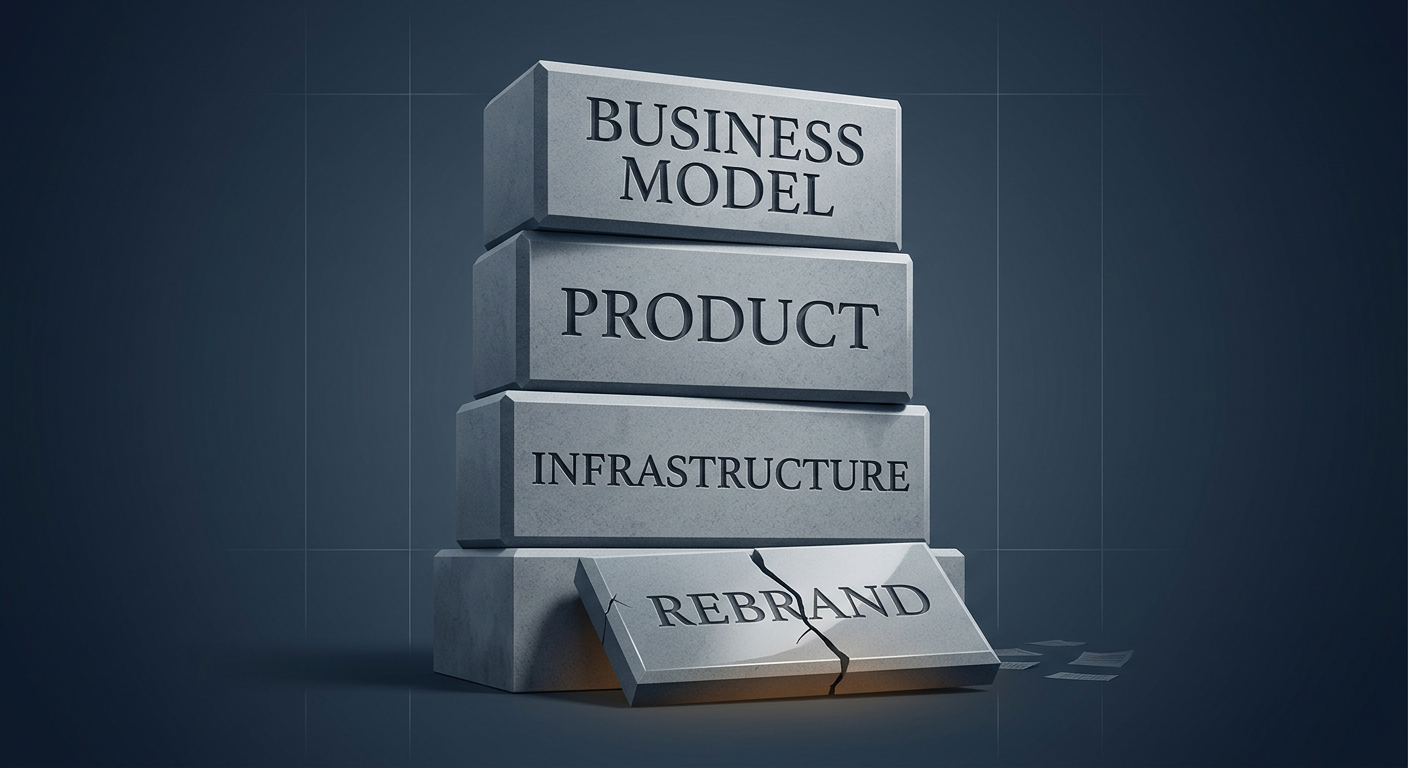
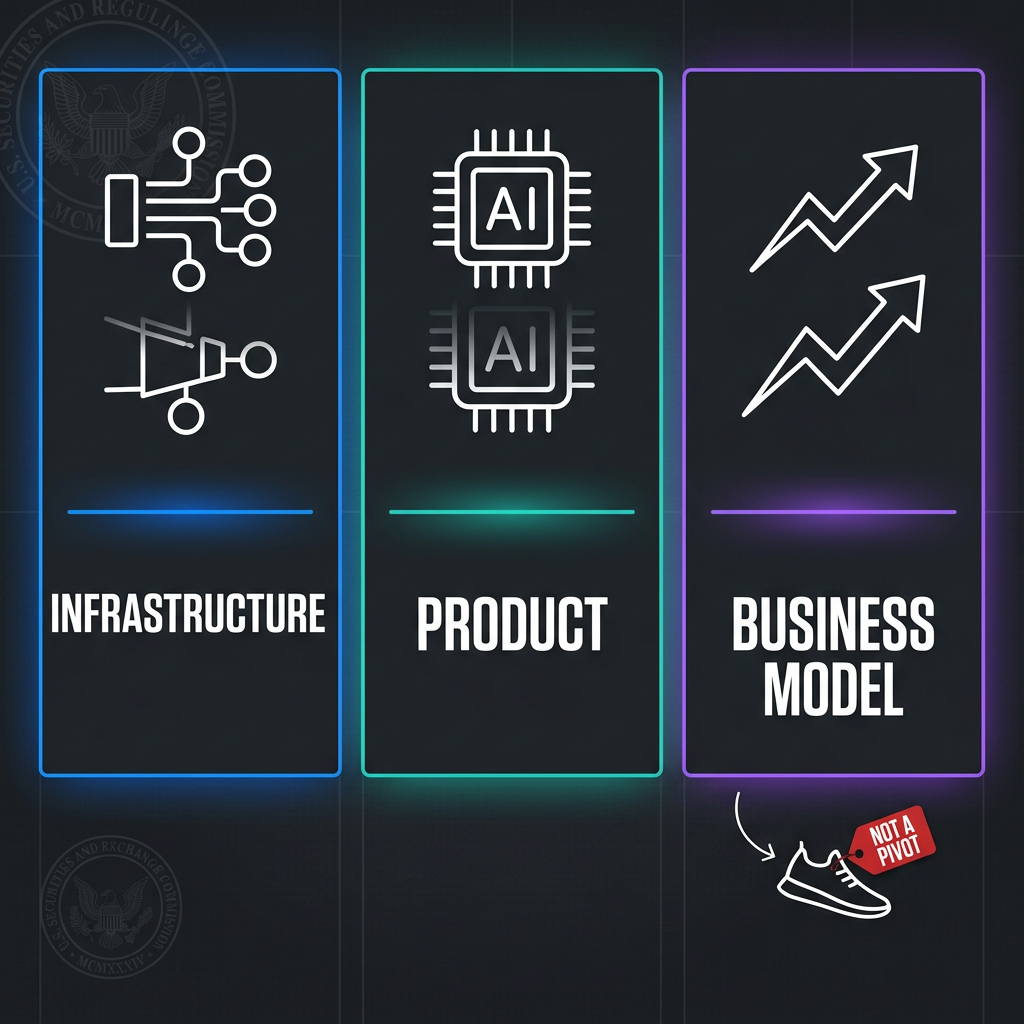
- Infrastructure pivot: The company changes what it builds on — new data pipelines, compute architecture, or AI-native backend systems.
- Product pivot: The company ships a fundamentally different product powered by AI, not just an AI feature bolted onto the old one.
- Business model pivot: The company changes how it makes money — from services to SaaS, from licensing to usage-based pricing tied to AI outputs.
The SEC noticed the pattern too. In early 2026, the Commission issued updated guidance flagging misleading AI pivot disclosures in public filings as a material compliance risk. If your 10-K says “AI-first” but your R&D spend didn’t change, regulators are watching.
For ongoing coverage of which companies are making real moves versus noise, I track announcements through our ai news roundup.
The 2026 AI Pivot Wave: Numbers Behind the Headlines
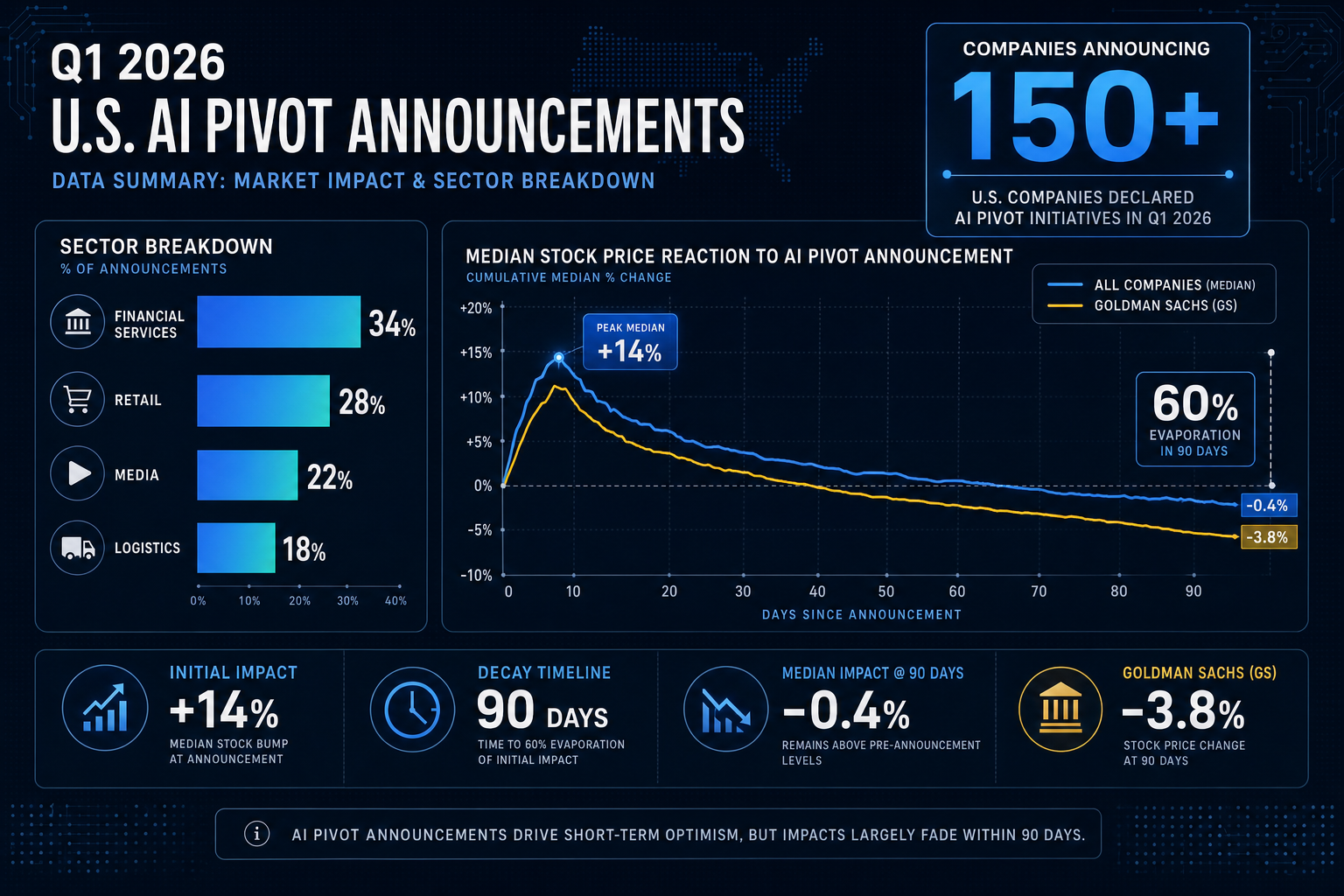
Reuters reported in April 2026 that more than 150 U.S.-listed companies had formally repositioned themselves as AI or technology businesses since January — a 3x increase over the same period in 2024. Most were mid-cap firms in retail, media, logistics, and financial services.
McKinsey’s 2026 Global AI Survey pegged enterprise AI adoption at 72% of companies with over 1,000 employees, up from 55% in 2024. That’s adoption, not transformation. The distinction matters.
Sector-by-sector, the pivot activity is uneven. Financial services leads — 34% of firms surveyed had restructured at least one revenue-generating product line around AI. Retail is second at 28%, driven mostly by demand forecasting and personalization. Media sits at 22%, almost entirely in content automation. Logistics trails at 18%, but with the deepest infrastructure changes.
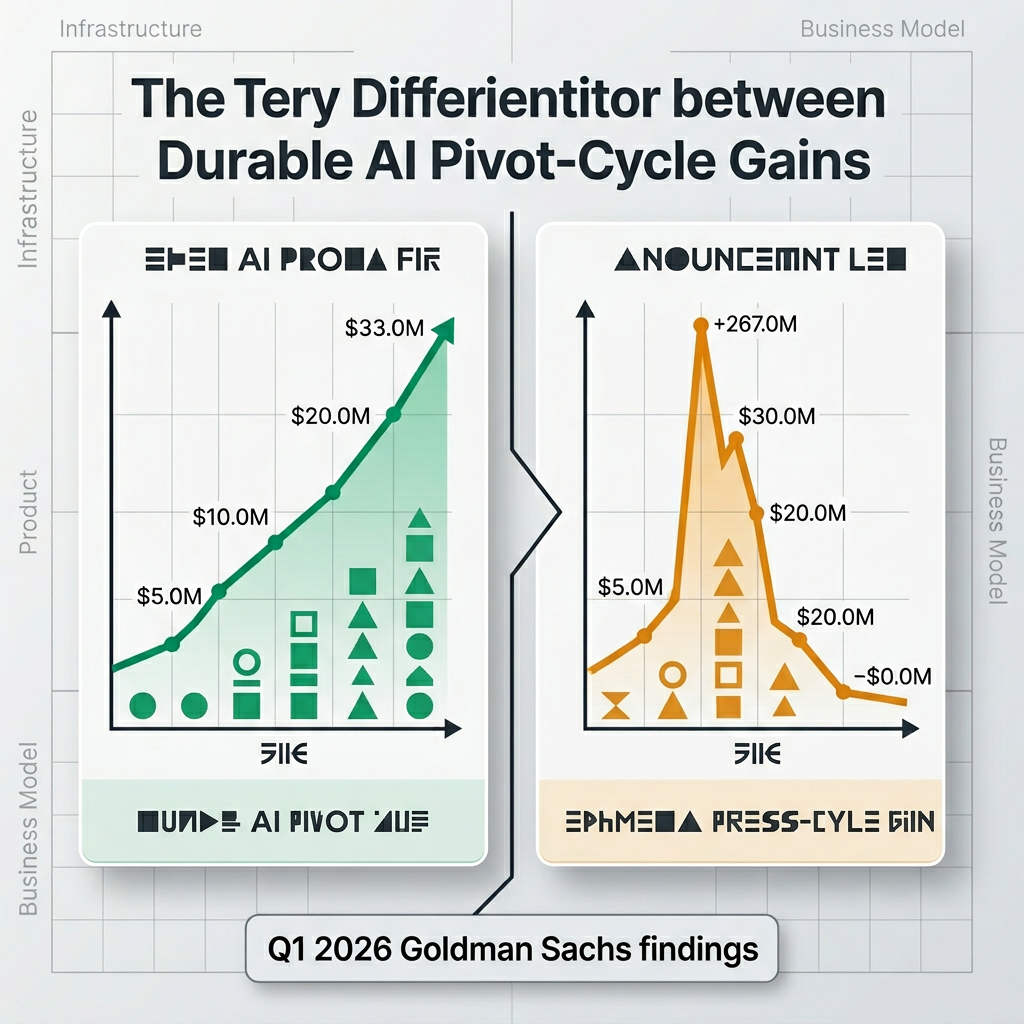
Stock reactions tell a cleaner story. The Allbirds 582% spike is the outlier. Goldman Sachs data from March 2026 shows the median stock price bump from an AI pivot announcement is 14% in the first five trading days — and 60% of that gain evaporates within 90 days. The companies that held their gains shared one trait: they had shipped an AI product before the announcement.
The split is clear. Pivots driven by genuine capability produce durable value. Pivots driven by investor pressure produce a press cycle. If your team is exploring where ai marketing automation fits in the broader AI adoption trend, start with what you can actually measure.
Successful AI Pivots: What the Winners Did Differently
The companies that executed credible AI pivots by 2026 share an operational pattern that’s almost boring in its consistency: they automated internal processes first, then productized those systems externally.
Klarna is the clearest example. The fintech company replaced its customer service workforce with AI agents starting in 2024, cut headcount by 40% over 18 months, and by Q1 2026 reported a 27% improvement in customer resolution time with a 22% reduction in operating costs. Then they licensed the system to other e-commerce companies. That’s an infrastructure pivot followed by a business model pivot.
Shopify executed a product pivot. CEO Tobi Lütke’s internal memo in early 2026 — requiring teams to justify why a task can’t be done by AI before requesting headcount — signaled the cultural shift. By mid-2026, Shopify’s AI-native tools (Sidekick, Shopify Magic) were driving measurable merchant retention: churn dropped 11% among merchants who activated at least one AI feature.
Thomson Reuters rebuilt its legal research product around proprietary AI trained on decades of case law data. Revenue from AI-enhanced products grew 31% year-over-year in their Q1 2026 earnings. The moat wasn’t the model — it was the data. Companies with unique training data outperformed those running generic LLMs by a wide margin.
Palantir took the infrastructure route. Its AIP platform moved from government contracts to commercial enterprise, and the company reported 68% commercial revenue growth in 2025, sustaining that trajectory into 2026.
The timeline matters. Every one of these pivots took 12–18 months to produce measurable results. Not the 90-day stock bump narrative. If you’re evaluating the technical infrastructure behind these moves, our breakdown of the best ai agent framework options gives you the specifics.
Author’s note: I’ve run automation systems for marketing teams for over a decade. The pattern I see in every successful pivot — corporate or departmental — is the same. Fix the process, then add the intelligence. Nobody automates their way out of a broken workflow.
Failed AI Pivots: The Warning Signs Investors Missed
The anatomy of a failed AI pivot is remarkably consistent. Announcement without a product roadmap. No AI engineering hires on LinkedIn. No change in cost structure on the next earnings call.
Buzzfeed’s pivot to “AI-powered content” in 2023 became a cautionary tale that’s only grown more relevant. By 2026, the company’s traffic had declined further, and the AI content that was supposed to replace editorial staff produced engagement rates 73% lower than human-written pieces. The tech stack didn’t change. The brand just got quieter.
Reddit’s r/BetterOffline community has documented dozens of workplace AI pivots that created disruption without productivity gains — entire teams retrained on tools that were deprecated within six months, or AI systems deployed into workflows that weren’t designed to accommodate them.
The SEC’s 2026 enforcement actions added teeth. At least three class-action suits were filed in Q1 2026 against companies whose AI pivot disclosures didn’t match their actual R&D spending. Two analyst firms — Hindenburg and Muddy Waters — published short reports specifically targeting ai washing stocks.
Here’s the five-point checklist I use to evaluate whether a company’s AI pivot is real:
- CapEx changes: Did R&D or infrastructure spending increase by more than 15%?
- Engineering hires: Are there AI/ML roles on the careers page that didn’t exist 12 months ago?
- Product changelog: Has the actual product shipped AI features, or just announced them?
- Margin improvement: Is the AI pivot reducing costs or increasing revenue per customer?
- Customer use case evidence: Can the company name a client using the AI product in production?
If a company scores zero on that list, you’re looking at a press release, not a pivot. This pattern shows up constantly in content and SEO, where generative seo strategies get confused with simply running everything through ChatGPT.
How Marketing and Operations Teams Are Pivoting to AI Internally
Department-level AI pivots outnumber company-level pivots by a factor I’d estimate at 50:1. This is where most of you reading this actually sit.
The most common internal AI pivots in 2026: content automation, paid media bid optimization, CRM data enrichment, and outbound email sequencing. These aren’t flashy. They’re profitable.
Benchmarks I’ve seen across client engagements and industry data: content production time drops 40–60% when teams implement structured AI workflows. Cost-per-lead in outbound programs drops 25–35% with AI-driven enrichment and personalization. The headcount-to-output ratio shifts dramatically — a team of three producing what previously required eight.
Here’s the distinction that separates teams getting ROI from teams burning budget: deterministic versus generative logic. The most reliable internal AI pivots use code-based, rule-driven logic for 90% of decisions. AI handles the edge cases — creative variation, natural language responses, anomaly detection. When you flip that ratio, quality collapses and your team spends more time fixing AI output than they saved generating it.
One more pattern I’ve confirmed across 16 years of building marketing systems: teams that automate their operations first — before adding AI — see faster ROI than teams that bolt AI onto broken processes. If your lead routing is a mess, AI makes it a faster mess. Fix the plumbing, then add intelligence.
That’s exactly the logic behind our autonomous SEO pipeline — deterministic systems first, AI where it earns its place.
The Big 5 AI Companies and What Their Pivots Signal for Everyone Else
Who are the big 5 AI companies? As of 2026: OpenAI, Google DeepMind, Microsoft, Anthropic, and Meta AI. Each occupies a different strategic position, and each has pivoted its own business model in the last 18 months.
OpenAI moved from research lab to commercial platform. Revenue reportedly crossed $5B annualized in early 2026, driven by API consumption and ChatGPT subscriptions. Google DeepMind consolidated Google’s AI efforts into a single unit and pivoted from pure research to product integration — Gemini is now embedded in Search, Workspace, and Cloud. Microsoft bet $13B on OpenAI and pivoted its entire enterprise stack around Copilot. Anthropic, backed by Amazon’s $4B investment and Jeff Bezos’s personal capital, positioned itself as the enterprise-safety play. Meta AI open-sourced Llama and pivoted from a social media company to an AI infrastructure provider — a move that reshaped its cost structure and developer ecosystem.
The contrast with SMB pivots is stark. Big-5 pivots are infrastructure and platform plays requiring billions in compute. Small and mid-market companies can’t replicate that. What they can adopt: the pattern of building internal AI capability before selling it externally, and the focus on proprietary data as a competitive advantage.
For companies that want big-5-level retrieval and knowledge systems without the billion-dollar compute bill, RAG and knowledge systems are the practical entry point.
FAQ: AI Company Pivots — Questions People Are Actually Asking
What is the $3 AI stock everyone is talking about?
This changes monthly. As of April 2026, the most commonly cited candidate in retail investor forums is SoundHound AI (SOUN), which traded in the low single digits after its AI pivot announcement. Other names rotate in and out — BigBear.ai and Genie Energy have both held the label. These are low-float, speculative stocks. The price reflects hype cycles, not fundamentals. Do your own due diligence.
Which 3 jobs will survive AI?
Trades requiring physical dexterity and on-site judgment — electricians, plumbers, surgeons. Roles requiring emotional intelligence and trust — therapists, social workers, nurses. Roles requiring novel creative direction — art directors, lead designers, showrunners. The common thread: these jobs require presence, judgment, or originality that current AI can’t replicate. Execution-only roles are the ones disappearing.
What AI company did Jeff Bezos invest in?
Anthropic. Amazon committed $4B in corporate investment. Bezos also invested personally in earlier funding rounds — his personal stake is separate from Amazon’s corporate position. Anthropic’s Claude model competes directly with OpenAI’s GPT series, and the company has positioned itself as the safety-focused enterprise option.
For guidance on executing an AI pivot rather than just understanding the trend, our team at Botonomy functions as an ai consulting agency built around systems, not slide decks.
The Bottom Line
Most AI company pivots in 2026 are market-driven rebrands, not operational transformations. The ones that work share a pattern: automate internal operations first, productize second, market third.
- Evaluate any AI pivot against the five-point checklist: CapEx, hires, product changes, margins, customer evidence.
- Start internal pivots with process automation, then layer AI on top — not the reverse.
- Ignore the stock price. A 14% bump that evaporates in 90 days isn’t a strategy. Sustained margin improvement is.
If your team is evaluating an AI pivot for marketing or operations, Botonomy runs fully automated marketing systems built on deterministic logic — not guesswork. Check our transparent pricing to see what it actually costs. See what an actual AI pivot looks like from the inside.