
Martin Kelly, Founder of Botonomy, has spent enough on AI image tokens to buy a Tesla — which is exactly why he knows where the real costs hide in OpenAI’s pricing structure.
In short
OpenAI Image 2 is the company's most advanced image generation model as of 2026, using token-based pricing where a standard 1024×1024 image costs 40 tokens at roughly 8 cents, compared to 12 cents for the same resolution in DALL-E 3. Resolution multiplies costs exponentially, so a 4096×4096 image runs 640 tokens at $1.28 each, making resolution matching to your actual display medium the single biggest cost lever available.
What Is OpenAI Image 2 and Why Token Economics Matter
OpenAI Image 2 represents the company’s most advanced image generation model as of 2026, delivering photorealistic outputs that surpass DALL-E 3 in quality, coherence, and speed. Unlike traditional subscription models where you pay a flat monthly fee, OpenAI charges based on tokens — computational units consumed for each image request. This distinction is critical for any business planning to integrate AI-generated visuals into its content pipeline at scale.
This token-based pricing fundamentally changes how businesses budget for AI content creation. A marketing team generating 100 product images monthly faces vastly different costs depending on resolution, style complexity, prompt iteration requirements, and whether they’re leveraging enterprise volume discounts. The difference between a manageable $50 monthly bill and a $500 budget shock depends entirely on understanding these token mechanics before you commit resources.
Token economics matter because they directly impact content strategy decisions at every level of an organization. Teams that grasp the cost structure optimize their workflows, reduce waste, and scale visual content production efficiently. Those who don’t often face budget overruns, executive scrutiny, and the uncomfortable task of justifying unexplained charges to finance departments. AI content marketing systems require precise cost forecasting to deliver sustainable ROI, and that forecasting starts with understanding exactly how OpenAI meters every image request.
Beyond budgeting, token economics influence creative direction. When every pixel has a price tag, teams make smarter decisions about when to invest in high-resolution outputs and when standard quality serves the purpose perfectly. This cost-aware creativity doesn’t limit output — it sharpens it. The organizations winning with AI-generated imagery in 2026 are the ones that treat token management as a strategic competency, not an afterthought.
OpenAI Image 2 Pricing Structure in 2026
OpenAI charges 40 tokens per standard 1024×1024 image in Image 2, compared to 60 tokens for the same resolution in DALL-E 3. At $0.002 per token, each standard Image 2 generation costs $0.08 versus $0.12 for DALL-E 3 — a 33% reduction that adds up quickly at scale. For a team generating 1,000 images monthly, that savings alone amounts to $40 per month, or nearly $500 annually.
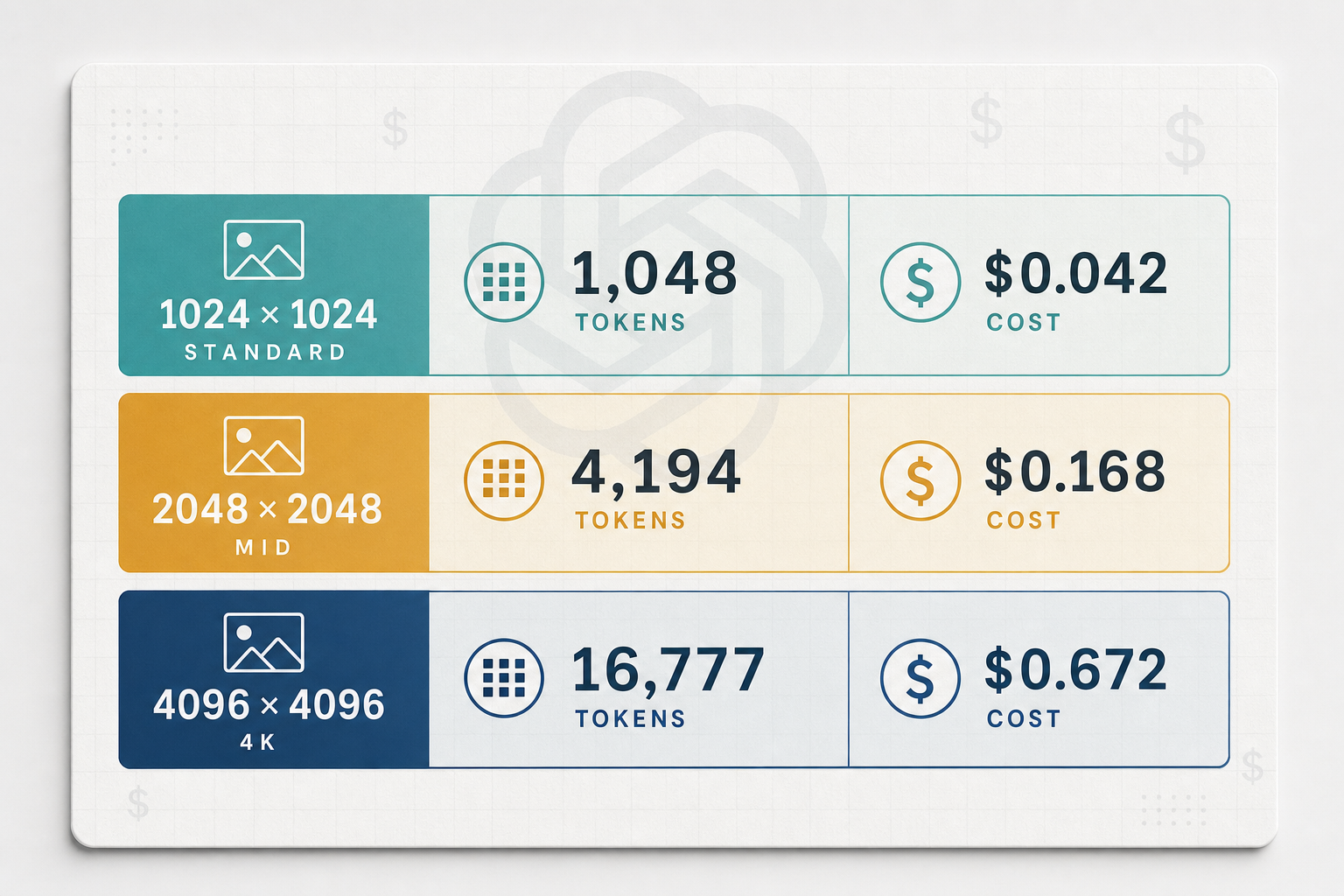
Higher resolutions multiply token consumption exponentially. A 2048×2048 image consumes 160 tokens ($0.32), while 4096×4096 resolution demands 640 tokens ($1.28) per generation. These multipliers reflect the computational complexity required for larger canvases and higher detail rendering. Understanding this exponential relationship is essential because many teams default to maximum resolution without realizing the cost implications.
Here’s a quick reference table for OpenAI Image 2 token consumption by resolution:
| Resolution | Tokens per Image | Cost per Image (Standard) | Cost per Image (Volume Tier 1) | Cost per Image (Enterprise Plus) |
|---|---|---|---|---|
| 1024×1024 | 40 | $0.08 | $0.06 | $0.04 |
| 1536×1536 | 90 | $0.18 | $0.135 | $0.09 |
| 2048×2048 | 160 | $0.32 | $0.24 | $0.16 |
| 3072×3072 | 360 | $0.72 | $0.54 | $0.36 |
| 4096×4096 | 640 | $1.28 | $0.96 | $0.64 |
Enterprise customers accessing OpenAI’s Volume Tier receive significant discounts once they exceed 10,000 tokens monthly. The first tier reduces costs to $0.0015 per token, dropping standard image costs from $0.08 to $0.06. Enterprise Plus customers generating over 100,000 tokens monthly pay just $0.001 per token, making standard images cost $0.04 each. Autonomous SEO pipeline teams processing hundreds of images monthly benefit substantially from these volume breaks.
It’s also worth noting that OpenAI’s pricing includes additional charges for certain advanced features within Image 2. Inpainting — selectively editing portions of an existing image — consumes approximately 60% of the tokens a full generation requires at the same resolution. Outpainting, which extends images beyond their original canvas, scales based on the amount of new content generated. These auxiliary features are powerful creative tools, but they come with token costs that many teams overlook during initial budget planning.
How Image Resolution Affects Token Consumption
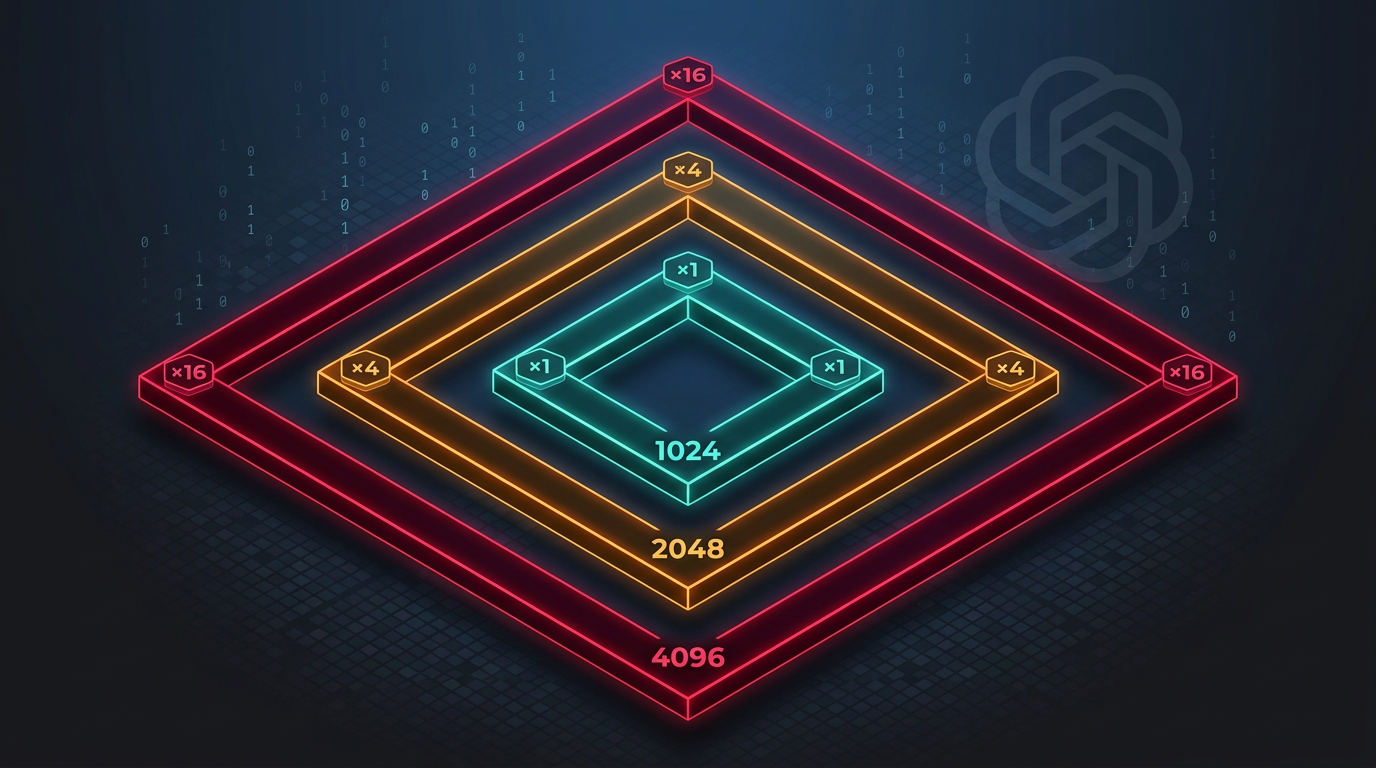
Resolution directly determines token consumption through OpenAI’s scaling formula. The base 1024×1024 resolution consumes 40 tokens, but each doubling of pixel dimensions quadruples the token requirement. This exponential scaling means a 2048×2048 image needs 4x the tokens (160), not 2x. Teams accustomed to linear pricing models from other software categories frequently miscalculate their projected costs because they assume doubling resolution simply doubles the price.
Quality improvements plateau beyond certain resolutions for most use cases. Social media posts perform identically whether generated at 1024×1024 or 2048×2048, making the 4x token premium entirely wasteful for platforms like Instagram, LinkedIn, and X (formerly Twitter), which compress images during upload regardless of input quality. Print materials, billboard advertising, and large format displays justify higher resolutions, but web content rarely benefits from the additional computational expense.
The key is matching resolution to the delivery medium. Email marketing images, blog post illustrations, and social media graphics all display at resolutions well within the 1024×1024 range. Even e-commerce product pages, where image quality directly impacts conversion rates, typically serve images at 1000-1500 pixels wide due to responsive design constraints. Generating these assets at 4096×4096 and then downscaling them is the equivalent of printing a highway billboard to hang in a cubicle.
Smart resolution selection saves substantial money at every scale. E-commerce product shots work perfectly at 1024×1024 for web display, costing $0.08 per image. Upgrading to 2048×2048 for minimal quality gains costs $0.32 — a 300% increase that customers won’t notice on screen. Marketing teams that audit their resolution choices and match them to actual display requirements reduce image generation costs by 60-80% without sacrificing any perceptible output quality.
For teams that do need higher resolutions, a hybrid approach often works best: generate the initial concept at 1024×1024 for rapid iteration and creative approval, then upscale only the final approved version to the required resolution. This workflow ensures you’re only paying premium token costs for final assets, not for exploratory drafts that may never see production.
Real-World Cost Analysis: Image 2 vs Competitors
OpenAI Image 2 costs $0.08 per standard image compared to Midjourney’s $10 monthly unlimited plan and Stable Diffusion’s $20 monthly Pro tier. The break-even point sits at 125 images monthly for Midjourney and 250 images for Stable Diffusion Pro. Below those thresholds, OpenAI’s per-image pricing is the more economical choice. Above them, the subscription models offer better unit economics — at least on paper.
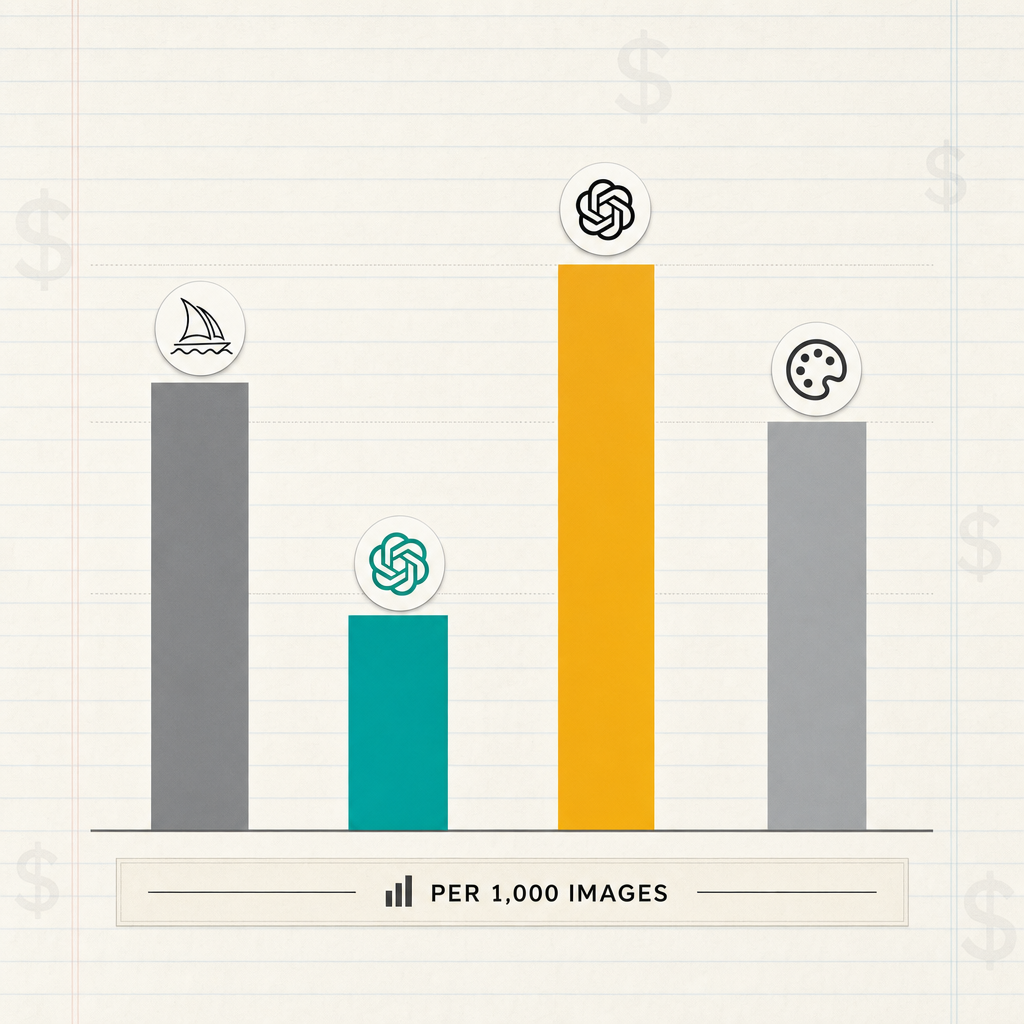
However, raw per-image cost comparisons miss the full picture. Quality-adjusted pricing favors OpenAI for enterprise applications requiring consistent output, brand compliance, and API integration. Midjourney produces stunning artistic images but lacks the commercial polish and controllability needed for product photography, corporate marketing materials, or brand-consistent visual systems. Stable Diffusion offers deep customization through fine-tuning and LoRA models but requires technical expertise and infrastructure management that increases total cost of ownership well beyond the $20 monthly subscription.
API integration costs add hidden expenses to competitor solutions that rarely appear in pricing comparisons. Midjourney requires unofficial API wrappers costing $50-200 monthly, introducing reliability risks and potential terms-of-service violations. Self-hosted Stable Diffusion demands GPU infrastructure averaging $300-500 monthly for reasonable performance, plus engineering time for deployment, maintenance, and model updates. OpenAI’s official API eliminates these overhead costs entirely, providing enterprise-grade uptime guarantees, structured documentation, and direct support channels.
When you factor in these hidden costs, OpenAI becomes the cheaper option for businesses generating 200+ images monthly despite its higher per-image pricing. The total cost of ownership calculation looks like this:
- OpenAI Image 2 (500 images/month): 500 × $0.08 = $40/month
- Midjourney + API wrapper (500 images/month): $10 subscription + $100 API wrapper = $110/month
- Stable Diffusion self-hosted (500 images/month): $20 subscription + $400 GPU infrastructure + engineering time = $500+/month
These numbers shift at very high volumes where Midjourney’s unlimited plan offers significant value, but for most business use cases requiring API access, programmatic generation, and integration with existing content systems, OpenAI Image 2 delivers the best cost-to-capability ratio. Social media automation platforms benefit particularly from OpenAI’s reliability, consistent output quality, and native API support.
Token Optimization Strategies for Businesses
Batch processing reduces token waste by grouping similar image requests into single API calls. OpenAI allows up to 10 images per request, sharing computational overhead and reducing total token consumption by 15-20% compared to individual calls. Marketing teams generating product variations — the same item in multiple colors, angles, or contexts — benefit most from this approach. A single batch call for 10 color variants of a product image costs roughly 340 tokens instead of 400 tokens for 10 individual requests.
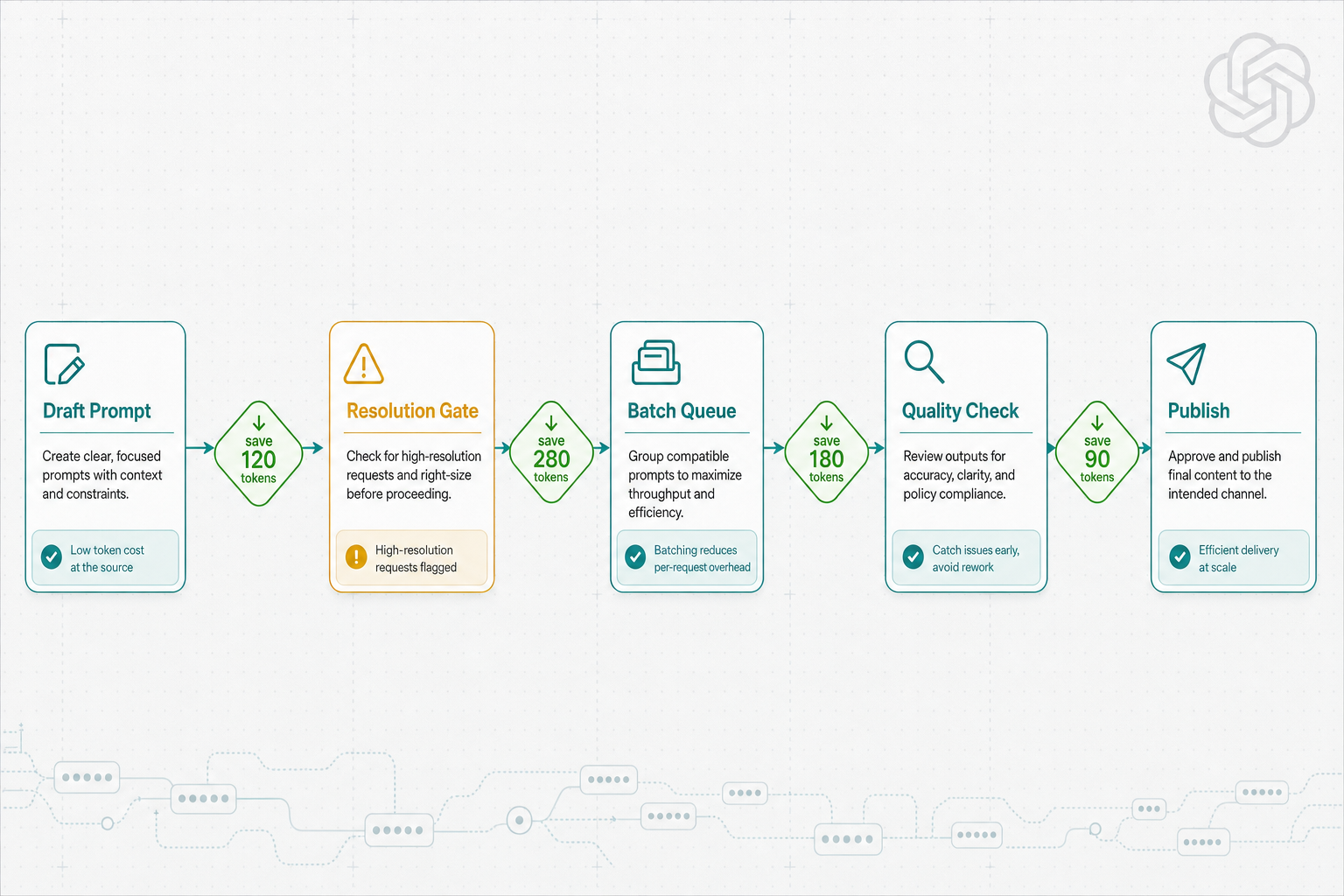
Prompt engineering eliminates costly iteration cycles that drain token budgets faster than any other factor. Specific, detailed prompts produce acceptable results on the first generation, while vague prompts require multiple attempts to achieve desired output. A prompt specifying “professional headshot, business casual attire, neutral gray background, soft studio lighting, 35mm lens depth of field” succeeds immediately, while “nice photo of person” typically requires 3-5 iterations — effectively tripling or quintupling the cost of producing a single usable image.
Developing a prompt library is one of the highest-ROI activities any content team can undertake. Document prompts that consistently produce excellent results, organized by use case: product photography, social media graphics, blog illustrations, executive headshots, and so on. When a new team member needs to generate images, they start from a proven template rather than experimenting with tokens on the company’s dime. Organizations with mature prompt libraries report 50-70% reductions in tokens spent per usable image.
Caching and reuse strategies prevent duplicate generation costs that accumulate invisibly. Teams often recreate similar images unknowingly — different departments requesting nearly identical assets, or the same team regenerating images they created weeks ago because they couldn’t locate the original files. Smart digital asset management systems track generated images with their associated prompts and metadata, suggesting existing alternatives before approving new generation requests. This approach reduces redundant generation by 40-60% in most organizations.
Style presets and template systems offer another layer of optimization. Rather than describing visual style from scratch in every prompt, teams can define reusable style parameters — lighting conditions, color palettes, composition rules, brand-specific visual elements — that attach to any generation request. This consistency not only saves tokens by reducing iteration but also ensures brand coherence across hundreds or thousands of generated images.
Finally, consider implementing a tiered approval workflow for high-cost generations. Standard 1024×1024 images can be generated freely within department budgets, but 2048×2048 and above require manager approval. 4096×4096 requests trigger automatic review to confirm that the resolution is genuinely necessary for the intended use case. This simple governance layer prevents casual high-resolution requests from inflating costs without adding bureaucratic friction for everyday usage.
Enterprise Implementation: Managing Token Budgets
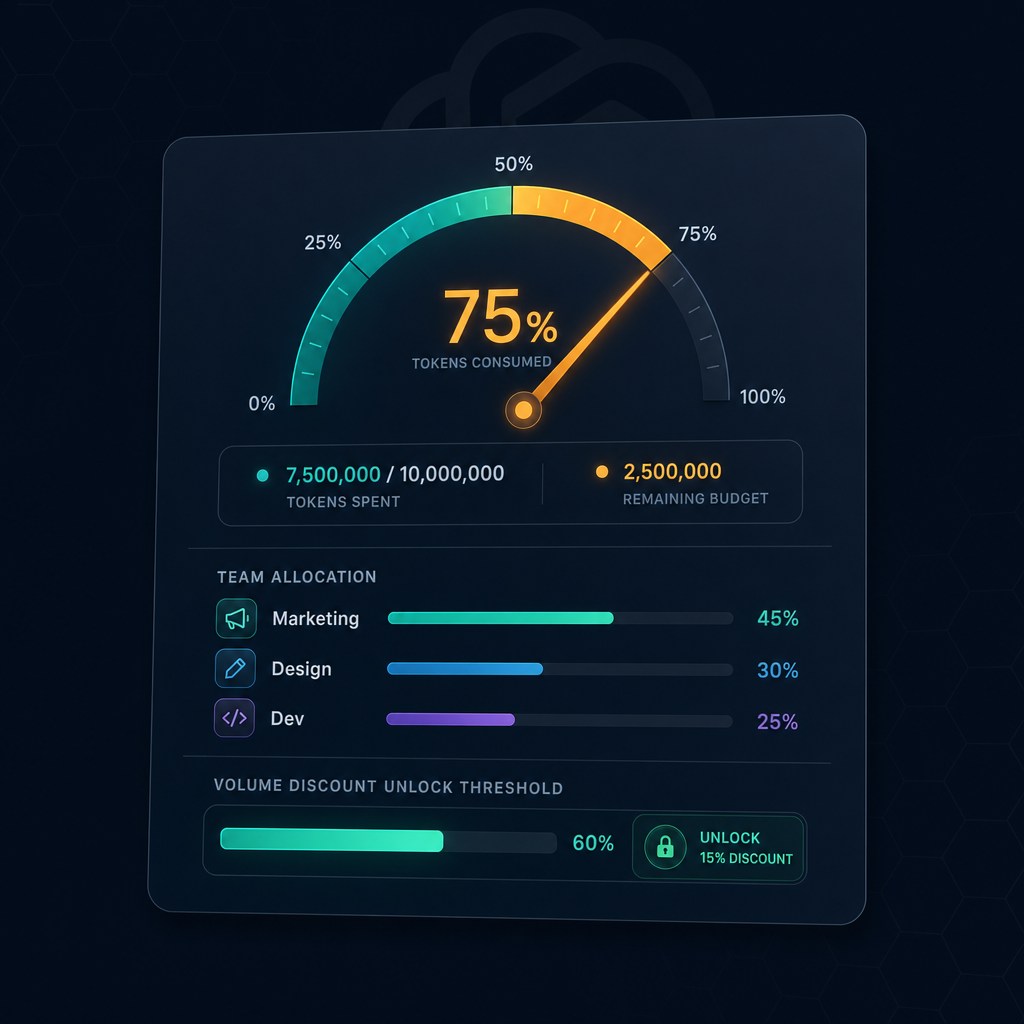
Department-level token limits prevent runaway costs while maintaining creative flexibility. Marketing departments might receive 5,000 tokens monthly ($10 at standard pricing), while product teams get 15,000 tokens ($30) for higher-volume needs. Design teams creating customer-facing assets might warrant 25,000 tokens ($50), reflecting their direct revenue impact. These allocations align spending with business value and prevent budget surprises that erode organizational trust in AI initiatives.
Setting these budgets requires historical data or reasonable estimates. For teams new to AI image generation, start with a three-month pilot period where usage is tracked but not restricted. This discovery phase reveals actual consumption patterns, peak usage periods, and which teams derive the most value from generated images. Use this data to set informed budget levels rather than arbitrary caps that either waste money through over-allocation or stifle productivity through under-allocation.
Usage monitoring systems track token consumption in real-time, sending alerts when departments approach 75% and 90% of their limits. Automated weekly and monthly reporting shows cost per image, resolution distribution, prompt iteration rates, peak usage patterns, and per-user consumption. This visibility enables data-driven optimization and prevents month-end budget overruns that damage stakeholder confidence. The best monitoring setups integrate directly with project management tools, tagging token expenditures to specific campaigns, clients, or product lines.
Chargeback models work particularly well for agencies and large organizations where multiple business units share AI resources. Rather than funding image generation from a central IT budget, each department or client account bears its own token costs. This accountability drives efficient usage because teams spending their own budget naturally optimize harder than teams spending shared resources. Implementing chargebacks also creates a clear paper trail for client billing in agency contexts.
ROI tracking connects image generation spend to business outcomes, transforming token costs from an expense line item into a measurable investment. E-commerce teams measure conversion rate lifts for AI-generated product images versus traditional photography, calculating revenue per token spent. Social media teams track engagement metrics — likes, shares, click-through rates — to determine optimal image investment levels per post. Content marketing teams compare organic traffic growth against image generation budgets to establish cost-per-visitor metrics. CRM automation systems integrate these metrics with customer lifetime value calculations for comprehensive ROI analysis that justifies continued investment to leadership.
Documentation and governance round out a mature enterprise implementation. Establish clear policies covering acceptable use, brand guidelines for AI-generated content, disclosure requirements (increasingly important as regulations evolve), and escalation procedures for when generation outputs don’t meet quality standards. These policies protect the organization while giving teams the confidence to use AI image generation proactively rather than cautiously.
Future Token Economics: What to Expect in 2026 and Beyond
Token prices will likely decrease 20-30% through the remainder of 2026 as OpenAI scales infrastructure and competition intensifies. Google’s Imagen 3 and Adobe’s Firefly 3 models pressure pricing across the market, forcing all providers to reduce costs or significantly improve their value propositions. Historical patterns support this trajectory: DALL-E 3 pricing dropped 40% within 18 months of launch as computational efficiency improved and competitive alternatives matured. Early adopters who optimize workflows now position themselves to compound savings as base prices decline.
Model updates may introduce new pricing tiers based on output complexity rather than pure resolution. Simple graphics, icons, and illustrations might cost fewer tokens than photorealistic renders with complex lighting and material properties. Conceptual art with fewer physical accuracy requirements could fall into an intermediate tier. This complexity-based pricing creates opportunities for cost optimization through intelligent style selection — choosing the least expensive generation tier that meets the creative brief’s actual requirements.
OpenAI’s track record suggests backward compatibility with existing integrations, protecting current API implementations from breaking changes during pricing transitions. However, new features and capabilities typically launch at premium pricing before settling into standard tiers as adoption grows. Teams should budget for experimentation with new capabilities at launch pricing while maintaining core workflows on established, optimized pricing structures.
The emergence of hybrid generation pipelines represents another important trend. Rather than relying on a single provider, sophisticated teams route different image types to different models based on cost and quality tradeoffs. Simple social media graphics might route to the cheapest available model, while hero images for landing pages route to the highest-quality option regardless of cost. This multi-provider strategy requires more complex orchestration but delivers optimal cost-to-quality ratios across diverse content needs.
Preparing for pricing shifts requires flexible budget allocation, vendor diversification, and infrastructure that can adapt without manual intervention. Teams building critical dependencies on a single provider face disruption when pricing models change, features are deprecated, or terms of service evolve. Botonomy AI marketing automation systems adapt to pricing changes automatically, maintaining cost efficiency across multiple AI providers while preserving output quality and brand consistency.
Regulatory developments also bear watching. As AI-generated content becomes more prevalent, governments are introducing labeling requirements, copyright frameworks, and usage restrictions that could affect the economics of AI image generation. Compliance costs — metadata embedding, disclosure systems, audit trails — add overhead that doesn’t appear in token pricing but affects total cost of ownership. Forward-thinking teams build compliance infrastructure now while it’s optional, avoiding costly retrofitting when requirements become mandatory.
Frequently Asked Questions
How much does OpenAI Image 2 cost per image?
Standard 1024×1024 images cost $0.08 each at current token pricing ($0.002 per token × 40 tokens). Higher resolutions cost proportionally more, with 2048×2048 images costing $0.32 and 4096×4096 images costing $1.28. Enterprise volume discounts can reduce these costs by up to 50%, bringing standard images down to $0.04 each for high-volume users.
Is OpenAI Image 2 more expensive than DALL-E 3?
No, Image 2 costs 33% less than DALL-E 3 for identical resolutions. Image 2 uses 40 tokens for standard images compared to DALL-E 3’s 60 tokens, reducing costs from $0.12 to $0.08 per image. The quality improvement means fewer regeneration attempts are needed as well, further reducing effective per-image costs.
What factors affect OpenAI Image 2 token consumption?
Resolution is the primary factor, with token requirements scaling exponentially as pixel dimensions increase. Style complexity, batch processing efficiency, prompt specificity, and the use of advanced features like inpainting and outpainting also influence total costs through iteration requirements and processing overhead.
How does OpenAI Image 2 compare to Midjourney for business use?
OpenAI Image 2 offers superior API integration, consistent commercial-quality output, and better cost efficiency for programmatic generation at moderate volumes. Midjourney’s $10 unlimited plan is cheaper for high-volume artistic use cases, but its lack of an official API and limited commercial control make it less suitable for enterprise workflows requiring reliability and brand consistency.
Can I reduce OpenAI Image 2 costs without sacrificing quality?
Yes. The three most effective strategies are matching resolution to your actual display requirements (saving 60-80%), writing specific prompts that succeed on the first attempt (saving 50-70% on iteration costs), and implementing batch processing for similar images (saving 15-20% on computational overhead). Combined, these optimizations can reduce total spend by 70% or more.
Conclusion
OpenAI Image 2’s token economics reward teams who understand the cost structure and optimize accordingly. Smart resolution selection, batch processing, and prompt engineering reduce costs by 60-80% while maintaining — or even improving — output quality. The organizations seeing the best returns are those treating token management as a strategic discipline, not an operational afterthought.
Key takeaways for managing Image 2 costs:
- Use 1024×1024 resolution for web content — higher resolutions waste money without visible benefit on screens
- Batch similar requests to reduce token consumption by 15-20% through shared computational overhead
- Write specific, detailed prompts to eliminate costly iteration cycles that multiply your per-image costs
- Build a prompt library to capture institutional knowledge and reduce experimentation waste
- Implement department-level budgets and real-time monitoring to prevent cost surprises
- Track ROI by connecting token spend to business outcomes like conversions, engagement, and traffic
Ready to optimize your AI image generation costs? Botonomy’s automated content systems help you manage token budgets while scaling visual content production across every channel. See how our deterministic approach reduces waste and maximizes ROI.