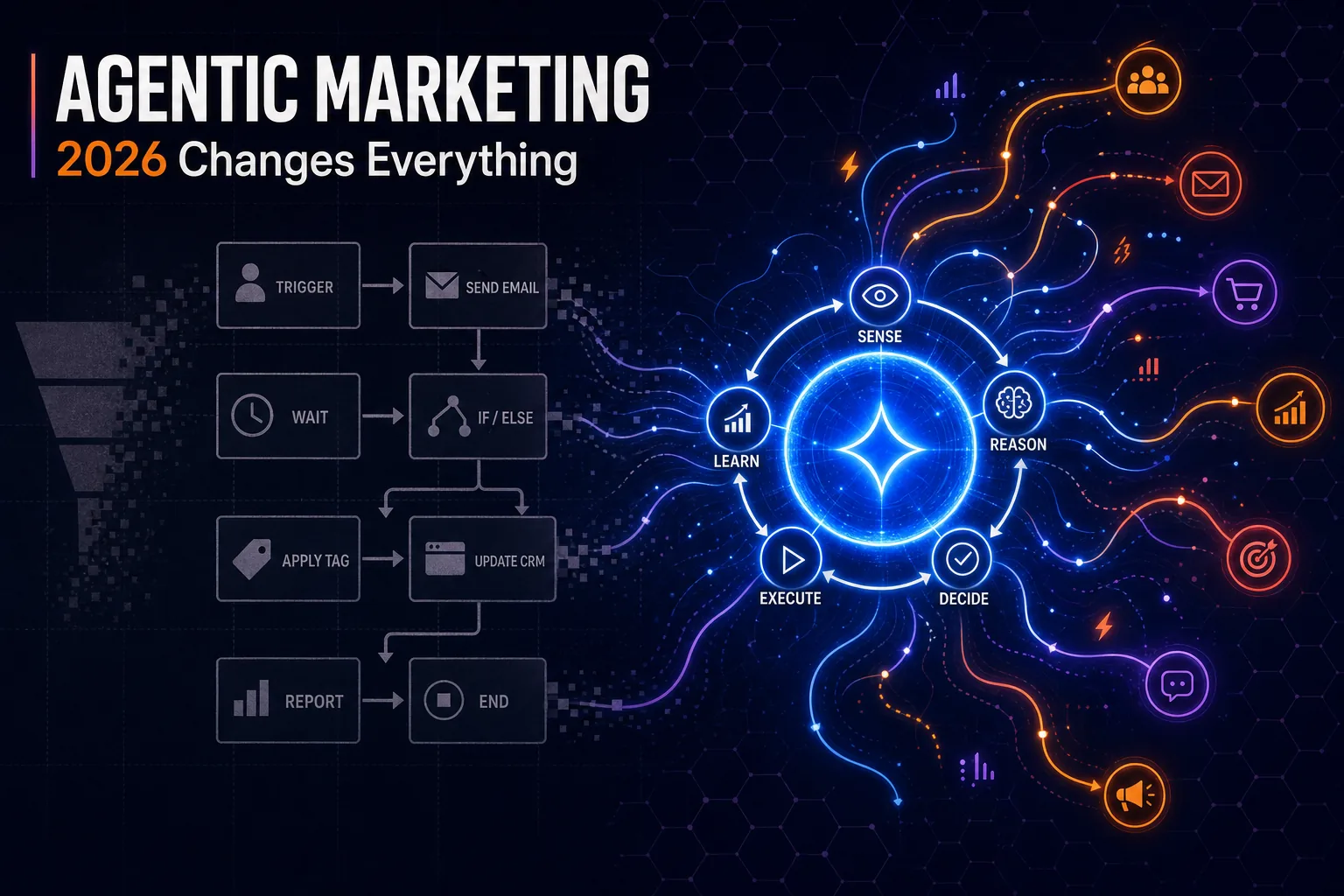

Martin Kelly is the founder of Botonomy AI and the kind of person who’s deployed enough autonomous marketing agents to know which ones deserve the label — and which ones are just a workflow with a press release.
Last updated: June 2026
In short
Agentic marketing is the practice of deploying autonomous AI agents that sense real-time signals, reason over data, decide on actions, execute across channels, and learn from outcomes, removing the human from the execution loop entirely. Unlike traditional marketing automation, which runs a playbook you built, agentic marketing pursues a goal you set and figures out the playbook on its own, continuously self-optimizing without waiting for human approval on each action.
What Is Agentic Marketing?
Agentic marketing is the practice of deploying autonomous AI agents that sense real-time signals, reason over data, decide on actions, execute across channels, and learn from outcomes — going beyond traditional marketing automation by removing the human from the execution loop entirely.
The distinction matters. Marketing automation runs a playbook you built. Agentic marketing pursues a goal you set — and figures out the playbook on its own. The agent decides what to do, when to do it, and whether it worked, then adjusts without waiting for you to log in Monday morning.
TL;DR — Five Things to Know About Agentic Marketing:
- Agentic marketing deploys AI agents that act autonomously toward business goals, not just follow pre-set rules.
- The word “agentic” means self-directed toward a goal — borrowed from Albert Bandura’s agentic theory in psychology and adopted across AI and marketing from around 2024 into 2025–2026.
- It is not the same as marketing automation or AI-assisted marketing. The human governs; the agent operates.
- True agentic marketing started becoming production-viable in 2026 — though most teams are still gearing up to scale it — because of converging capabilities: large language models, retrieval-augmented generation (RAG), real-time CDPs, and multi-channel orchestration APIs.
- Most platforms slapping “agentic” on their landing page in 2026 are still AI-assisted with a rebrand. Read the fine print.
The word “agentic” means acting with agency — self-directed toward a goal. Bandura introduced the concept in social cognitive theory decades ago. AI researchers borrowed it. Marketers adopted it in 2025 when LLM-powered agents started doing things that actually warranted the label.
Why now? Three forces converged. LLMs gave agents the ability to reason over unstructured data. RAG gave them access to brand-specific knowledge without hallucinating (most of the time). And real-time CDPs plus orchestration APIs gave them something to actually do — push a bid change, trigger a personalized email, update a product page — across channels, in milliseconds.
McKinsey’s 2026 work on agentic AI frames it as the shift from AI as a passive copilot to a system that acts on its own — AI that doesn’t suggest actions, but takes them. Academics who study this have been blunter still: autonomous decision-making in marketing isn’t a feature upgrade — it’s a structural change in how marketing organisations operate.
I agree. This isn’t a tool change. It’s a job-description change. If you’ve built your career pressing “send,” that should make you uncomfortable — or excited, depending on whether you like the strategic part of the job or just the button-pressing part.
For context on how this evolved from earlier approaches, see our breakdown of ai marketing automation.
How Agentic Marketing Works: The Autonomous Marketing Loop
Most frameworks describing agentic marketing stop at four steps. They’re wrong — they collapse reasoning and action into one step and ignore the feedback loop entirely. Here’s the full picture.
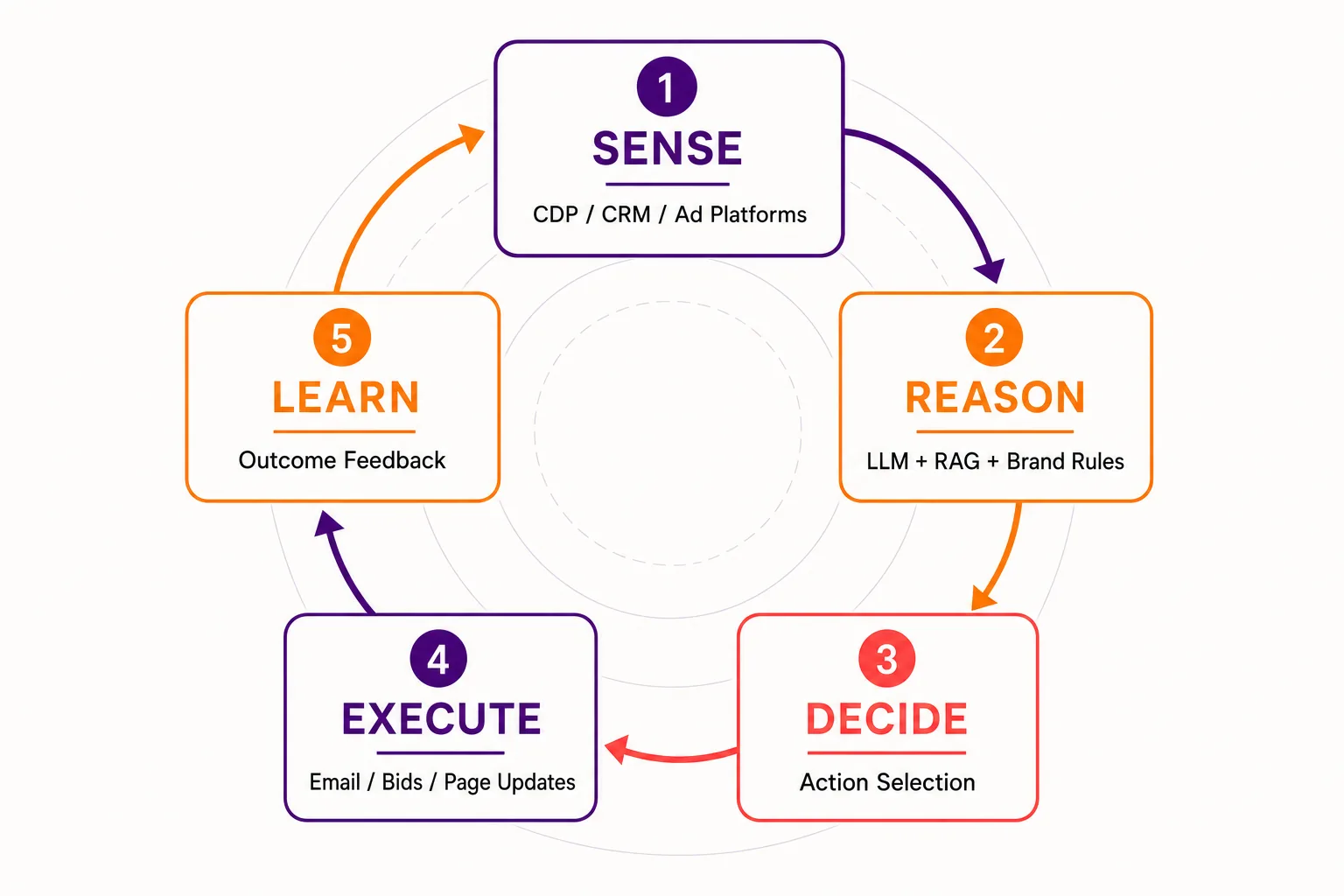
The Autonomous Marketing Loop — 5 Steps:
-
Sense — The agent ingests real-time signals from your CDP, CRM, web analytics, ad platforms, and third-party data. No batch processing, no overnight syncs. It sees what’s happening now — a spike in branded search, a drop in email open rates, a competitor price change.
-
Reason — The LLM, augmented by RAG and knowledge systems, processes those signals against your brand rules, tone guidelines, compliance requirements, and historical performance data. It builds context, not just correlation.
-
Decide — The agent selects the next-best-action from a ranked set of options. This is where AI governance guardrails apply. A human-in-the-loop override exists here — not to approve every action, but to block categories of actions that fall outside policy. The agent picks; the guardrail vetoes if needed.
-
Execute — The agent deploys autonomously: adjusts paid bids, publishes content, sends an email sequence, updates on-site personalization, rotates creative. Across channels. Without a ticket, a Slack message, or a meeting about it.
-
Learn — Outcome data feeds back into the loop. The agent updates its models — what worked, what didn’t, what changed in the environment. No manual retraining. No quarterly “optimization review.” Continuous.
The whole loop runs in minutes or seconds, not days. That’s the difference between “AI-assisted” and “agentic.” One waits for you. The other doesn’t.
Agentic Marketing vs. Marketing Automation vs. AI Marketing
Most of the confusion around agentic marketing comes from vendors relabelling existing products. Here’s how to tell the three apart.
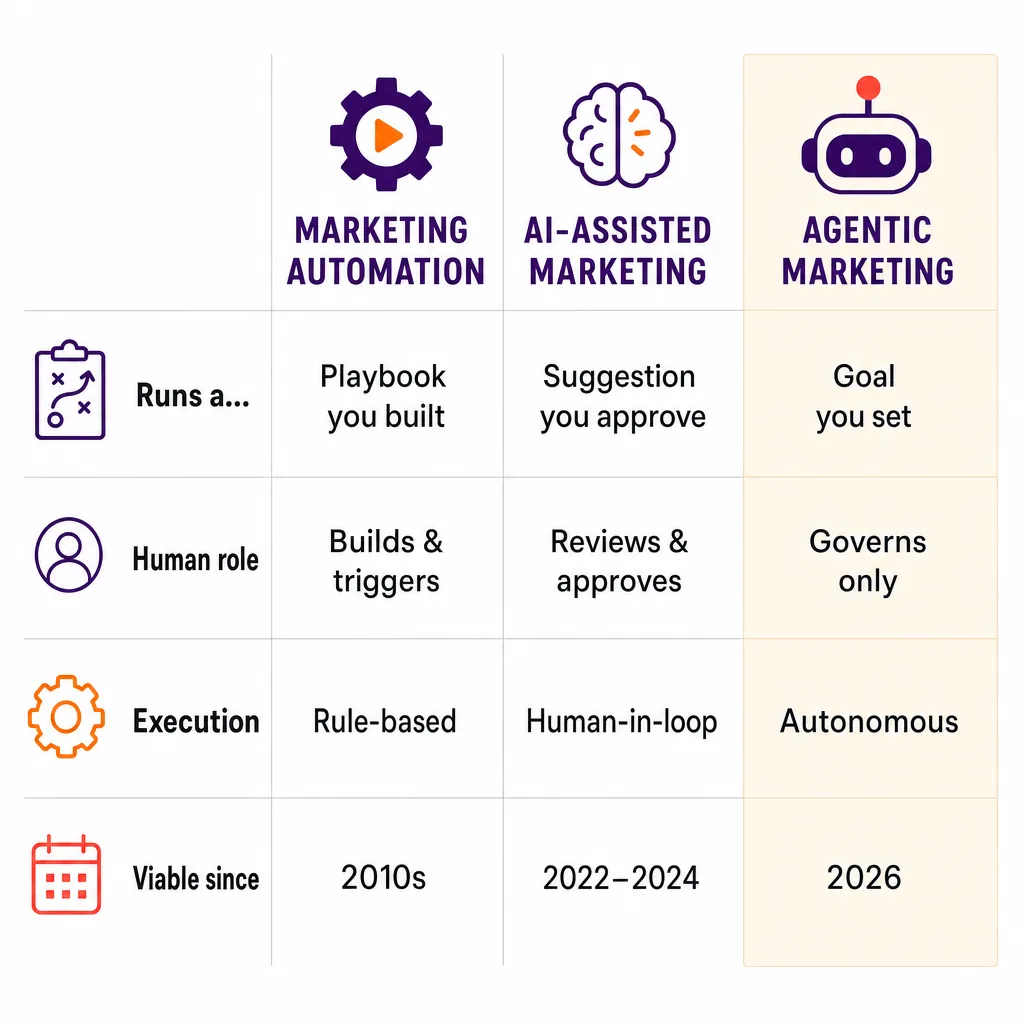
| Dimension | Traditional Marketing Automation | AI Marketing (Predictive + Generative) | Agentic Marketing |
|---|---|---|---|
| Decision-making | Rule-based, human-configured | Model-assisted, human-approved | Autonomous, goal-directed |
| Human involvement | Builds and triggers every workflow | Reviews recommendations, presses go | Sets objectives and guardrails |
| Real-time capability | Batch / scheduled | Near-real-time scoring | True real-time |
| Personalization | Segment-level | Audience-level | Individual-level |
| Channel orchestration | Single-channel workflows | Single or dual channel | Cross-channel, simultaneous |
| Optimization cadence | Manual, periodic | Periodic model refresh | Continuous, self-optimizing |
| Typical tools | HubSpot workflows, Marketo | Predictive lead scoring, AI copy tools | Salesforce Agentforce, HubSpot Breeze, Botonomy |
Here’s my editorial take: most platforms marketed as “agentic” in 2026 are still AI-assisted with a new label. True agentic marketing means the system acts without a human in the execution loop — the human governs, not operates. If a human still clicks “approve” on every action, you have a copilot, not an agent. Nothing wrong with copilots. Just don’t pay agent prices for one.
For a deeper comparison of the technical foundations underneath these platforms, see our guide to the best ai agent framework.
A question I get constantly: “Is ChatGPT an agent or an LLM?” ChatGPT is an LLM — a language model. An agent uses an LLM as one component but adds memory, tool access, and autonomous action. Marketing agents built on GPT-4o or Claude are agents. ChatGPT in a browser tab is not. It can’t check your CRM, adjust your bids, or send an email on your behalf. It can write a nice paragraph about doing those things, which is a different skill entirely.
What an Agentic Marketing Practice Actually Does
I run one. So I’ll skip the theory and tell you what the day looks like.
At Botonomy, we deploy a roster of specialized agents. An AI SEO agent runs technical audits, identifies content gaps, and generates optimized briefs. An AI content agent produces and publishes. An AI paid ads agent manages bids and rotates creative. An AI outbound agent sequences prospects. An AI creative agent generates visual assets.
Each agent operates autonomously within defined guardrails. The guardrails are the job. I set business objectives, define brand rules, draw ethical boundaries, and review performance dashboards. When an edge case surfaces — and edge cases always surface — I intervene. The rest of the time, the agents run.
What makes this work isn’t a bigger model — it’s the architecture. Each agent runs mostly deterministic code with the LLM reserved for the judgment calls, so its behaviour is auditable and repeatable rather than improvised. That’s the difference between an autonomous system you can trust with execution and a demo that looks good on a stage.
What this looks like by vertical:
- Ecommerce: Autonomous product page optimization paired with dynamic retargeting. The SEO agent updates title tags and meta descriptions based on search trend shifts; the paid agent adjusts retargeting bids based on margin data. No human touches either workflow.
- SaaS / B2B: Autonomous lead scoring connected to outbound sequencing. The scoring model updates continuously; the outbound agent adjusts messaging and cadence based on engagement signals.
- Retail: Real-time offer personalization across email and on-site. The agent selects the offer, picks the channel, times the delivery — all based on individual behavior, not segment rules.
The human’s role isn’t to run campaigns. It’s to make sure the agents are pursuing the right goals and staying inside the lines.
Agentic Marketing Pricing: What It Costs in 2026
Nobody else on the SERP covers this, which tells you something about the state of “thought leadership” in this category.
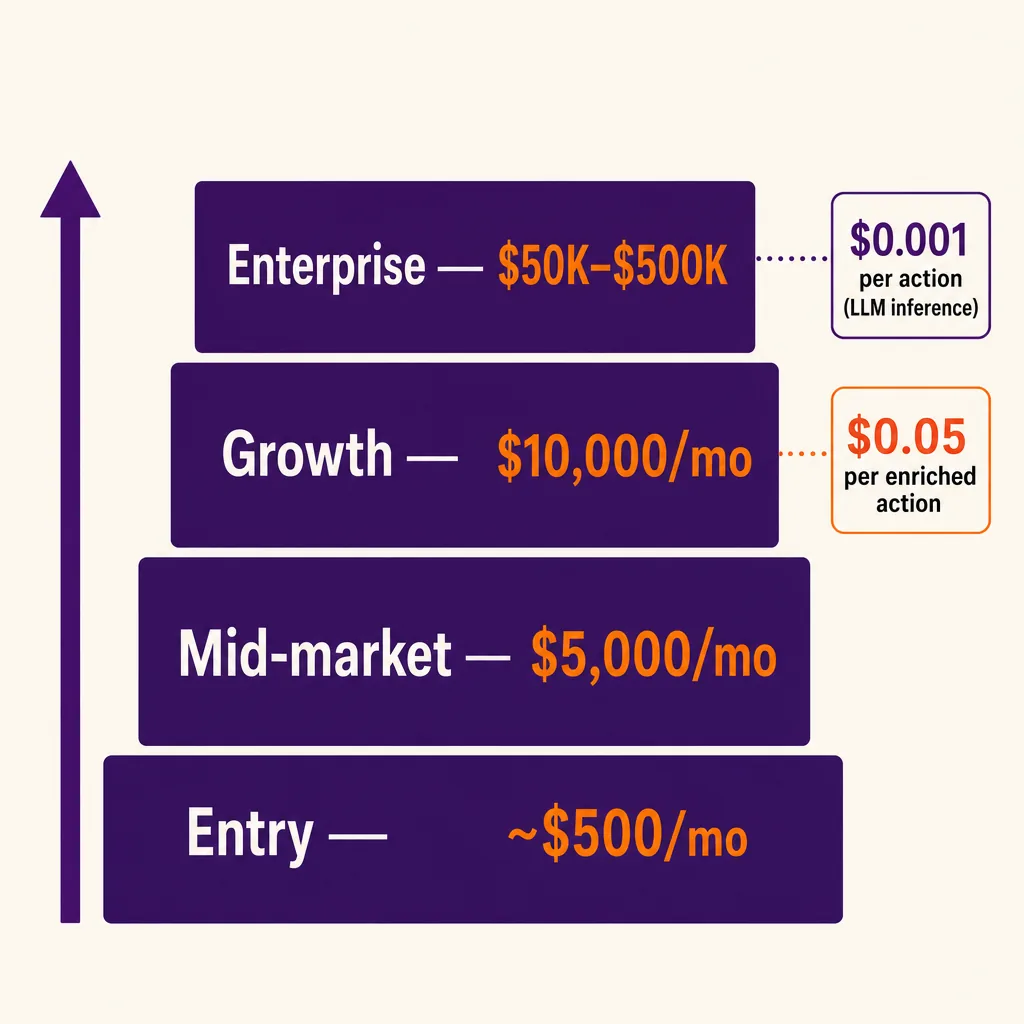
Common Pricing Models
| Model | Range | How It Works |
|---|---|---|
| Per-agent | $500–$5,000/mo per agent | Pay for each autonomous agent deployed |
| Per-decision / per-interaction | $0.001–$0.05 per decision | Consumption-based, tied to agent actions |
| Platform subscription (SaaS) | $800–$10,000/mo | Seat-based or tier-based access |
| Usage-based / consumption | Variable | Tied to data volume or API calls |
| Outcome-based | % of revenue lift or per-conversion | Performance-aligned, higher risk for vendor |
All ranges are illustrative 2026 market estimates, not vendor-confirmed prices.
Pricing by Vendor Tier
| Tier | Examples | Annual Range | Contract |
|---|---|---|---|
| Enterprise | Pega, Salesforce Agentforce, Adobe | $50K–$500K+/yr | Annual, full-stack orchestration |
| Mid-Market | Bloomreach (Loomi), HubSpot Breeze AI | $12K–$100K/yr | Monthly or annual, channel-specific |
| SMB / Startup | Botonomy, emerging tools | $500–$5K/mo | Monthly, modular agent deployment |
For an example of transparent pricing at the SMB tier, see our own pricing page. Always request a demo and custom quote — scope changes everything.
Hidden Costs to Budget For
- Integration and implementation services (often the majority of total enterprise cost — frequently more than the platform licence itself)
- CDP or data warehouse infrastructure
- Team training on agent governance
- Ongoing optimization headcount — even with agents, someone governs
- AI compute and token costs at scale
How to Evaluate Agentic Marketing ROI
- Baseline your current CPL and CPA
- Estimate labor hours reclaimed by autonomous agents
- Project incremental revenue from real-time personalization
- Factor in martech stack consolidation savings
- Calculate payback period — at the mid-market tier it’s typically measured in months, not years
The math: Agentic marketing at the mid-market tier runs $1,500–$10K/mo vs. traditional automation at $800–$3,200/mo. The premium buys autonomous optimization, not just workflow triggers. If your agents reclaim 40+ hours of manual execution per month and lift conversion rates by even 10%, the premium pays for itself fast.
AI Governance and Ethical Guardrails in Agentic Marketing
Autonomous agents without boundaries aren’t innovative. They’re liabilities.
Four pillars matter:
Bias monitoring. Regularly audit agent decisions for demographic skew. If your retargeting agent is systematically excluding zip codes or age brackets, you have a discrimination problem, not an optimization win.
Consent management. Agents must respect opt-outs in real time, across every channel. GDPR, CCPA, and the growing patchwork of state privacy laws aren’t optional. This means tight integration with CRM automation systems that store consent records.
Transparency and explainability. Dashboards that show why an agent took an action. Regulators are moving fast here, and the direction of travel on AI transparency in advertising is clear: if you can’t explain the decision, you can’t defend it.
Regulatory alignment. The EU AI Act classifies AI systems — including marketing uses — into risk tiers, with enforcement phasing in through 2026. Know where your agents fall.
At Botonomy, most of the logic is deterministic code, not prompts. That’s a design choice — it makes agent behavior auditable and predictable. If you can’t explain why your agent sent that email, you don’t have governance. You have a lawsuit waiting to happen.
What are the risks of agentic marketing? Brand safety incidents from unsupervised agents, regulatory non-compliance, data privacy violations, over-optimization that degrades customer experience (nobody wants 14 emails in a week), and vendor lock-in that makes switching painful.
FAQ: Agentic Marketing Questions Answered
Is agentic marketing the same as marketing automation?
No. Marketing automation executes pre-built rules you configure. Agentic marketing deploys autonomous agents that reason, decide, and act toward goals without step-by-step human instruction. One follows a script. The other writes its own.
What companies offer agentic marketing platforms?
Enterprise: Pega, Salesforce (Agentforce), Adobe. Mid-market: Bloomreach (Loomi), HubSpot (Breeze AI). SMB: Botonomy and emerging tools.
How much does agentic marketing cost?
Ranges from $500/mo for SMB agent tools to $500K+/yr for enterprise orchestration platforms. Common models include per-agent, per-decision, and outcome-based pricing. See the pricing section above for detailed breakdowns.
What is the 40-40-20 rule in marketing?
A direct mail principle attributed to Ed Mayer: 40% of success comes from audience quality, 40% from the offer, 20% from creative. In agentic marketing, agents optimize all three simultaneously — audience micro-segmentation, dynamic offer selection, and creative variant generation — rather than treating them as separate workstreams.
Who are the big 4 AI agents?
In marketing, the most-cited enterprise agent platforms in 2026 include Salesforce Agentforce, HubSpot Breeze, Adobe’s Experience Platform, and Netcore — though the list shifts depending on who’s counting and the industry context.
Is ChatGPT an agent or LLM?
ChatGPT is an LLM (large language model). An AI agent uses an LLM as a reasoning engine but adds memory, tool access, and autonomous action capabilities. ChatGPT alone doesn’t act on your behalf — an agentic marketing platform does.
How is the future of marketing agentic?
The trajectory is clear: marketing organizations in 2026 are shifting from teams that execute campaigns to teams that govern agents executing campaigns. The operational model is changing faster than the job titles. Within two years, marketing teams that still rely on manual campaign execution will be competing against teams that don’t — and losing on speed, personalization depth, and cost efficiency.
Agentic marketing is not a buzzword — it’s the operational model where autonomous agents handle execution and humans handle governance.
- Define your business objectives and ethical guardrails before deploying agents
- Evaluate platforms on actual autonomy, not marketing copy — ask whether a human must approve every action
- Budget for governance, not just software — the agent is the easy part; the oversight is the job
If you want to see what an agentic marketing practice looks like from the inside — not a demo, but a real system running SEO, content, paid, and outbound autonomously — contact us. Or explore how our agents work: AI SEO agent, AI content agent, AI paid ads agent.