
Martin Kelly is the founder of Botonomy AI and has spent more time stress-testing AI search tools than any reasonable person should — which is exactly why he has opinions about DeepSearch AI.
In short
DeepSearch AI is a mobile people-search app made by Hubx Limited, not to be confused with OpenAI's deep search feature inside ChatGPT Pro, which are entirely separate products. The Hubx app aggregates public records to surface contact details and background information, but Reddit's OSINT community has flagged inconsistent accuracy and outdated results. Full access requires a paid subscription after a limited free trial.
What Is DeepSearch AI and How Does It Work?
DeepSearch AI is an AI-powered search assistant developed by Hubx, available on iOS and Android, that aggregates data from multiple public sources to deliver people-lookup results and general web search. It uses artificial intelligence to surface deep search results — including contact details, social profiles, and background information — from across the open web.
That’s the pitch. Here’s how it actually works.
DeepSearch AI pulls from publicly available databases, social media platforms, and web indexes. It then uses AI to consolidate and present those results in a single interface. Think of it as a layer on top of existing public data — not a proprietary intelligence engine.
This is conceptually similar to how RAG and knowledge systems operate: retrieve information from multiple sources, then synthesize it into a coherent output. The difference is that DeepSearch AI targets consumer-level people searches rather than enterprise knowledge retrieval.
One critical distinction: DeepSearch AI (the Hubx app at deepsearchai.co) is not the same product as OpenAI’s “deep search” feature. These are entirely separate tools built by different companies for different purposes. If you’ve searched “deepsearch ai openai,” you’ve already encountered this confusion.
DeepSearch AI vs. OpenAI Deep Search: Don’t Confuse the Two
Google “deepsearch ai” and you’ll get results for two completely different products. That’s a problem if you’re trying to evaluate either one.
DeepSearch AI (Hubx) is a mobile app focused on people lookup and OSINT-style searches. It’s available on the App Store and Google Play. Its primary audience is individuals searching for contact information, background details, or social media profiles.
OpenAI’s deep search is a reasoning-intensive research feature built into ChatGPT Pro. It performs multi-step web research, synthesizing dozens of sources into comprehensive answers. It launched as part of ChatGPT’s premium tier and targets researchers, analysts, and professionals.
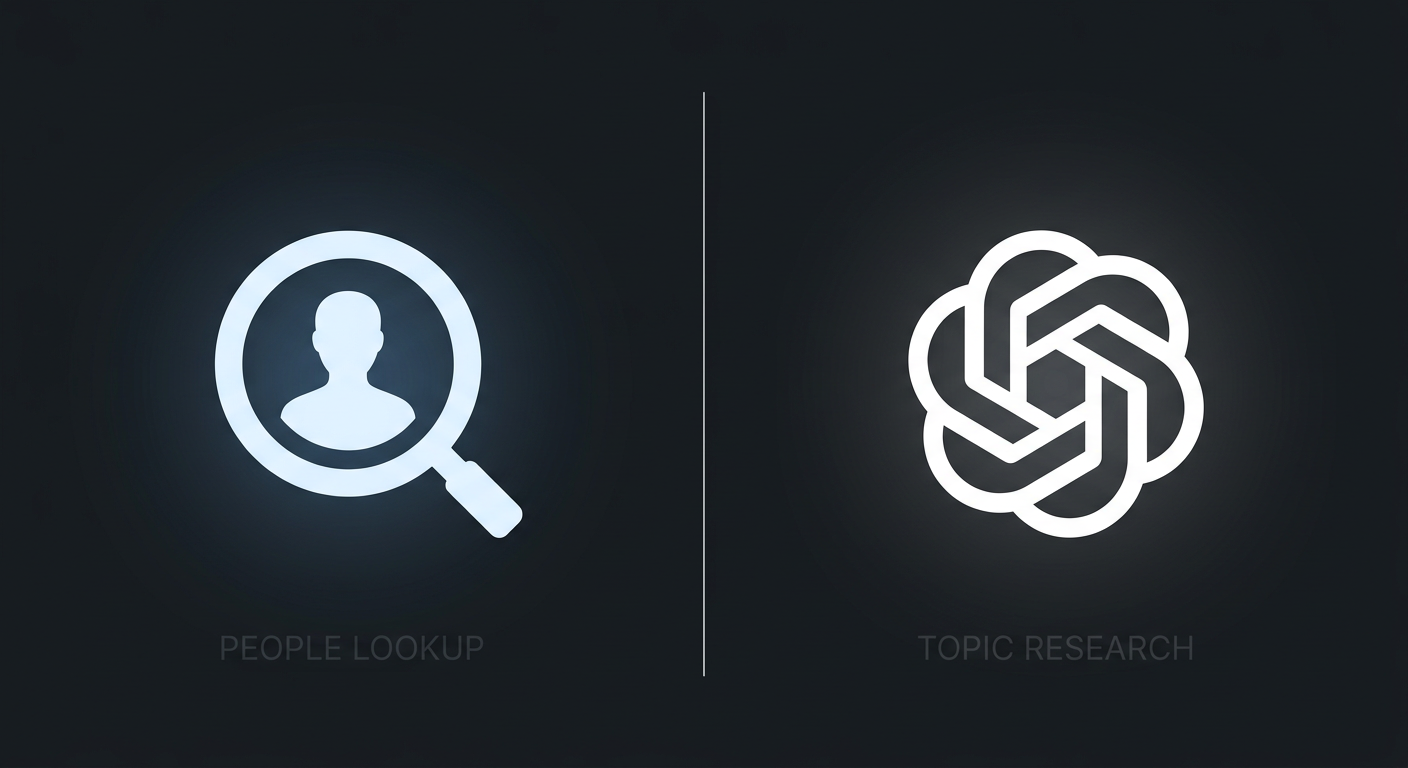
The overlap is purely naming. DeepSearch AI searches for people. OpenAI’s deep search researches topics. If you’re evaluating tools for AI content marketing or research workflows, knowing which product you’re actually looking at matters.
What Is DeepSearch AI Actually Used For in 2026?
The app markets itself for three primary use cases: people lookup, background searches, and general AI-assisted web search. But what are people actually using it for?
People lookup remains the core function. Users enter a name, phone number, or email address, and the app returns aggregated public records. This is the same category as Spokeo, BeenVerified, and TruePeopleSearch — just with an “AI” label.
OSINT research is where things get interesting. Reddit’s r/OSINT community has discussed DeepSearch AI multiple times, with users testing it against established tools. The consensus from a widely cited 2025 thread: results are hit-or-miss. Several users reported inaccurate phone numbers and outdated addresses. One commenter noted the app “returns confident-looking results that are sometimes completely wrong.”
That tracks with broader research. Stanford’s Human-Centered Artificial Intelligence Institute (HAI) has documented that AI systems can produce hallucinated outputs at rates between 3% and 27%, depending on the task and model (Stanford HAI, 2024). For people-lookup queries, where accuracy is binary — either that’s the right phone number or it isn’t — even a 5% error rate creates real problems.
For marketing and SEO professionals evaluating tools like this for research workflows, an autonomous SEO pipeline built on verified data sources will outperform a general-purpose AI search app every time.
Is DeepSearch AI Legit? Separating Real From Fake
“Is DeepSearch AI real or fake?” is one of the most searched questions about this tool. The answer: it’s real. It’s a legitimate app published by Hubx Limited, available on the Apple App Store and Google Play Store.
As of early 2026, the iOS app holds approximately 4.0 stars with over 15,000 ratings. The Android version shows similar numbers. Those are real downloads from real users.
But “legit” and “accurate” aren’t the same thing. Reddit users in r/OSINT have flagged specific issues: results that combine data from different individuals, outdated records presented as current, and subscription billing that’s difficult to cancel.
The subscription model itself has drawn criticism. The app offers a free trial, then converts to a paid subscription — a pattern common in this category but one that catches users off guard.
In 16 years of search marketing, I’ve evaluated dozens of tools that sit in this space. My litmus test: does the tool tell you where its data comes from, and can you verify it independently? DeepSearch AI doesn’t surface its sources with enough granularity. That’s a red flag for any tool claiming intelligence-grade results.
DeepSearch AI Pricing: Can You Use It for Free?
Two separate questions get tangled here. Let’s untangle them.
DeepSearch AI (Hubx app): Free to download. You get a limited number of searches before hitting a paywall. Full access requires a weekly or monthly subscription, typically ranging from $7.99/week to $29.99/month depending on the plan and promotional pricing. Users searching for “deepsearch ai login” should note that an account is required even for free-tier access.
OpenAI’s deep search (ChatGPT): Not free. It’s available exclusively to ChatGPT Pro subscribers at $200/month as of 2026. That buys you access to OpenAI’s full reasoning model suite, including the deep search feature. There’s no standalone pricing for deep search alone.
The value proposition differs dramatically. DeepSearch AI charges $30/month for people lookups. OpenAI charges $200/month for a full AI research platform that includes deep search as one feature among many. Neither is free beyond trial periods.
Where DeepSearch AI Falls Short (and What to Use Instead)
AI-generated search results still hallucinate. A 2024 study published in Nature found that large language models produced factually incorrect statements in 15–20% of information retrieval tasks (Nature, 2024). People-search apps layering AI on top of already imperfect public records compound that error rate.

Privacy is the other concern. Tools that aggregate personal data from public sources operate in a legal gray zone. The data may be public, but the aggregation creates profiles that individuals never consented to.
Better alternatives exist for specific use cases:
- OSINT research: Maltego, Shodan, and Google Dorking remain more transparent and controllable.
- AI-powered web research: OpenAI’s native deep search within ChatGPT Pro offers sourced, multi-step reasoning.
- Marketing and SEO research: General AI search assistants aren’t built for this. Purpose-built systems with deterministic logic — code-first, not prompt-dependent — deliver repeatable results without hallucination risk.
That’s the fundamental difference between a consumer AI search app and a system designed for professional workflows. Botonomy AI marketing automation takes the latter approach: deterministic pipelines that execute the same way every time, rather than probabilistic AI that gives you a different answer on Tuesday than it did on Monday.
FAQ: DeepSearch AI Questions Answered
Is DeepSearch AI real or fake?
Real. It’s a legitimate app by Hubx Limited, available on iOS and Android with thousands of verified reviews. However, “real app” doesn’t mean “accurate results.” Verify any information independently.
What is DeepSearch used for?
People lookup, background searches, and OSINT-style research. It aggregates publicly available data using AI to surface contact information, social profiles, and background details.
Can I use DeepSearch for free?
Partially. The app offers limited free searches after download, but full functionality requires a paid subscription starting around $7.99/week.
Is ChatGPT DeepSearch free?
No. OpenAI’s deep search feature requires a ChatGPT Pro subscription at $200/month as of 2026.
For more AI tool breakdowns and marketing automation analysis, visit the Botonomy blog.
The Bottom Line
Verdict: 3 out of 5. A legitimate people-lookup app that is fine for casual use, but inconsistent accuracy and an aggressive paywall hold it back for serious research.
DeepSearch AI is a real product that solves a narrow problem — people lookup — with inconsistent accuracy and a subscription model that frustrates users.
- Verify independently. Never treat AI-generated people-search results as fact without cross-referencing.
- Know which “deep search” you need. The Hubx app and OpenAI’s feature serve entirely different purposes.
- Match the tool to the task. Consumer AI search apps aren’t built for professional marketing or SEO research workflows.
If you’re evaluating AI search tools for marketing or research, general-purpose apps like DeepSearch AI are a starting point — not a destination. For teams that need reliable, repeatable search intelligence without the hallucination risk, purpose-built automation systems deliver more. See how Botonomy’s deterministic approach to SEO and content automation compares →