
Martin Kelly is the founder of Botonomy AI and has spent more time than is probably healthy wiring up retrieval pipelines and protocol integrations — which is why he has strong opinions about when each one actually earns its place in your stack.
In short
MCP and RAG solve different problems: RAG retrieves relevant text from a static knowledge base and injects it into a prompt, while MCP is a protocol that connects an LLM to live systems, APIs, and tools it can both read from and write to. RAG suits document search over stable content, MCP suits real-time data and action execution, and in production most systems use both together inside an agentic workflow.
What Are MCP and RAG? Simple Definitions That Actually Stick
Most people conflate these two things because they both solve the same surface-level problem: getting external information into an LLM. That’s where the similarity ends.
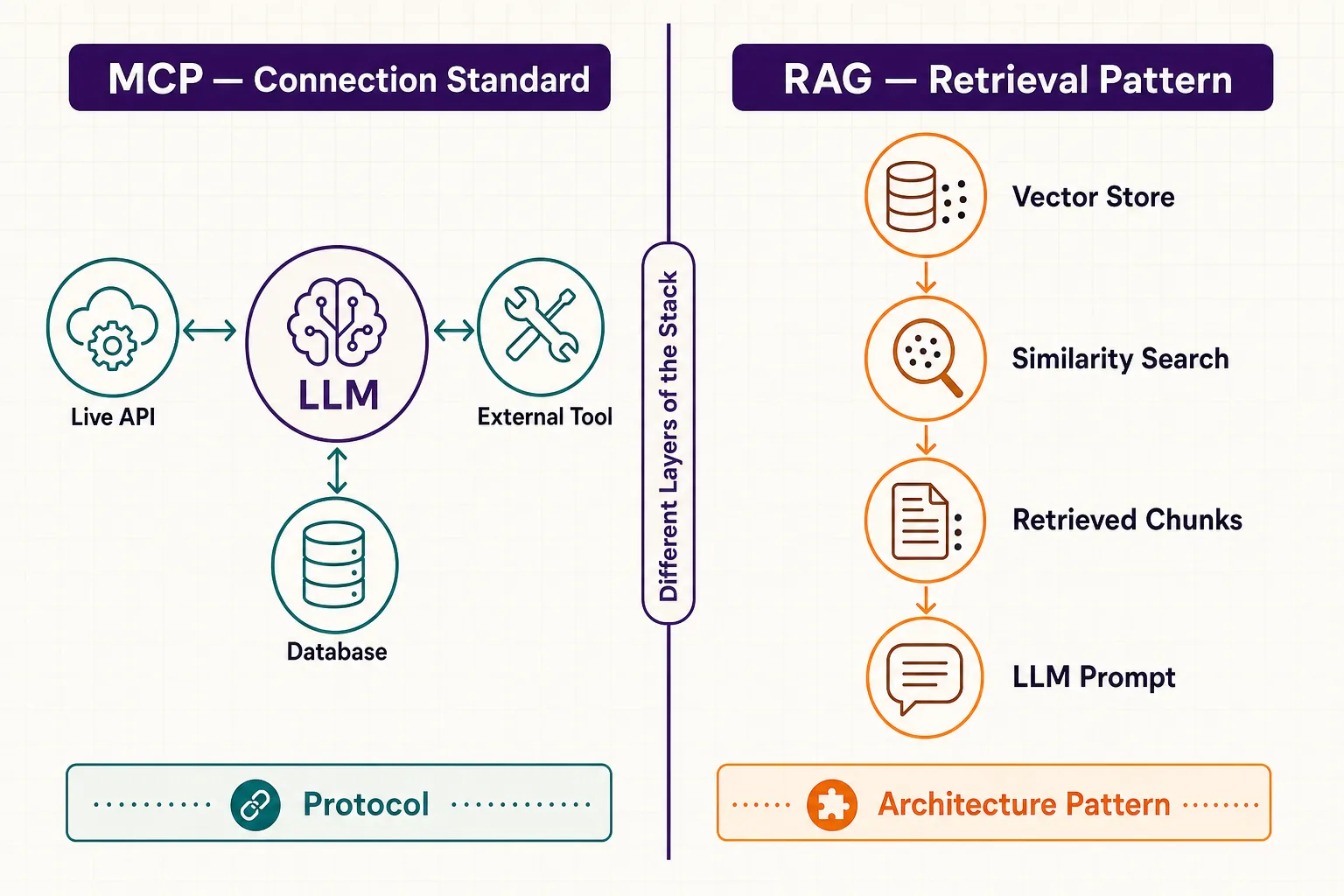
Model Context Protocol (MCP) is an open standard originally published by Anthropic in late 2024. It defines a universal way for LLMs to connect to external tools, APIs, and live data sources. Think of it as a standardized plug — one protocol, many systems. By mid-2026, MCP has hit significant adoption milestones: thousands of public MCP servers, native support in Claude, GPT-series models, and most major agent frameworks. The spec defines how a client (the LLM or its orchestrator) discovers what a server can do, calls its tools, and handles the results. It’s a connection standard.
Retrieval Augmented Generation (RAG) is an architecture pattern first formalized by Lewis et al. in their 2020 paper at Meta AI. RAG retrieves relevant chunks of text from a knowledge base — usually via vector similarity search — and injects those chunks into the LLM’s prompt before generation. The model reads the retrieved text and uses it to produce a grounded answer. It’s a retrieval pattern.
Here’s the distinction that matters: MCP is a protocol. RAG is an architecture pattern. They operate at different layers of the stack entirely.
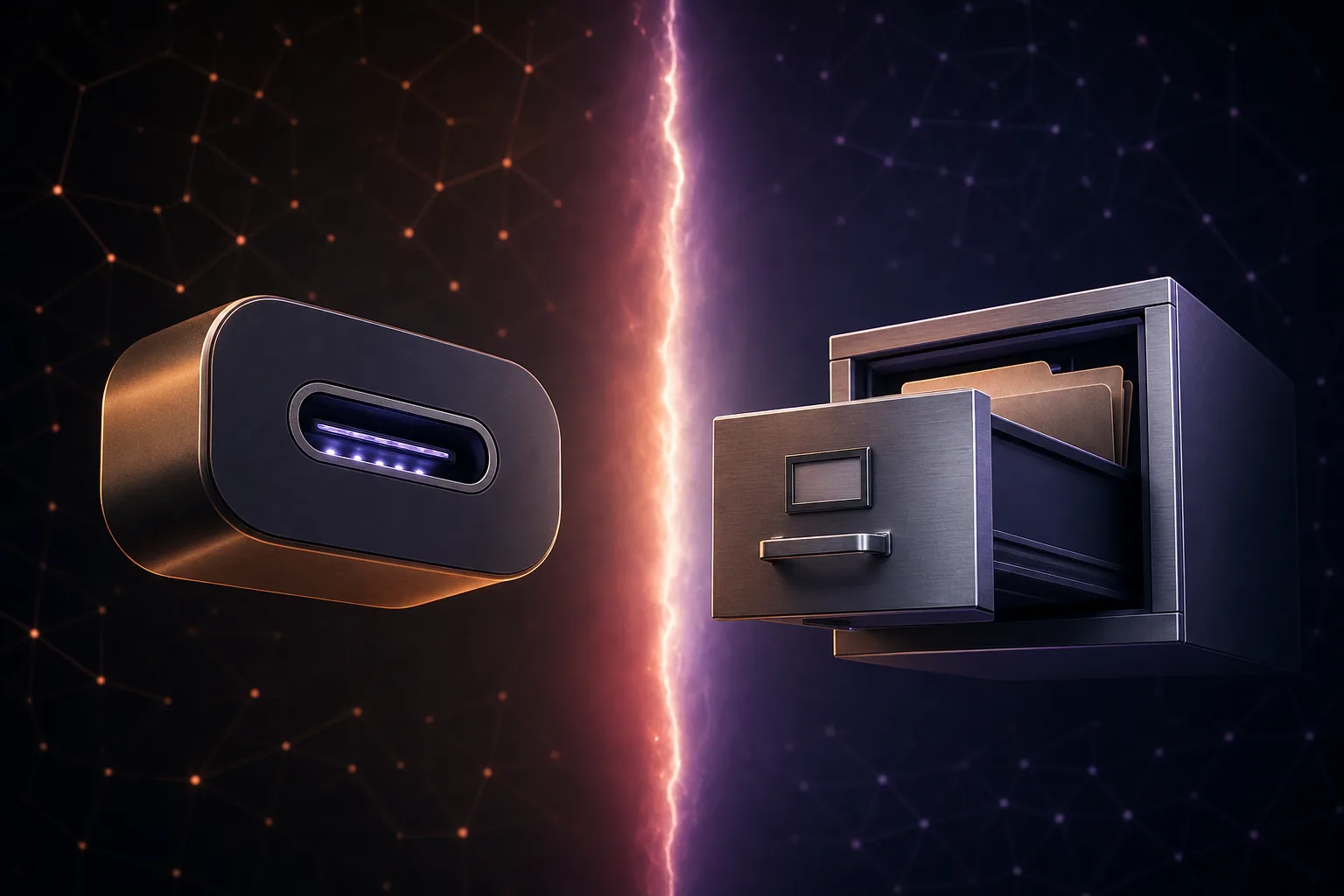
MCP is the USB-C port. RAG is the file manager that finds the right document to plug in.
You can build a RAG and knowledge systems pipeline without ever touching MCP. You can use MCP without a single vector store. Or — and this is where things get interesting in 2026 — you can use both in the same system, each doing what it does well.
The Common Ground: Where MCP and RAG Overlap
Both MCP and RAG exist because LLMs have a fundamental limitation: they only know what was in their training data, and that data has a cutoff date. Your proprietary CRM data, your internal docs, your live inventory — the model has never seen any of it.
Both solve this problem at inference time. Neither requires retraining the model. You don’t fine-tune; you augment. This is the shared DNA.
Both are composable with agentic architectures. A single AI agent can use RAG to search a knowledge base and MCP to call an external API — in the same conversation, in the same workflow. They’re not competing for the same slot. They fill different slots in the same system.
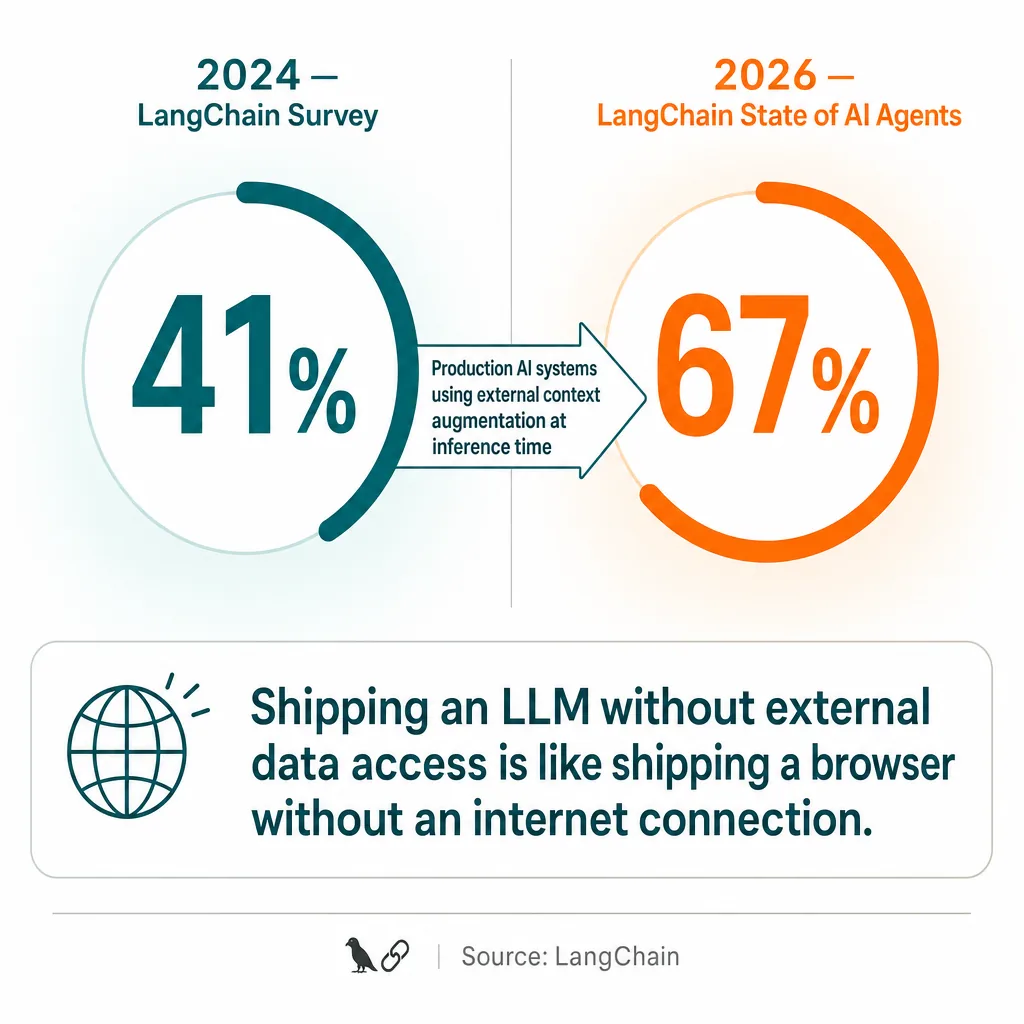
The LangChain 2026 State of AI Agents report found that over 67% of production AI systems now use some form of external context augmentation at inference time. That number was 41% in their 2024 survey. The direction is clear: shipping an LLM without external data access is like shipping a browser without an internet connection.
Both also share a failure mode worth noting: if the external data is garbage, the LLM output is garbage. RAG with a poorly chunked corpus produces hallucination-flavored nonsense. MCP connected to a broken API produces confidently wrong structured data. The augmentation is only as good as the source.
The Critical Divergence: How MCP and RAG Differ
The overlap is real. The differences are bigger.
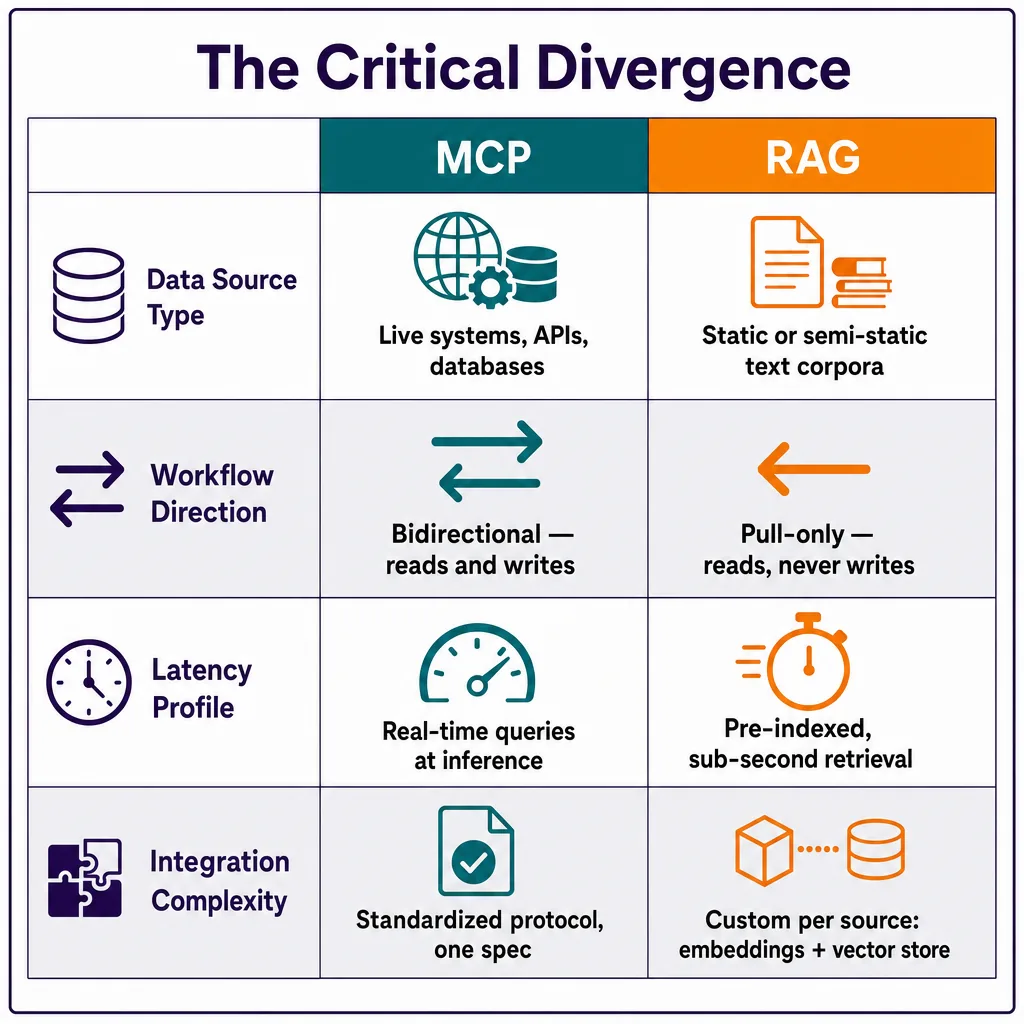
| Dimension | MCP | RAG |
|---|---|---|
| Data source type | Live systems, APIs, databases | Static or semi-static text corpora |
| Workflow direction | Bidirectional — reads and writes | Pull-only — reads, never writes |
| Latency profile | Real-time queries at inference | Pre-indexed, sub-second retrieval |
| Integration complexity | Standardized protocol, one spec | Custom per source: embeddings + vector DB |
| Best-fit use case | Tool execution and live data access | Semantic search over documents |
MCP enables the LLM to do things. Read a database row. Trigger a webhook. Write to a CRM field. Update a ticket. It’s not just pulling information — it’s executing actions on external systems. This is a fundamental architectural difference. RAG retrieves text for the model to read. That’s it. Read-only. No side effects.
The infrastructure requirements diverge sharply too. A RAG pipeline needs an embedding model, a vector store (Pinecone, Weaviate, Qdrant — pick your poison), chunking logic, and retrieval ranking. That’s four components minimum before you write a single line of application code. An MCP integration needs a server implementing the protocol spec and a compatible client. Two components. The complexity lives in different places: RAG complexity is in the data pipeline; MCP complexity is in the server-side tool implementation.
According to Anthropic’s MCP documentation, the protocol uses a JSON-RPC transport layer with capability negotiation — meaning the client discovers what the server can do before calling anything. RAG has no equivalent discovery mechanism. You build the retrieval pipeline, and it retrieves. There’s no negotiation, no capability listing, no standardized interface. Every RAG integration is bespoke. Every best ai agent framework that supports MCP gets standardized tool access for free.
Static Knowledge vs Dynamic Systems: How Each Handles Data
RAG was built for documents. Product manuals. Policy PDFs. Research papers. Support articles. Content that changes on a weekly or monthly cadence — or not at all. For this use case, RAG is hard to beat. You embed the corpus once, re-index periodically, and queries return semantically relevant chunks in under 100 milliseconds.
MCP was built for systems. Your CRM automation platform. Your billing database. Your project management tool. Data that changes per-second and often requires write access. For this use case, RAG doesn’t just underperform — it fundamentally can’t do the job.
The embedding freshness problem is RAG’s biggest operational headache. Stale vectors produce stale answers. Re-indexing a million-document corpus in a typical Pinecone setup takes 15–45 minutes depending on chunk size and embedding model. During that window, your retrieval system is serving answers based on yesterday’s data. For a product FAQ, that’s fine. For a live inventory count, that’s a customer telling you they ordered something that’s been out of stock for three hours.
MCP sidesteps the freshness problem entirely because it queries live systems at inference time. The tradeoff is latency. A vector search returns results in 50–200ms. An MCP server call to a database or API can take 500ms–2s depending on the external system. You trade speed for recency.
Harrison Chase, CEO of LangChain, has been vocal about this tradeoff throughout 2026: the choice between indexed retrieval and real-time tool calls isn’t about which is “better” — it’s about whether your data changes faster than your re-indexing cycle. If it does, you need live access. If it doesn’t, pre-indexed retrieval is faster and cheaper.
That framing is the right one. Match the retrieval method to the data velocity.
A Tale of Two Workflows: How MCP and RAG Process Requests
A user asks: “Show me Q1 revenue.”
Here’s what happens in each system.
The RAG Workflow
- User query received. The system embeds the query into a vector.
- Vector search. The embedding hits the vector store. Similarity search returns the top-k most relevant chunks.
- Retrieval. The system pulls those chunks — maybe a cached quarterly report, maybe a revenue summary doc.
- Context injection. The chunks get stuffed into the LLM prompt alongside the original question.
- Generation. The LLM reads the chunks and produces an answer.
- Response delivered. The user gets the revenue number from the last time the report was indexed.
Six steps. All read-only. The number you get is from the most recently embedded document — not from the live system.
The MCP Workflow
- User query received. The LLM parses the intent: “I need Q1 revenue data.”
- Tool identification. The LLM (or the orchestrating agent) identifies that the financial database MCP server can fulfill this request.
- MCP client request. The client sends a structured tool call to the MCP server:
query_revenue(period="Q1-2026"). - Server execution. The MCP server runs the actual database query against the live financial system.
- Structured result returned. The server sends back the current number — $4.2M, as of right now.
- Response delivered. The LLM formats and presents the live figure.
Six steps. Read-write capable. The number is current because it came from the live database, not a cached document.
The key difference: RAG is a retrieval loop. MCP is a tool-use protocol. RAG answers questions. MCP answers questions and takes actions.
In production, many systems combine both. An AI SEO agent might use RAG to retrieve content guidelines from a knowledge base, then use MCP to push optimized content to a CMS. Retrieval for knowledge, protocol for action.
MCP vs RAG vs Agents: How All Three Fit Together in 2026
I see this question come up constantly: “Should I use MCP or RAG or an agent?” It’s a category error. These aren’t competing options. They’re different layers of the same architecture.
An agent is the orchestration layer. It’s the decision-maker. It receives a user request, figures out what needs to happen, and coordinates the tools that do the work.
RAG is one of those tools. When the agent needs to find information in a document corpus, it calls the RAG pipeline. Semantic search over static knowledge.
MCP is another tool. When the agent needs to interact with a live system — query a database, update a record, call an API — it uses MCP to do so through a standardized interface.
The agent decides when to retrieve and when to act. Neither RAG nor MCP makes that decision. They execute. The agent orchestrates.
A related question I get: “What about MCP vs RAG vs LangChain?” LangChain is a framework. It orchestrates both RAG pipelines and MCP tool calls. It’s not a competitor to either one — it’s the wiring that connects them. As of 2026, LangChain, LlamaIndex, CrewAI, and AutoGen all support MCP servers as first-class tool providers. The framework war is over in this regard: everyone adopted the protocol.
Gartner’s 2026 AI Infrastructure report estimates that 40% of enterprise AI deployments now use some form of tool-use protocol (MCP being the dominant one), up from under 5% in 2024. RAG adoption in enterprise hit 72% by the same report’s measure. The pattern is clear: enterprises adopted RAG first (it’s simpler), and now they’re layering MCP on top for ai marketing automation and operational workflows that require action, not just answers.
When to Use MCP, When to Use RAG, and When to Use Both
Here’s the decision framework I use. No flowchart needed — three questions get you there.
Use RAG when:
- You have a large corpus of documents that the LLM needs to reference
- Semantic search matters — the user’s query might not use the exact words in the document
- You need to ground the LLM’s answers in specific source material (citations, quotes, policy language)
- You don’t need the LLM to write, update, or trigger anything in an external system
Use MCP when:
- You need live data from external systems — not cached, not indexed, live
- The LLM needs to take actions: create a record, send a message, trigger a workflow
- You’re integrating multiple tools and want a standardized interface instead of writing custom code for each one
- Your data changes faster than any reasonable re-indexing cycle
Use both when:
- Your system needs to retrieve knowledge AND interact with live systems in the same workflow
The customer support agent is the canonical example. A user asks about a return policy — the agent uses RAG to search the policy knowledge base and retrieve the relevant section. The user then says “okay, process my return” — the agent uses MCP to create a return ticket in the order management system, update the CRM record, and trigger a confirmation email.
Knowledge retrieval and system action in a single conversation. RAG handled the first part. MCP handled the second. The agent decided when to use each.
We build systems like this as part of our autonomous SEO pipeline — retrieval for content analysis, protocol-based tool calls for automated implementation. The combination is where the real power sits.
Frequently Asked Questions
Does MCP replace RAG?
No. MCP and RAG solve different problems. MCP is a protocol for connecting LLMs to live tools and taking actions. RAG is a pattern for retrieving relevant text from a knowledge base. MCP can’t do semantic search over a document corpus. RAG can’t write to a database. They’re complements, not substitutes.
Can you use MCP and RAG together?
Yes — and most production AI systems in 2026 do exactly this. An agent uses RAG when it needs to find information in a static knowledge base, and MCP when it needs to call a live API or execute an action. The two work side by side in the same workflow without conflict.
What is the difference between MCP and RAG?
MCP is a standardized protocol for LLMs to connect to external tools, APIs, and live data. It supports bidirectional communication — reads and writes. RAG is an architecture pattern that retrieves text from an indexed corpus and injects it into the LLM prompt. It’s read-only. MCP connects; RAG retrieves. Different problems, different layers, different infrastructure.
The Bottom Line: MCP and RAG Are Complements, Not Competitors
MCP is a connection protocol. RAG is a retrieval pattern. Treating them as an either-or choice is the fastest way to build the wrong system.
- Pick RAG for semantic search over static document collections where grounding and citations matter.
- Pick MCP for live data access and actions against external systems — CRMs, databases, SaaS APIs.
- Combine them when your workflow requires both knowledge retrieval and system interaction — which, in 2026, is most non-trivial AI systems.
If you’re building AI systems that need both knowledge retrieval and live tool access, I can help. We build production-grade RAG pipelines and MCP integrations as part of our autonomous marketing stack. Contact us and skip the guesswork.
Sources
- Lewis, P., et al. “Retrieval-Augmented Generation for Knowledge-Intensive NLP Tasks.” Meta AI, 2020. arXiv:2005.11401.
- Anthropic. “Model Context Protocol Specification.” 2024 (updated 2026).
- LangChain. “State of AI Agents 2026.” Annual industry survey.
- Gartner. “AI Infrastructure Hype Cycle, 2026.” Enterprise adoption data on RAG and tool-use protocols.