

Martin Kelly is the founder of Botonomy AI and someone who’s spent enough years vetting vendor pitch decks to develop a healthy distrust of any CEO who gets fired and rehired inside a long weekend.
TL;DR — Five-step enterprise AI vendor trust evaluation:
- Vendor risk questionnaire — Map the vendor’s AI governance structure, leadership accountability, and risk appetite documentation before a single contract gets signed.
- Third-party audit evidence — Demand independent audit reports (not self-assessments) covering bias testing, data governance, and model performance.
- Framework alignment check — Confirm vendor alignment with NIST AI RMF, ISO/IEC 42001, and EU AI Act classification requirements for your use case.
- Contractual safeguards — Embed model rollback clauses, incident notification SLAs, IP indemnification, and data deletion rights directly into the agreement.
- Continuous monitoring — Establish ongoing review cadences: quarterly vendor scorecards, annual re-audits, and triggered reviews after major model updates or leadership changes.
In short
Choosing the right AI vendor is the most consequential trust decision enterprise teams face in 2026, because leadership instability, opaque governance, and weak incident response create operational and regulatory exposure no contract alone can fix. The OpenAI board crisis demonstrated that vendors can fail on governance axes like transparency, accountability, and incident response simultaneously. Enterprises should require NIST AI RMF alignment, third-party audit evidence, and contractual model rollback rights before signing.
Why AI Vendor Trust Is the Enterprise Decision That Matters Most in 2026
In November 2023, OpenAI’s board fired Sam Altman. Seventy-two hours later, he was back. In the months that followed, more governance departures, a restructuring from nonprofit to for-profit, and a rolling series of safety team exits turned OpenAI into a live case study in vendor leadership risk. Enterprises that had built infrastructure on OpenAI’s APIs spent that weekend refreshing X feeds instead of running production workloads. That’s not a governance hiccup. That’s a single point of failure wearing a hoodie.

Here’s the thesis: vendor trust is not a feeling. It is a measurable, auditable property. Enterprises that treat it as a vibe check — “they seem solid” — are exposed to regulatory, operational, and reputational risk that no NDA will fix.
The data backs this up. Gartner predicts over 40% of agentic AI projects will be canceled by end of 2027 due to escalating costs, unclear business value, or inadequate risk controls — and separately has predicted that 60% of AI projects lacking AI-ready data will be abandoned through 2026. When your vendor’s leadership stability looks like a reality TV show, confidence is earned, not assumed. Keep up with the latest shifts in ai news — they move fast enough that last quarter’s “stable vendor” might be this quarter’s cautionary tale.
Enterprise AI Vendor Trust Evaluation Framework
Most enterprise procurement teams still evaluate AI vendors the same way they evaluate SaaS tools: security questionnaire, SOC 2 report, handshake. That worked when the software was deterministic. It does not work when the software hallucinates.
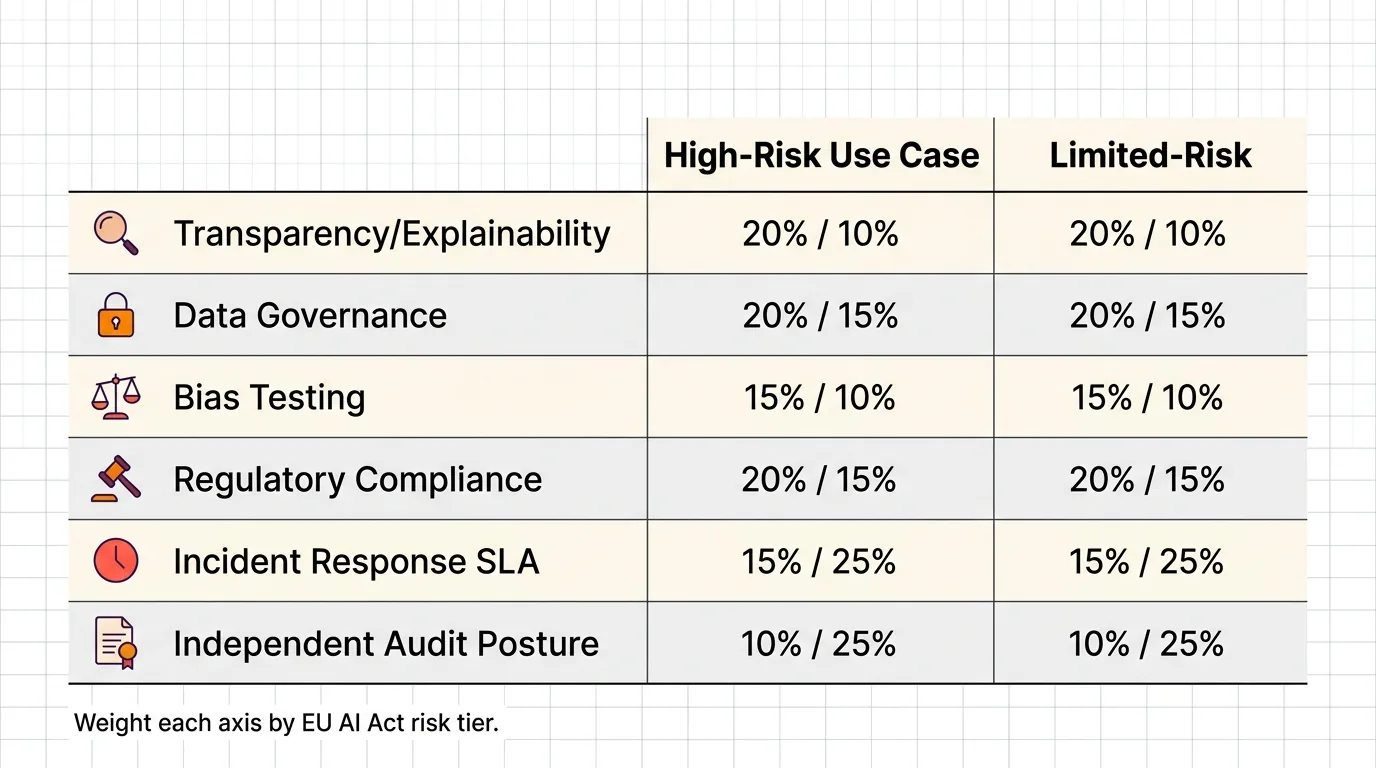
Score your AI vendors across six axes:
| Axis | What to Evaluate | Weight (High-Risk Use Case) | Weight (Limited-Risk) |
|---|---|---|---|
| Transparency / Explainability | Model cards, AI Bill of Materials (AI BOM), decision documentation | 20% | 10% |
| Data Governance | Training data provenance, PII handling, retention policies | 20% | 15% |
| Bias Testing | Demographic parity results, fairness metrics, testing cadence | 15% | 10% |
| Regulatory Compliance | EU AI Act classification, NIST AI RMF alignment, ISO 42001 status | 20% | 15% |
| Incident Response SLA | Notification timelines, model rollback capability, communication protocols | 15% | 25% |
| Independent Audit Posture | Third-party audit frequency, auditor independence, public reporting | 10% | 25% |
Key Terms:
– AI Bill of Materials (AI BOM): A structured inventory of an AI system’s components — training data sources, model architecture, dependencies, and known limitations. Think of it as a nutrition label for your model.
– Model Cards: Standardized documentation (originated at Google) describing a model’s intended use, performance benchmarks, and ethical considerations.
– AI Assurance: The practice of providing evidence-based confidence that an AI system operates as intended, safely, and within regulatory bounds.
Weight each axis based on risk tier. The EU AI Act classifies systems as unacceptable, high-risk, limited-risk, or minimal-risk. A high-risk medical diagnostic model demands 20% weight on bias testing. A chatbot answering shipping FAQs doesn’t.
Map the Altman situation onto this framework. Transparency and explainability? OpenAI’s internal safety debates were opaque even to its own board. Incident response SLA? Enterprise customers had zero contractual recourse during the CEO crisis. If your vendor scores poorly on two or more axes, that’s not a yellow flag — it’s a red one you’re choosing to ignore.
NIST’s AI RMF Playbook provides suggested actions and references aligned to AI RMF subcategories across the four functions (Govern, Map, Measure, Manage). Third-party tools such as EFROS’s 20-question assessment are separately developed resources mapped to the AI RMF — use them. I’ve run our own systems through similar rigor — Botonomy’s autonomous SEO pipeline is built primarily on deterministic logic, with most of the pipeline using code-based rather than prompt-driven AI to produce repeatable, auditable outputs, specifically because “trust us, the model is fine” is not an engineering standard.
NIST AI Risk Management Framework: What Enterprise Buyers Must Require from Vendors
The NIST AI RMF (AI 100-1) organizes AI risk management into four core functions. Each one maps directly to something you should require from any vendor before signing.
Govern
- Vendor must demonstrate board-level AI risk oversight with named accountable roles — not a vague “AI ethics committee” that meets quarterly and produces nothing.
- Vendor must document a risk appetite statement specific to AI systems, not just a recycled enterprise risk policy.
- Vendor must show role-based accountability: who approves model deployment, who can halt it, who communicates to customers during incidents.
The Altman crisis was a Govern failure. The board technically had oversight authority. It exercised that authority. Then the company reversed the board’s decision under employee pressure. If your vendor’s governance structure can be overridden by a staff petition, it’s theater.
Map
- Vendor must provide MAP 1.1 compliance: documented intended use, known limitations, and deployment context for every model you consume.
- Vendor must identify who is affected by the AI system’s outputs and how — not in a white paper, in the contract.
Measure
- Vendor must share bias testing results with methodology, not just a summary claiming “we tested for bias.”
- Vendor must provide performance benchmarks on data distributions that match your use case, not just industry-standard benchmarks.
- Vendor must disclose validation methodology — who tested, when, using what data, and what thresholds triggered a pass or fail.
Manage
- Vendor must maintain an incident response plan specific to AI failures (hallucinations, data leaks, adversarial attacks) — not just their general IT incident plan.
- Vendor must demonstrate model rollback capability — if a model update degrades performance or introduces bias, can they revert within hours?
- Vendor must define stakeholder communication protocols: who gets notified, how fast, and through what channel.
Sample procurement language you can use today:
“Vendor shall provide, within 30 days of request, third-party audit documentation demonstrating conformity with NIST AI RMF Govern and Measure functions, including named individuals responsible for AI risk oversight and bias testing results with methodology disclosure.”
That sentence does more for your risk posture than a 40-page vendor-provided “AI Ethics Report” ever will.
How Much Does a Third-Party AI Audit Cost in 2026?
AI audit pricing is opaque. I find that ironic, given that the whole point of an audit is transparency. Here’s what the market actually looks like.
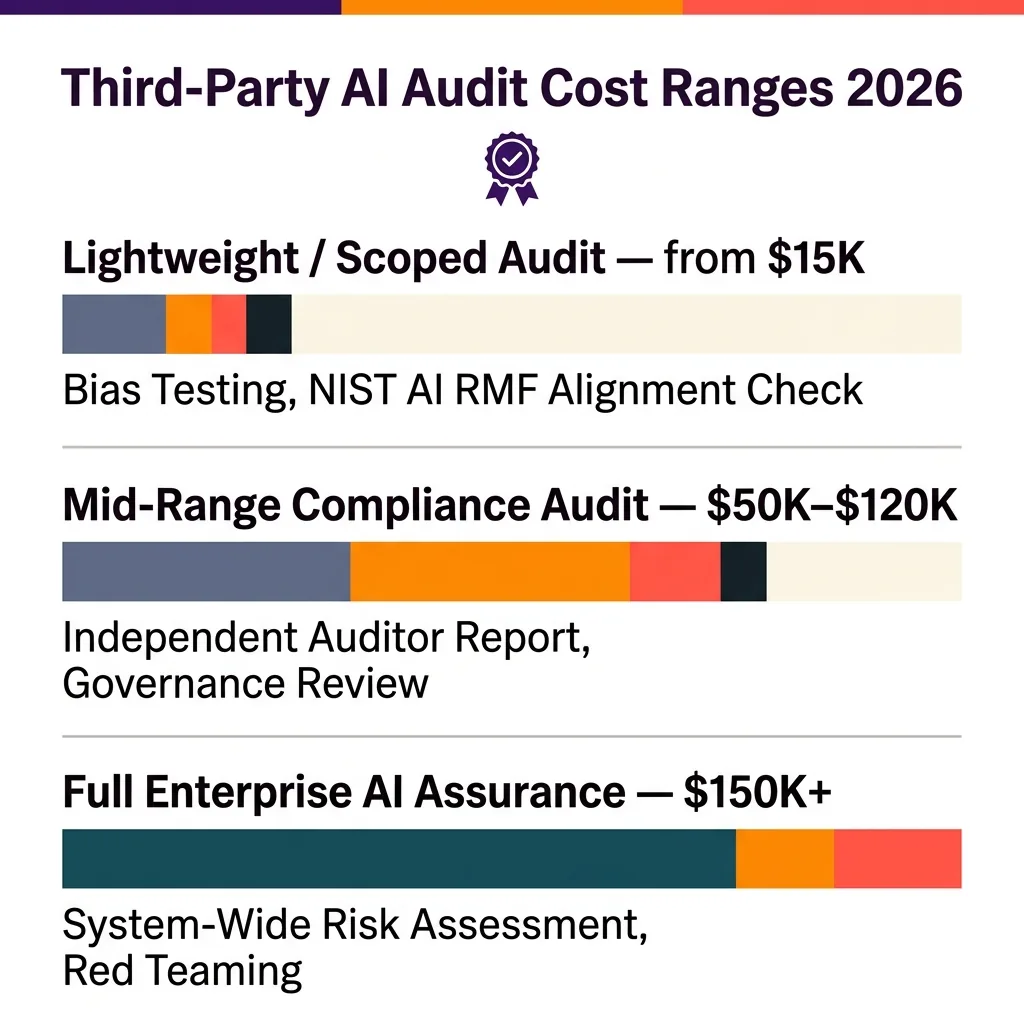
| Tier | Scope | Cost Range | Deliverables | Typical Firm |
|---|---|---|---|---|
| Tier 1 — Single Model | One model, narrow use case | ~$15K–$50K | Bias report, model card review, risk summary | Boutique (Holistic AI, ORCAA, Credo AI) |
| Tier 2 — Enterprise Multi-Model | Multiple models, cross-functional | Varies; consult providers directly | Full risk assessment, remediation roadmap, executive summary | Mid-market / Big Four |
| Tier 3 — ISO 42001 Certification | Full AI management system | Varies; see ISO 42001 section below | Gap analysis, implementation support, certification audit | Big Four, BSI, Bureau Veritas |
What Drives AI Audit Costs?
Five factors account for most of the variance:
- Model complexity — A single classification model costs less to audit than a multi-agent system with chained LLM calls.
- Data sensitivity — Healthcare and financial data trigger additional regulatory requirements and higher auditor rates.
- Regulatory jurisdiction — EU AI Act conformity assessments cost more than voluntary U.S. audits because the stakes (and the documentation burden) are higher.
- Number of use cases — Each distinct AI application requires its own risk assessment.
- Readiness level — Organizations with existing documentation and governance pay less. Governance consulting engagements typically carry a 20–40% premium over standard AI consulting rates due to specialized compliance knowledge requirements.
AI Safety & Red-Team Audit Pricing
Frontier model red-teaming is a different animal. Firms like METR (formerly ARC Evals) and Apollo Research conduct adversarial evaluations on large-scale frontier AI models — testing for dangerous capabilities, alignment failures, and catastrophic misuse potential. Pricing for AI red-team audits ranges from approximately $8K for simple chatbot evaluations to $400K+ for comprehensive enterprise engagements, with frontier model evaluations typically falling in the $50K–$150K range.
Executive Order 14110 and NIST AI 600-1 established reporting requirements for dual-use foundation models. Frontier Model Forum members (OpenAI, Anthropic, Google DeepMind, Microsoft) committed to pre-deployment safety testing. Whether those commitments survive commercial pressure is a separate question.
What’s Included in an AI Safety Audit?
Threat modeling, adversarial input testing, hallucination rate benchmarking, data poisoning assessment, and alignment evaluation. These are distinct from compliance audits (regulatory conformity) and algorithmic audits (bias-focused, e.g., NYC Local Law 144).
For context on what transparent pricing looks like when a vendor actually commits to it, compare those ranges to what we publish openly.
ISO/IEC 42001 Certification Cost: What Enterprises Should Budget in 2026
ISO/IEC 42001:2023 is the first international standard for AI management systems (AIMS). Certification signals that your organization — or your vendor — manages AI risk systematically, not ad hoc.
| Phase | Scope | Cost Range |
|---|---|---|
| Phase 1 — Gap analysis & readiness | Assess current state vs. Annex A controls, Statement of Applicability | Varies widely; part of a broader certification investment typically ranging from $15,000 to $200,000+ depending on organization size and scope |
| Phase 2 — Implementation & internal audit | Build AIMS, document PDCA cycle, conduct internal audit | Typically $15,000–$200,000+, depending on organization size and scope |
| Phase 3 — Certification body audit (Stage 1 + Stage 2) | External audit by accredited body | $5K–$75K+, depending on organization size; total all-in certification costs may reach $200K for larger organizations |
Total first-year cost: approximately $15,000–$200,000, depending on organizational size and complexity.
Certification bodies include BSI, Bureau Veritas, TÜV, DNV, and Schellman. Choose one with AI-specific auditor experience — not every ISO auditor understands model drift.
| ISO 42001 | SOC 2 | NIST AI RMF | |
|---|---|---|---|
| Scope | AI management system | IT general controls | AI risk management |
| Mandatory? | Voluntary | Voluntary (de facto required) | Voluntary |
| Audit Frequency | Annual surveillance | Annual | Self-assessed (no formal audit) |
| Cost | $15K–$200K+ | $10K–$200K+ (Type 1 auditor fees start around $10K; total first-year program costs for Type 2 can exceed $200K for large enterprises) | Free framework; audit costs vary |
| Recognition | Global (ISO accredited) | U.S.-centric | U.S. federal alignment |
EU AI Act Penalties: Fine Tiers Under Article 99 (Updated 2026)
The EU AI Act is now enforceable. Prohibited practices penalties took effect August 2, 2025. High-risk system obligations apply from August 2, 2026. General-purpose AI provisions hit August 2, 2027.
| Tier | Violation Type | Maximum Fine |
|---|---|---|
| Tier 1 | Prohibited AI practices (social scoring, manipulative systems, real-time biometric ID in public spaces) | €35M or 7% global annual turnover (whichever is higher) |
| Tier 2 | Non-compliance with high-risk AI obligations | €15M or 3% global annual turnover |
| Tier 3 | Supplying incorrect, incomplete, or misleading information | €7.5M or 1% global annual turnover |
You’ll see “€30M / 6%” cited on many blogs. Those were draft figures. The final regulation text (Official Journal of the EU, Regulation 2024/1689, Articles 99–101) superseded them. The actual numbers are higher.
Enforcement runs through national market surveillance authorities coordinated by the EU AI Office. And here’s the part most enterprises miss: if your AI vendor is non-compliant, you as the deployer may share liability under Article 26. Your vendor’s compliance gap becomes your regulatory exposure.
If your marketing AI stack runs on opaque models from vendors who won’t share audit evidence, you’re not just trusting them with your brand — you’re trusting them with your regulatory posture. Botonomy AI marketing automation is built on deterministic systems specifically because “the model probably won’t do anything weird” is not a compliance strategy.
AI Audit Cost FAQ
Q1: How much does an AI audit cost?
Between $15K and $300K+, depending on scope. A narrow, single-model bias audit from a boutique firm like Holistic AI or ORCAA starts around $15K–$50K. A full AI management system audit for ISO 42001 certification can run into the hundreds of thousands. Most mid-market enterprises should expect to consult directly with audit providers for multi-model assessments covering bias, performance, and regulatory alignment.
Q2: What factors affect AI audit pricing?
Five primary drivers: model complexity (a single classifier vs. a multi-agent LLM chain), data sensitivity (healthcare and financial data cost more), regulatory jurisdiction (EU AI Act conformity adds documentation burden), the number of distinct AI use cases under review, and your organization’s readiness level. Governance consulting engagements typically carry a 20–40% premium over standard AI consulting rates due to specialized compliance knowledge requirements.
Q3: How much does ISO 42001 certification cost?
Budget approximately $15,000–$200,000+ for the full certification cycle, depending on organizational size and scope. Phases include gap analysis and readiness, implementation and internal audit, and external certification audit (Stage 1 + Stage 2). Certification bodies like BSI, TÜV, and Schellman set their own rates based on organizational size and AI system complexity.
Q4: What is the cost of an EU AI Act conformity assessment?
For high-risk AI systems, third-party conformity assessments typically cost €10,000–€40,000 per system, while overall EU AI Act compliance — including legal review, documentation, and risk classification — may run €30,000–€80,000 for smaller organizations. Costs depend on whether the system falls under a harmonized standard (which allows self-assessment) or requires third-party conformity assessment by a notified body. Multi-system enterprises should budget for portfolio-level assessments rather than pricing each system individually.
Q5: Are there free AI audit tools?
Yes. The NIST AI RMF Playbook is a free public resource providing suggested actions aligned to AI RMF subcategories. Various other open frameworks and toolkits exist to support internal readiness assessments and documentation. These do not replace independent third-party audits. A self-assessment is not an audit — it’s homework you grade yourself.
Q6: How often should AI systems be audited?
Annually at minimum. Trigger additional reviews after major model updates, significant changes in training data, or shifts in deployment context. The EU AI Act’s Article 9 requires ongoing risk management for high-risk systems, which functionally mandates continuous monitoring and periodic re-evaluation — not a single audit-and-forget exercise.
Q7: What is the difference between an AI audit and a SOC 2 audit?
SOC 2 evaluates IT general controls — access management, availability, confidentiality. It doesn’t assess whether your model hallucinates, discriminates, or produces unsafe outputs. An AI audit specifically evaluates model-level risks: bias, explainability, safety, data provenance, and alignment with AI-specific frameworks like NIST AI RMF or ISO 42001. You need both. Neither substitutes for the other.
What the Altman Controversies Actually Teach Enterprise Buyers
The single most important lesson from the OpenAI governance saga: vendor trust is a supply chain risk, and you manage it with evidence, not faith.
- Build vendor-agnostic AI stacks. Abstract your model layer so you can swap providers without rewriting your application. The enterprise that couldn’t survive a 72-hour OpenAI leadership crisis had an architecture problem, not just a vendor problem.
- Demand audit evidence at procurement. If a vendor won’t share third-party audit results, bias testing methodology, or incident response documentation, that tells you everything you need to know.
- Embed contractual safeguards. Model rollback clauses, notification SLAs, data deletion rights, and IP indemnification belong in the contract — not in a follow-up email you’ll never send.
If you’re evaluating AI vendors for marketing, start with the ones that show their work. Botonomy AI marketing automation is built on deterministic systems, with LLM components reserved only for judgment calls — making agent behavior auditable and repeatable rather than prompt-driven. Explore our AI content agent and see what transparent AI marketing automation actually looks like.
Sources & Methodology
- NIST AI 100-1: AI Risk Management Framework (January 2023) — nist.gov
- NIST AI 600-1: AI RMF Generative AI Profile (July 2024)
- EU AI Act: Regulation (EU) 2024/1689, Official Journal of the European Union — Articles 9, 26, 99–101
- ISO/IEC 42001:2023: Artificial Intelligence Management System Requirements
- Executive Order 14110: Safe, Secure, and Trustworthy Development and Use of AI (October 2023)
- Gartner predictions on agentic AI project cancellation rates and AI-ready data abandonment (cited figures)
- Audit firm pricing based on published rates and author’s direct vendor evaluation experience across engagements from 2023–2026
- NIST AI RMF Playbook, NIST Crosswalks to ISO 42001 and EU AI Act
- Frontier Model Forum public commitments (2023–2026)