
Martin Kelly is the founder of Botonomy AI and has personally debugged enough multi-agent meltdowns to develop a healthy distrust of any system that lets LLMs run the show unsupervised.
In short
Multi-agent LLM systems fail primarily due to structural coordination breakdowns, economic cost explosion, and verification gaps, not simply bad prompts. Research from the MAST taxonomy identifies 14 distinct failure modes across categories like inter-agent miscoordination, runaway loops, and unchecked outputs passing downstream. A five-agent system can burn 10 to 50 times the tokens of a single-agent call, making cost itself a failure mode when API expenses outpace task value.
What Are Multi-Agent LLM Systems — and Why Do They Break?
A multi-agent LLM system is exactly what it sounds like: multiple LLM-powered agents collaborating on a decomposed task, sharing or partitioning context as they go. One agent plans. Another researches. A third writes. A fourth checks the output. In theory, they’re a division of labor. In practice, they’re a division of blame.
Adoption exploded through 2025 and into 2026. AutoGPT, CrewAI, LangGraph, Microsoft AutoGen — frameworks multiplied faster than anyone could stress-test them. The pitch was compelling: let AI agents coordinate like a team of specialists. The reality? Failure rates stayed stubbornly high. Cemri et al. documented this systematically in their MAST taxonomy paper (arXiv:2503.13657), presented at NeurIPS 2025 and ICLR 2025. They catalogued 14 distinct failure modes across 4 categories. Fourteen ways for your agent swarm to eat itself.
Here’s the thesis I keep coming back to after 16 years of building production systems: multi-agent LLM systems fail for structural, economic, and coordination reasons — not just “bad prompts.” The prompt is rarely the problem. The architecture is. If you’re evaluating frameworks, I’ve written a comparison of the best ai agent framework options available right now.
The MAST Failure Taxonomy: 14 Ways Multi-Agent Systems Collapse
Multi-agent LLM systems fail due to these primary categories of breakdown:
- Specification and design failures cause agents to pursue wrong or vague goals.
- Inter-agent coordination failures produce misalignment, deadlocks, and conflicts.
- Task execution failures generate loops, hallucinations, and resource exhaustion.
- Verification and validation failures let bad outputs pass unchecked downstream.
- Cascading hallucinations compound errors across the entire agent chain.
- Role confusion makes agents duplicate work or contradict each other.
- Premature termination stops tasks before completion without useful output.
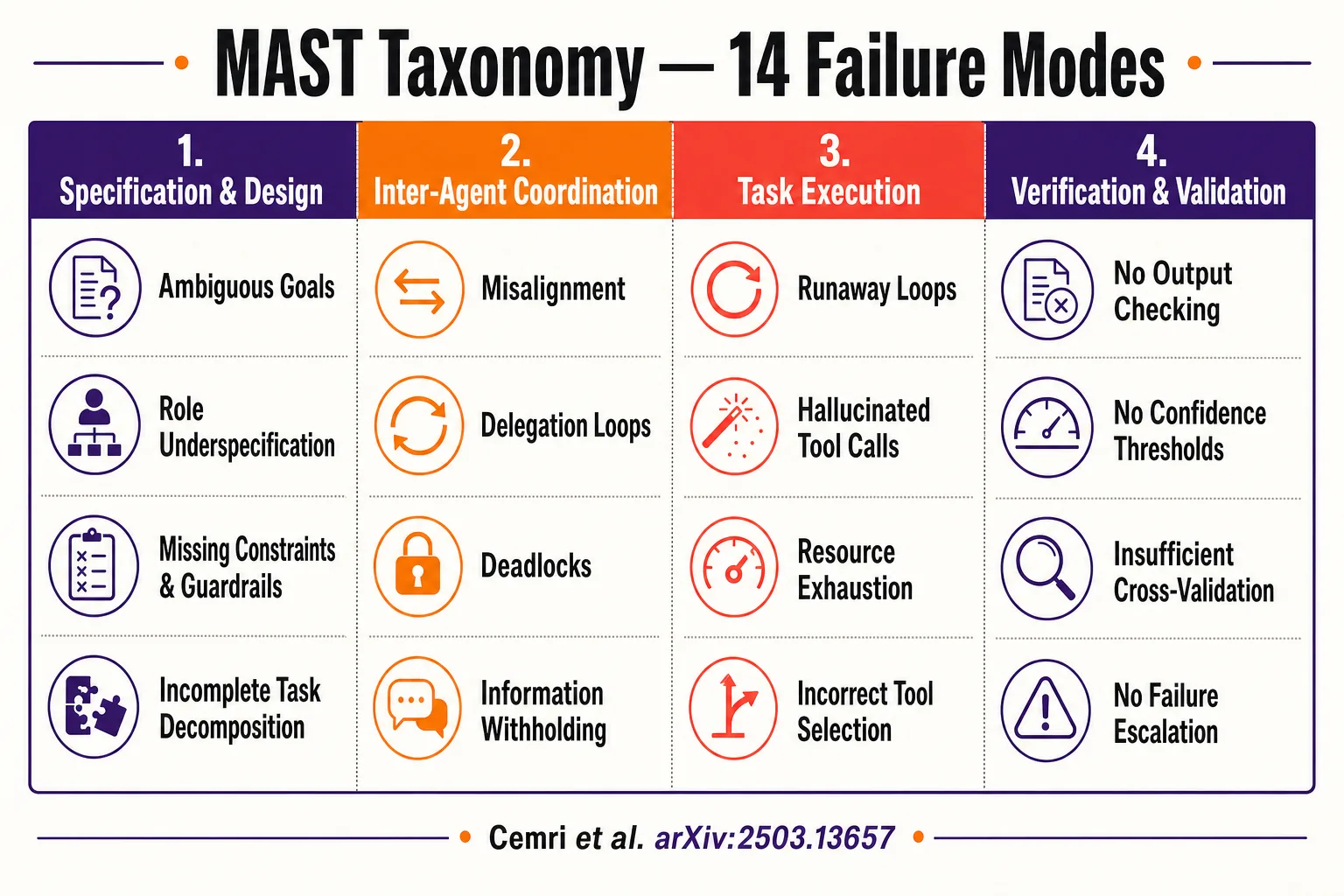
The MAST taxonomy from Cemri et al. breaks these into 4 top-level categories containing 14 specific failure modes. Here’s the full map:
1. Specification & Design Failures — Ambiguous goal definitions, missing constraints, underspecified agent roles, and flawed task decomposition. The system was broken before a single token was generated.
2. Inter-Agent Coordination Failures — Inter-agent misalignment, communication breakdowns, infinite delegation loops, and deadlocks. The MAST paper found that coordination failures account for the largest share of breakdowns in systems running 3+ agents. More agents, more chaos.
3. Task Execution Failures — Hallucinated tool calls, runaway loops, resource exhaustion, goal drift, and premature termination. These are the failures you actually see in your logs at 2 AM.
4. Verification & Validation Failures — No output checking, no confidence thresholds, no inter-agent review. Bad results pass through because nobody — human or machine — was asked to check.
The critical pattern: most multi-agent failures stem from coordination and verification gaps, not from individual LLM capability limits. GPT-4o is plenty smart. The problem is what happens when five instances of it try to work together without adult supervision.
The MAST taxonomy and its evaluation dataset are available as an open resource on GitHub (github.com/multi-agent-systems-failure-taxonomy/MAST).
Auto-GPT Failure Modes: Miscoordination, Runaway Loops & Cascading Errors
Auto-GPT, created by Toran Bruce Richards in 2023, uses recursive self-prompting: one agent spawns sub-agents, which spawn more sub-agents, each prompting itself to figure out the next step. No external orchestration layer. No human-in-the-loop by default. It’s an architecture designed to be impressive on a demo and catastrophic in production.

I’ve watched Auto-GPT instances burn through $40 in API credits accomplishing absolutely nothing. Here are the specific failure modes, mapped to the MAST taxonomy:
-
Runaway loops / infinite self-delegation — An agent spawns a sub-agent that spawns another sub-agent, recursively, with no termination condition. Maps to MAST: Task Execution Failures.
-
Goal drift from original objective — The system starts writing a blog post and ends up researching quantum computing. Three levels of delegation and nobody remembers the original ask. Maps to MAST: Specification & Design Failures.
-
Resource exhaustion / token burn without progress — Agents consume thousands of tokens per step, burning budget while circling the same reasoning loop. Maps to MAST: Task Execution Failures.
-
Miscoordination between spawned sub-agents — Sub-agents duplicate work, contradict each other, or pass incompatible outputs upstream. Maps to MAST: Inter-Agent Coordination Failures.
-
Hallucinated tool calls — Agents call APIs that don’t exist or pass parameters in the wrong format. Maps to MAST: Task Execution Failures.
-
No exit criteria — The system has no definition of “done.” It keeps running until it hits a token limit, crashes, or you kill the process. Maps to MAST: Specification & Design Failures.
ChaosGPT remains the cautionary tale here — an Auto-GPT instance given a deliberately provocative goal that demonstrated just how quickly uncontrolled agent autonomy drifts into incoherent and potentially dangerous territory.
Auto-GPT vs. Supervised Multi-Agent Frameworks
| Failure Mode | Auto-GPT | LangGraph | CrewAI |
|---|---|---|---|
| Runaway loops | No mitigation | Graph-based termination | Step limits configurable |
| Goal drift | No mitigation | State machine enforces scope | Role definitions constrain scope |
| Token burn | No budget controls | Configurable token limits | Per-agent budgets available |
| Sub-agent miscoordination | No orchestration | Explicit edge definitions | Sequential/hierarchical modes |
| Hallucinated tool calls | No validation | Tool schema validation | Tool schema validation |
| Missing exit criteria | No default | Required end nodes | Configurable termination |
Auto-GPT fails because it lacks three things: termination conditions, inter-agent verification, and token budgets. Supervised frameworks like LangGraph and CrewAI mitigate most of these but add complexity and latency. LLM-as-a-Judge evaluation — where one model scores another’s output — partially addresses verification failures, though it introduces its own cost and reliability tradeoffs.
This is exactly why we built our AI content agent on deterministic orchestration rather than pure LLM autonomy. The LLM does what it’s good at. Code handles everything else.
Cost Explosion: Why OpenAI API Pricing Makes Multi-Agent Systems Expensive in 2026
Cost is a failure mode. I don’t mean that metaphorically. A system that works correctly but costs $50 per run for a task worth $10 has failed. Multi-agent systems multiply token usage by N agents × M reasoning steps × context window size. A 5-agent system routinely burns 10–50× the tokens of a single-agent call.
OpenAI API Pricing as of 2026
| Model | Input (per 1K tokens) | Output (per 1K tokens) | Context Window |
|---|---|---|---|
| GPT-4o | $0.0025 | $0.0100 | 128K |
| GPT-4o-mini | $0.00015 | $0.0006 | 128K |
Pricing verified July 2026 against OpenAI’s published API rates.
Worked Cost Example
Formula: (N agents) × (M steps) × (avg tokens per step) × (price per token) = cost per run.
A 5-agent system processing a 10-step task, averaging 2,000 tokens per step (input + output combined) at GPT-4o rates: 5 × 10 × 2,000 = 100,000 tokens per run. At GPT-4o pricing, that’s about $0.48 per run at a typical 70/30 input-output split. Run it 100 times a day and the monthly bill gets ugly fast.
GPT-4o input pricing has halved since its mid-2024 launch ($5.00 → $2.50 per million tokens), but multi-agent architectures eat those savings by multiplying calls.
Cost Mitigation Strategies
- Model routing: Use GPT-4o-mini for simple sub-tasks (summarization, formatting) and GPT-4o only for complex reasoning steps.
- Response caching: Identical sub-queries shouldn’t hit the API twice.
- Per-agent token budgets: Hard caps prevent runaway agents from draining your account.
- Early termination on low-confidence outputs: If an agent’s confidence drops below a threshold, kill the branch instead of letting it spiral.
Unpredictable per-token costs are why transparent pricing matters. You shouldn’t need a spreadsheet and a prayer to estimate your monthly AI spend.
Single-Agent or Multi-Agent Systems: When Multi-Agent Is the Wrong Choice
Most tasks don’t need multiple agents. I realize that’s an unfashionable thing to say when every AI startup is selling “agent swarms,” but the MAST research backs it up: a single well-prompted agent outperforms a poorly orchestrated multi-agent system on standard benchmarks.
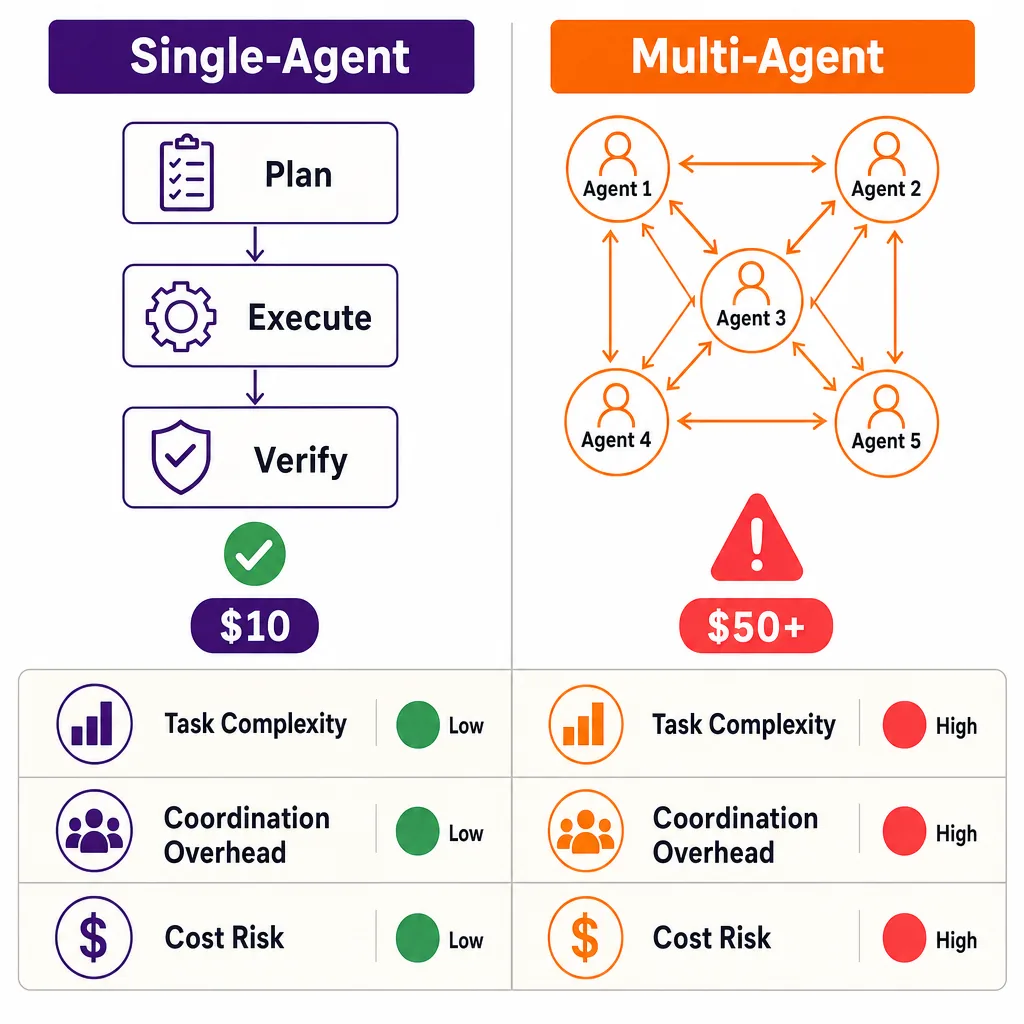
Multi-agent adds value only when tasks are genuinely decomposable, parallelizable, and require distinct tool access or expertise domains. If those three conditions aren’t met, you’re adding coordination overhead for zero gain.
Single-Agent vs. Multi-Agent
| Factor | Single-Agent | Multi-Agent |
|---|---|---|
| Latency | Low | High (sequential handoffs) |
| Cost | 1× baseline | 10–50× baseline |
| Coordination overhead | None | Significant |
| Error surface | Limited | Compounds with each agent |
| Best use case | Linear workflows, tight context | Parallel, decomposable tasks |
Single-agent wins for: linear workflows, tasks with tight context dependencies, low-budget applications, and anything where latency matters. Our autonomous SEO pipeline is a good example — it uses deterministic orchestration with targeted agent deployment rather than unconstrained multi-agent sprawl.
How to Prevent Multi-Agent LLM System Failures in 2026
Every multi-agent system I’ve built that actually works in production follows the same pattern: 90% of the logic is code, not prompts. Here’s the mitigation checklist I use:
- Define explicit termination conditions for every agent. No agent runs indefinitely. Period.
- Implement inter-agent verification. Use LLM-as-a-Judge or deterministic checks between handoffs. Don’t trust one model’s output without a second opinion.
- Set per-agent token budgets. Hard limits, not guidelines.
- Use model routing. Cheap models for simple tasks. Expensive models for reasoning.
- Add observability and tracing. LangChain’s agent observability framework (langchain.com) provides structured tracing for debugging agent chains. If you can’t see what your agents are doing, you can’t fix them.
- Prefer deterministic orchestration over pure LLM autonomy. Code should decide what happens next. The LLM should decide what to say.
One more thing: prompt injection is an emerging attack vector in multi-agent RAG systems. When agents pull context from external sources and pass it to other agents, a single poisoned document can compromise the entire chain. Research from agentsecurityaudit.com documents several attack patterns specific to RAG and knowledge systems architectures.
Conclusion: Build Systems That Fail Gracefully
Multi-agent LLM systems fail because of coordination gaps, missing verification, uncapped costs, and over-reliance on LLM autonomy. The fix is deterministic orchestration with targeted LLM use — not more agents.
- Define termination conditions and token budgets before writing a single prompt.
- Use multi-agent architecture only when tasks are genuinely decomposable and parallelizable.
- Treat cost as a failure mode: if you can’t predict the bill, the system isn’t production-ready.
Multi-agent systems don’t have to be fragile. At Botonomy, 90% of our logic is deterministic code — LLMs handle only what they’re good at. See how Botonomy AI marketing automation agents are built to fail gracefully, not expensively.
Sources & Further Reading
- Cemri et al., “MAST: Multi-Agent Systems Failure Taxonomy,” arXiv:2503.13657. Presented at NeurIPS 2025 and ICLR 2025.
- MAST GitHub Repository: github.com/multi-agent-systems-failure-taxonomy/MAST
- OpenAI API Pricing: openai.com/pricing/
- LangChain Agent Observability Documentation: langchain.com
- Agent Security Audit Research: agentsecurityaudit.com
Last updated: July 2026