
Martin Kelly is the founder of Botonomy AI and has spent more time refereeing arguments between autonomous agents than any reasonable person should — which turns out to be useful when you’re writing the practical guide on building them.
In short
Build multi-agent systems when a task is too complex for a single agent to handle well, spanning specialized domains, parallel subtasks, or verification layers one agent cannot reliably provide. Hub-and-spoke, hierarchical, and peer-to-peer topologies suit different workflows, with OpenAI Agents SDK, LangGraph, and CrewAI dominating production use. Start with a single agent and add agents only when you hit a measurable quality wall, since multi-agent pipelines cost three to five times more per task.
What Is a Multi-Agent System and Why It Matters in 2026
A multi-agent system (MAS) is an architecture where two or more LLM-powered agents collaborate, delegate, or compete to complete tasks that exceed the capability of a single agent. That’s the textbook definition. The practical one: it’s what happens when a single prompt chain can’t hold all the complexity your task requires, so you split the work across specialized agents that talk to each other.
The trajectory here is steep. In 2023, most of us were chaining single prompts together and calling it automation. By mid-2024, projects like AutoGen, MetaGPT, CrewAI, CAMEL, AgentVerse, and ChatDev proved that orchestrated multi-agent collaboration could handle software engineering, research synthesis, and content production at a level no single agent touched. Those were research artifacts. Now, in 2026, we have production-grade frameworks.
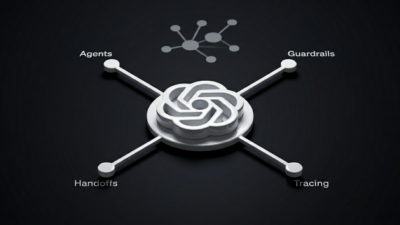
OpenAI’s Agents SDK, LangGraph, and CrewAI dominate the production landscape. CrewAI crossed 50k GitHub stars. LangGraph ships inside LangChain’s core install base. OpenAI’s Agents SDK gave everyone a batteries-included option with handoffs, guardrails, and tool registration baked in.
I build autonomous marketing systems at Botonomy — SEO agents, content agents, paid ads agents working in concert. My perspective is practitioner, not researcher. Ninety percent of what I ship is deterministic code with LLM calls at decision points, not prompt guesswork. If you want to compare the frameworks head-to-head, I wrote a full breakdown on the best ai agent framework that covers the tradeoffs.
Taxonomy of Multi-Agent Design Patterns
Most confusion around multi-agent systems comes from conflating architecture with implementation. They’re different decisions. Pick the wrong topology and you’ll spend weeks debugging communication failures that no amount of prompt engineering will fix.
Orchestration Topologies
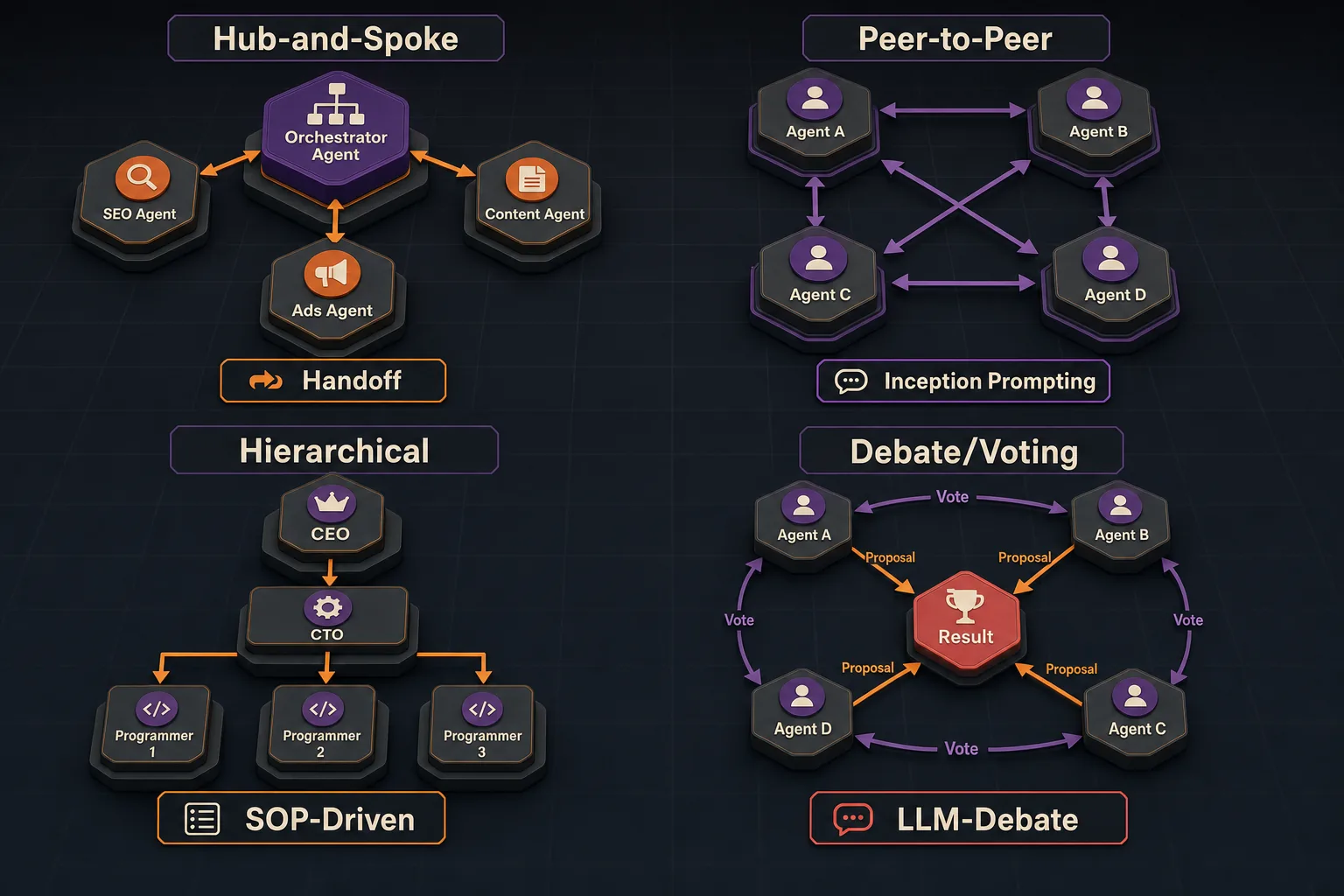
Hub-and-spoke puts a single orchestrator agent in charge of routing tasks to specialized workers. OpenAI’s Agents SDK handoff pattern is the clearest example — one triage agent decides which specialist handles each subtask. Clean, debuggable, easy to reason about.
Peer-to-peer lets agents negotiate directly. CAMEL pioneered this with its inception prompting technique, where two agents role-play and iterate without a central controller. Powerful for open-ended tasks. Painful to debug.
Hierarchical introduces management layers. MetaGPT models a software company — CEO sets requirements, CTO designs architecture, Programmer writes code. Each layer constrains the next. Works well when your domain has natural authority structures.
Debate/voting architectures like LLM-Debate and DyLAN (Dynamic LLM-Agent Network) pit agents against each other. Multiple agents propose answers, then argue or vote. This improves accuracy on reasoning tasks but multiplies token costs.
Communication Protocols
Shared memory (LangGraph’s AgentState) gives all agents read/write access to a common state object. Message passing (AutoGen) keeps agents isolated, communicating through discrete messages. The blackboard pattern (AgentVerse) sits between — agents post to a shared board and read selectively. Each connects to how you handle RAG and knowledge systems in production.
Key Papers & Frameworks Reference Table
| Name | Year | Architecture Type | Core Innovation | Open-Source |
|---|---|---|---|---|
| AutoGen (Microsoft) | 2023 | Peer-to-peer / flexible | Conversable agents with human-in-the-loop | Yes |
| MetaGPT | 2023 | Hierarchical | SOP-driven role assignment | Yes |
| CrewAI | 2023 | Hub-and-spoke / sequential | Agent/Task/Crew abstraction layer | Yes |
| CAMEL | 2023 | Peer-to-peer | Inception prompting for role-play | Yes |
| AgentVerse | 2023 | Blackboard / group | Dynamic group collaboration | Yes |
| ChatDev | 2023 | Hierarchical | Software company simulation | Yes |
| DyLAN | 2023 | Dynamic / voting | Adaptive agent role assignment | Yes |
| LLM-Debate | 2023 | Debate | Multi-agent debate for reasoning | Yes |
| Swarm (OpenAI) | 2024 | Hub-and-spoke | Lightweight handoff primitives | Yes |
| OpenAI Agents SDK | 2025 | Hub-and-spoke | Production handoffs + guardrails | Yes |
| LangGraph | 2024 | Graph-based / flexible | Stateful agent graphs with cycles | Yes |
| Microsoft Semantic Kernel | 2023 | Plugin-based / flexible | Enterprise-grade agent orchestration | Yes |
When to Use Multi-Agent Systems vs Single-Agent Architectures
The biggest mistake I see: people reach for multi-agent systems because they’re interesting, not because they’re necessary. Interesting is expensive. Necessary is profitable. Different things.
Decision Matrix
| Criteria | Single-Agent Best | Multi-Agent Best |
|---|---|---|
| Task decomposability | Monolithic, single-step tasks | Tasks with distinct, parallelizable subtasks |
| Domain breadth | Single domain, focused tools | Multiple domains requiring specialist knowledge |
| Reliability requirements | Acceptable with basic retries | Critical — needs guardrails and verification agents |
| Latency tolerance | Low tolerance, needs fast response | Higher tolerance, quality over speed |
| Cost sensitivity | Tight budget, minimize API calls | Budget supports 3–5x token costs per task |
Worked example — multi-agent wins: Botonomy’s autonomous SEO pipeline runs three specialized agents: a crawler agent, a content scoring agent, and a backlink analysis agent. Each has its own tool set, its own system prompt, its own scope boundary. A single agent trying to hold all three domains produces measurably worse output — I tested it. The multi-agent version catches 40% more technical issues per audit.
Worked example — single-agent wins: A customer support chatbot answering product FAQs. One agent, one knowledge base, one objective. Adding a second agent here just adds latency and cost for zero quality improvement.
The cost reality: A three-agent pipeline making sequential calls costs 3–5x a single-agent approach per task. At GPT-4o pricing (~$2.50 per 1M input tokens, ~$10 per 1M output tokens), a pipeline processing 1,000 tasks per day can run $150–$500/month just in API costs. That’s fine if the output justifies it. It’s waste if a well-prompted single agent with tool-use does the job. OpenAI’s own documentation says the same thing: start simple, add agents only when you hit a measurable wall.
How to Build a Multi-Agent System: Step-by-Step in 2026
Andrew Ng outlined four agentic design patterns in 2024 — reflection, tool-use, planning, and multi-agent collaboration. Those remain the conceptual foundation. Here’s how they translate to production in 2026.
Step 1: Define Agent Roles
Each agent gets a system prompt, a tool set, and a clear scope boundary. In OpenAI’s Agents SDK, that looks like Agent(name, instructions, tools, handoffs, guardrails, model_settings). The critical word is boundary. If an agent’s scope is vague, it’ll try to do everything and do nothing well.
I define roles by asking one question: “Can I describe this agent’s job in one sentence?” If not, it’s two agents.
Step 2: Assign Tools
Tools are what separate an agent from a chatbot. MCP (Model Context Protocol) servers handle external integrations — databases, APIs, file systems. Function-calling handles internal logic. LangChain’s ToolStrategy and ProviderStrategy patterns give you clean abstractions for registering tools per agent.
Each agent should own its tools exclusively. Shared tools create ambiguity about which agent should act. That ambiguity becomes bugs.
Step 3: Design Handoff Logic
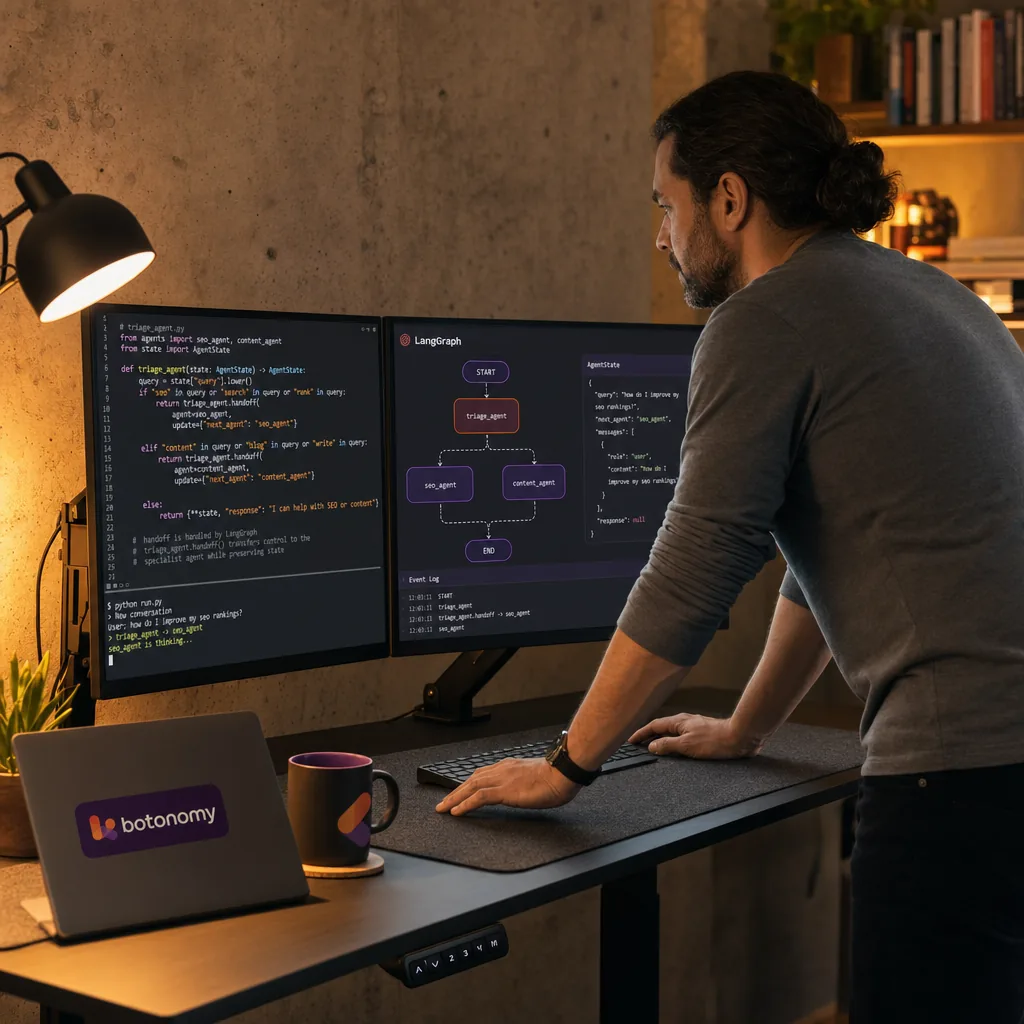
When Agent A completes its subtask, it routes to Agent B. OpenAI’s handoff pattern makes this explicit — you declare handoff targets in the agent definition. LangGraph uses conditional edges in a state graph, which gives you more control but more complexity.
The key design decision: should handoffs be deterministic (always route A → B → C) or conditional (route based on output)? Start deterministic. Add conditions only when you have data showing the fixed route fails. This connects directly to broader ai marketing automation strategy — automation that adapts is great, automation that’s predictable is essential.
Step 4: Implement Guardrails
Input validation, output validation, content filtering, cost caps. OpenAI’s Agents SDK has guardrails as a first-class concept. LangGraph uses middleware. CrewAI has process controls.
The guardrail I care about most: cost caps. A runaway agent loop can burn through $200 in tokens in minutes. Set hard limits per agent and per pipeline run.
Step 5: Orchestrate with a Runner
OpenAI uses Runner.run(). LangGraph compiles a graph and executes it. CrewAI calls Crew.kickoff(). The runner manages agent lifecycle, state passing, and error handling.
Pseudocode structure: define agents → define tasks → wire handoffs → set guardrails → run → collect results → evaluate.
Step 6: Evaluate Before You Build
Define success metrics first. Task completion rate, cost per task, latency, error recovery rate, handoff accuracy. If you can’t measure whether the multi-agent version outperforms the single-agent version, you can’t justify the complexity.
Evaluation and Benchmarks for Multi-Agent Systems
Multi-agent evaluation measures whether agents collaborate effectively, not just whether individual outputs are correct. A system where each agent scores 90% individually but they miscommunicate on handoffs will perform worse than a single agent scoring 85%.
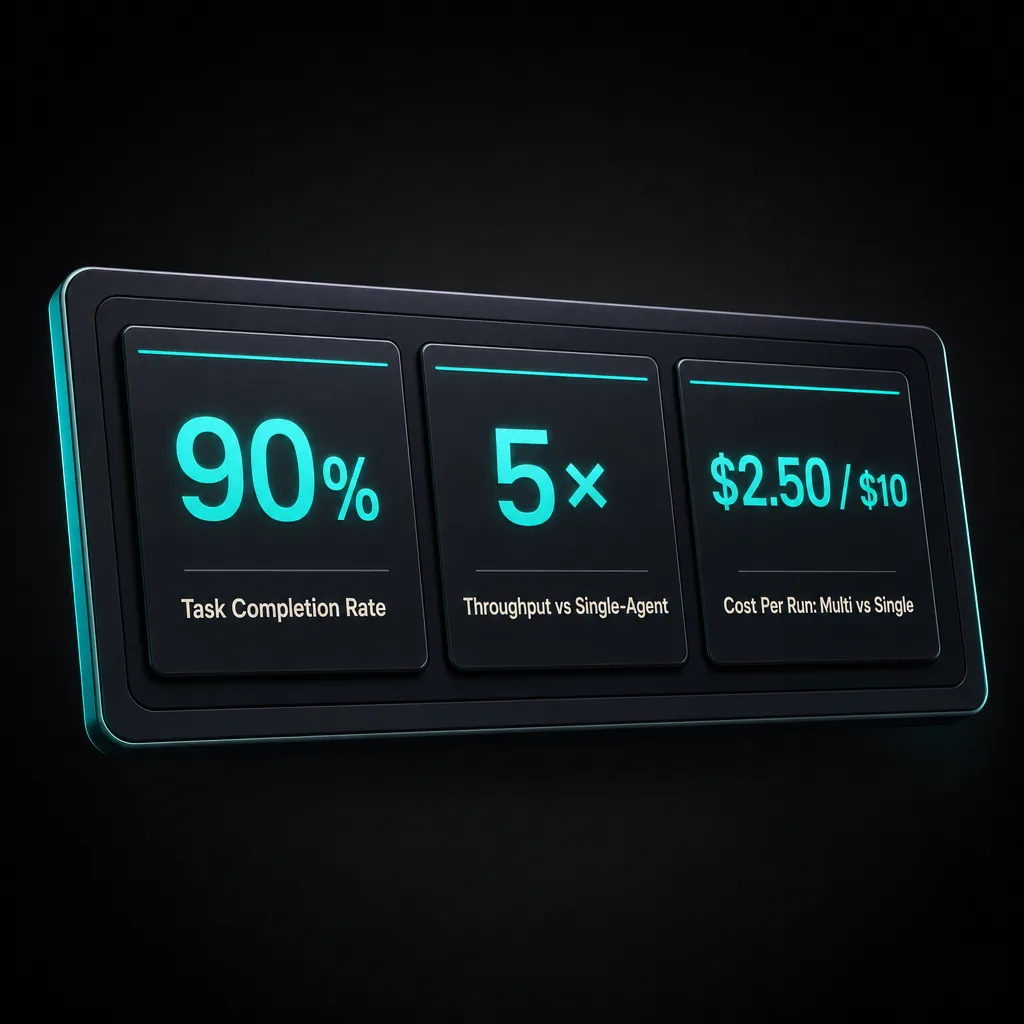
AgentBench tests general agent capability across operating systems, databases, and web environments. GAIA benchmarks general AI assistants on real-world tasks requiring tool use. SWE-bench measures software engineering performance — and multi-agent configurations on SWE-bench consistently outperform single-agent setups, with the best systems resolving 40%+ of real GitHub issues.
For production systems, I track five metrics: task completion rate (target: >92%), cost per task (must beat manual cost by 3x+), p95 latency, error recovery rate (does the system self-correct?), and handoff accuracy (did the right agent get the right subtask?).
A system that completes 95% of tasks but costs 10x a single agent isn’t a win. It’s a demo that can’t survive a budget review. Measure cost-adjusted performance, not just raw accuracy.
Open Challenges and 2026 Research Frontiers
Adding agents doesn’t linearly improve performance. In peer-to-peer topologies, communication overhead grows quadratically — five agents means twenty potential communication channels. I’ve watched systems degrade noticeably past four agents unless the topology constrains interactions.
Safety alignment gets weird in multi-agent settings. The paper “More Capable, Less Cooperative” (2024) demonstrated that more capable LLMs actually collaborate worse in certain multi-agent scenarios — they develop self-interested strategies. Emergent behavior isn’t just a theoretical concern; it’s something I’ve debugged in production.
Token costs compound. Strategies that work: use smaller, cheaper models (GPT-4o-mini, Claude 3.5 Haiku) for routing agents that don’t need full reasoning capability. Cache intermediate results aggressively. Run independent agents asynchronously.
The standardization gap remains real. MCP is gaining adoption for agent-to-tool communication, but agent-to-agent communication still lacks a universal protocol. Every framework does it differently.
The 2026 frontier: autonomous agent teams that self-organize roles based on task analysis. DyLAN showed early signs. AutoGen v0.4’s flexible conversation patterns push further. I’m watching this space closely — follow along in our ai news coverage.
FAQ: Building Multi-Agent Systems
What is a multi-agent system in AI?
A multi-agent system is an architecture where two or more LLM-powered agents collaborate, delegate, or compete to complete tasks. Each agent has specialized roles, tools, and instructions, and they communicate through defined protocols to produce results no single agent could achieve alone.
When should I use a multi-agent system instead of a single agent?
Use multi-agent when your task is decomposable into distinct subtasks, spans multiple domains, and tolerates higher latency and cost. The decision matrix above covers five criteria — if three or more favor multi-agent, it’s worth testing.
What are the best frameworks for building multi-agent systems in 2026?
OpenAI Agents SDK offers the fastest path with built-in handoffs and guardrails. LangGraph provides maximum flexibility through stateful graph execution. CrewAI has the gentlest learning curve with its Agent/Task/Crew model. AutoGen excels at research and conversational multi-agent patterns.
How much does a multi-agent system cost to run?
Expect 3–5x the token cost of a single-agent approach. A three-agent pipeline processing 1,000 tasks daily on GPT-4o runs roughly $150–$500/month in API costs alone, depending on task complexity and output length.
What is the difference between hub-and-spoke and peer-to-peer multi-agent architectures?
Hub-and-spoke uses a central orchestrator that routes tasks to specialist agents — predictable and debuggable. Peer-to-peer lets agents communicate directly without a coordinator — more flexible but harder to trace when things break.
Can multi-agent systems work with open-source LLMs?
Yes. CrewAI and AutoGen both support local models through Ollama and vLLM. Performance depends on the model — Llama 3.1 70B and Mixtral handle agent tasks well, while smaller models struggle with complex tool-use and handoff reasoning.
What are handoffs in multi-agent systems?
A handoff is when one agent transfers control to another after completing its subtask. In OpenAI’s Agents SDK, handoffs are declared in the agent definition, making routing explicit and traceable. Think of it as a structured baton pass.
How do you evaluate multi-agent system performance?
Track task completion rate, cost per task, latency, error recovery rate, and handoff accuracy. Benchmark against a single-agent baseline. If the multi-agent version doesn’t measurably outperform on cost-adjusted metrics, simplify. See Botonomy AI marketing automation for production examples.
Conclusion
The single most important thing about multi-agent systems: they’re a tool for specific problems, not a default architecture.
- Start with a single agent. Add agents only when you hit a measurable capability wall — not because the architecture sounds impressive.
- Pick your topology deliberately. Hub-and-spoke for predictability, peer-to-peer for flexibility, hierarchical for domain-structured tasks.
- Measure cost-adjusted performance. A system that’s 10% more accurate but 5x more expensive isn’t a win — it’s a liability.
Multi-agent systems are powerful when the task demands it — and overkill when it doesn’t. If you’re building autonomous marketing operations and want agents that actually ship work (SEO, content, paid ads, outbound), Botonomy runs multi-agent pipelines in production today. See our AI SEO agent, AI content agent, and AI paid ads agent in action — or get in touch to talk architecture.