
Martin Kelly is the founder of Botonomy AI and has spent 16 years automating marketing systems — the last two specifically figuring out where agentic AI earns its keep and where it’s just a chatbot with ambitions.
In short
Agentic AI differs from traditional automation in that it autonomously sets goals, plans multi-step actions, and adjusts when results fall short, while traditional automation simply executes predefined rules and stops when something unexpected arrives. Unlike generative AI, which only produces outputs when prompted, agentic systems use reasoning to decide what to do, act on it, and self-correct. In practice, agents handle judgment calls while reliable automation handles everything that does not require judgment.
What Is Agentic AI? Autonomous Agents Defined
Most people using the term “agentic AI” in 2026 can’t define it. They’ve heard the buzzword, bolted it onto a pitch deck, and moved on. So here’s a definition worth pinning down:
Agentic AI refers to AI systems that autonomously perceive their environment, reason over goals, plan multi-step actions, and execute decisions with minimal human intervention — distinguishing them from both generative AI (which produces outputs on prompt but doesn’t act) and traditional automation (which follows rigid, pre-coded rules).
That distinction matters because the three categories get conflated constantly. ChatGPT generates text when you ask it to. A Zapier workflow fires when a trigger condition is met. An agentic AI system decides what to do, how to do it, and whether it worked — then adjusts.
Key distinction: Generative AI produces outputs on demand, traditional automation executes predefined rules, and agentic AI autonomously plans and pursues goals using both as tools.
As of 2026, enterprises increasingly deploy agentic AI for supply chain optimization, autonomous customer service, and code generation workflows. IBM defines agentic AI as “AI that can autonomously plan and take actions to achieve user-defined goals”, while Google Cloud frames it as systems capable of “reasoning, planning, and acting with a degree of independence.” The convergence in definitions is telling — the industry agrees on what this is, even if marketing departments keep mangling the message.
| Attribute | Agentic AI | Traditional Automation | Generative AI |
|---|---|---|---|
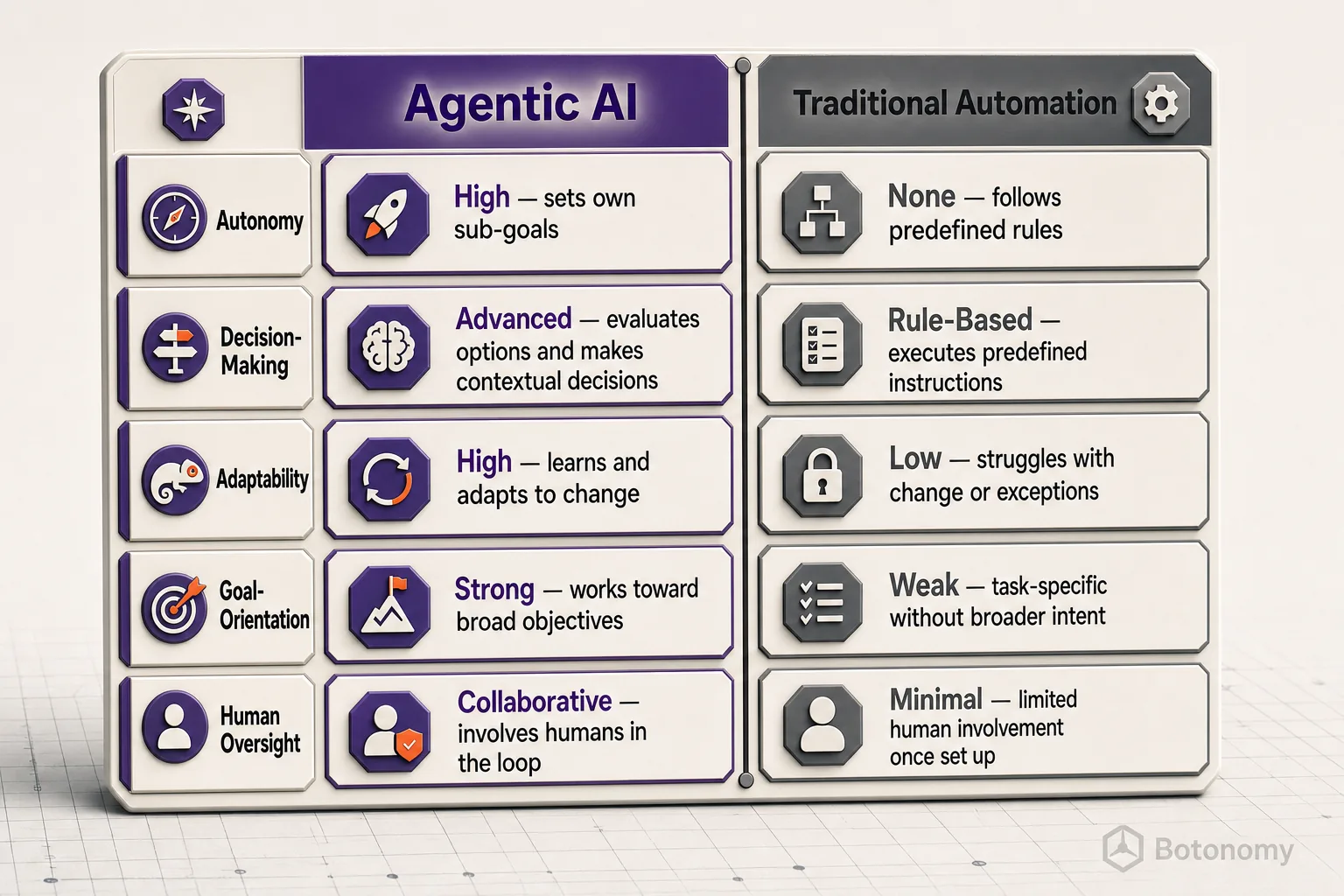
| Autonomy level | High — sets own sub-goals | None — follows predefined rules | Low — responds to prompts |
| Decision-making | Reasoning over context and goals | If-then conditional logic | Pattern completion from training data |
| Adaptability | Replans dynamically on new inputs | Breaks on unexpected inputs | Adapts tone/style, not actions |
| Goal-orientation | Pursues multi-step objectives | Executes single-step tasks | Produces requested output only |
| Human oversight | Supervisor reviews outcomes | Operator maintains every rule | User crafts every prompt |
| Example tools | LangChain, AutoGen, CrewAI, OpenAI Assistants API | Make.com, Zapier, UiPath | ChatGPT, Claude, Midjourney |
For a deeper comparison of the frameworks in that last row, see our breakdown of the best ai agent framework.
Core Capabilities of Autonomous AI Agents
1. Goal decomposition and planning. An agentic system takes a high-level objective — “increase organic traffic to this product category by 30%” — and breaks it into subtasks: audit existing pages, identify keyword gaps, generate content briefs, produce drafts, schedule publication. The planning layer typically uses LLM reasoning combined with structured task graphs.
2. Tool use and API orchestration. Agents don’t just think. They act. That means calling APIs, querying databases, triggering webhooks, and using external tools. An agent might pull data from Google Search Console, run it through a scoring model, then push optimization tasks to a CMS — all without a human clicking anything.
3. Memory and context persistence. Unlike a single ChatGPT prompt that starts fresh each time, agentic systems maintain memory across interactions. They remember what they tried, what failed, and what the user’s preferences are. This is the difference between a conversation and a workflow.
4. Self-evaluation and error correction. The ReAct (Reasoning + Acting) framework, now standard in most agent architectures, builds reflection into the loop. The agent evaluates its own output, checks it against success criteria, and retries or escalates when something looks wrong. This is where reinforcement learning signals come in — the agent gets better at knowing when it screwed up.
5. Multi-agent collaboration. Frameworks like CrewAI and AutoGen allow multiple specialized agents to work together: one researches, one writes, one reviews, one publishes. Each agent has a defined role and communicates results to the next. It’s delegation, not monologue.
How Agentic AI Agents Work — Step by Step
- Perceive. The agent ingests data from its environment — user input, API responses, database queries, sensor readings.
- Reason. It applies an LLM or reasoning engine to interpret the data against its current goal.
- Plan. It generates a sequence of actions, breaking the goal into executable subtasks.
- Act. It executes the plan — calling tools, writing outputs, triggering external systems.
- Reflect. It evaluates the results of its actions against expected outcomes.
- Iterate. If results fall short, it revises the plan and re-enters the loop.
Traditional Automation: What It Does Well (and Where It Stops)
A Zapier workflow that sends a Slack notification when a form is submitted will run flawlessly for years. That’s the strength of traditional automation: reliability, predictability, auditability, and low cost per execution for repetitive tasks.
Rule-based automation — RPA bots, cron jobs, email drip sequences, Make.com scenarios — thrives when the logic is known and the inputs are predictable. Gartner’s 2026 data shows RPA adoption still growing at 15% year-over-year in enterprise environments, precisely because it works for the boring stuff.
The ceiling appears the moment something unexpected arrives. A support ticket that doesn’t match any keyword filter. A lead form with a question in the company-name field. A product return request that requires checking three systems and making a judgment call.
Here’s the concrete version: a traditional automation workflow routes support tickets by keyword — “refund” goes to billing, “bug” goes to engineering. An agentic system reads the full ticket, checks the customer’s order history, identifies the likely issue, drafts a resolution, and escalates only if its confidence score drops below a threshold. One follows rules. The other pursues a goal.
5 Key Differences Between Agentic AI and Traditional Automation
1. Decision-making: rules vs. reasoning. Traditional automation evaluates conditions: if X, then Y. Agentic AI reasons about why and how. A rule-based email sequence sends a follow-up on day 3. An agentic system checks engagement signals and decides whether day 2 or day 5 produces better results — then tests its hypothesis.
2. Adaptability: static workflows vs. dynamic replanning. When a Google algorithm update tanks a page’s rankings, a Zapier workflow keeps publishing on the old schedule. An AI SEO agent detects the drop, re-crawls the affected pages, re-prioritizes fixes, and adjusts the content calendar. According to Andrew Ng’s framing of agentic workflows at Stanford in 2024, this capacity for iterative replanning is what separates agents from tools — the agent reflects on intermediate results and changes course.
3. Scope of action: single-task vs. multi-step goal pursuit. Traditional automation handles one task per trigger. Agentic AI pursues an outcome across many steps. The difference between “post this to social media” and “grow this account’s engagement rate by 20% over 90 days, adjusting strategy weekly.”
4. Error handling: fail-stop vs. self-correction. When a traditional workflow encounters an unexpected input, it stops or routes to a human. An agentic system evaluates the error, attempts an alternative approach, and only escalates when it runs out of options. Yann LeCun has drawn a clear line between reactive systems and those capable of planning under uncertainty — agentic AI sits firmly in the latter camp.
5. Human role: operator vs. supervisor. With traditional automation, humans build and maintain every rule. With agentic AI, humans set objectives and review outcomes. The role shifts from “configure the machine” to “manage the machine’s judgment.”
Worth noting: 90% of Botonomy’s logic is deterministic code, not prompts. Agentic AI works best as a layer on top of reliable automation — not a replacement for it. The agents handle judgment; the code handles everything that doesn’t need judgment.
How Agentic AI Differs From Generative AI
I keep seeing “agentic AI” and “generative AI” used interchangeably. They’re not the same thing, and the confusion costs people real money when they buy the wrong solution.
Generative AI produces content on demand. You prompt ChatGPT, it writes. You prompt Midjourney, it draws. The output exists because you asked for it, and the model does nothing else until you ask again.
Agentic AI uses generative models as one tool inside an autonomous loop. The analogy: generative AI is the engine. Agentic AI is the self-driving car that decides where to go, when to accelerate, and when to pull over. Our AI content agent demonstrates this directly — it uses generative models to draft content, but the agent layer handles research, brief creation, optimization, and publishing decisions autonomously.
A common PAA question: What are the 4 types of AI? The standard taxonomy is reactive machines, limited memory, theory of mind, and self-aware AI. Agentic AI isn’t a fifth type — it’s an architectural pattern that currently operates at the limited-memory level, using persistent context and tool access to simulate planning capabilities. The taxonomy describes cognitive capacity. “Agentic” describes behavior.
How Employees Should Think About an AI Agent-Enhanced Workplace
How should employees think about an AI agent-enhanced workplace? Start by dropping the replacement framing. The World Economic Forum’s 2026 Future of Jobs Report estimates that 60% of workers will need reskilling by 2030 — but the shift is toward augmentation, not elimination. The jobs change shape. They don’t disappear.
Three concrete role shifts I’ve seen play out:
1. SEO specialist → agent supervisor. Instead of manually running site audits and fixing meta tags, the specialist reviews autonomous audit outputs, validates recommendations, and handles the strategic decisions an agent can’t make — like whether to consolidate three underperforming pages or rewrite them.
2. Paid media buyer → strategist. The buyer stops adjusting bids at 2am and starts setting ROAS targets and guardrails for an AI paid ads agent that handles execution, budget allocation, and creative rotation autonomously.
3. Content writer → editor. The writer reviews and refines agent-generated drafts instead of producing first drafts from scratch. The creative judgment stays human. The keyboard work shrinks.
This is exactly what Botonomy’s full-stack delivery model looks like in practice — SEO, content, paid ads, outbound, all automated end-to-end. The humans focus on strategy and exceptions. The agents handle volume.
Real-World Use Cases: Agentic AI in 2026
1. Autonomous SEO pipelines. A traditional automation might schedule a weekly crawl report. An autonomous SEO pipeline crawls the site, audits technical and content issues, prioritizes fixes by traffic impact, generates optimized content, and publishes — all without a human touching a spreadsheet. The agentic layer adds judgment about which fixes matter most.

2. Customer service resolution. Forrester’s 2026 data shows organizations deploying agentic customer service systems resolve 70%+ of tickets end-to-end without human intervention. Traditional chatbots matched keywords and routed to agents. These systems read intent, check account history, execute refunds or exchanges, and escalate only the genuinely complex cases.
3. Supply chain reordering. Agentic systems monitor demand forecasting models, query supplier APIs for lead times and pricing, and place restock orders autonomously. Traditional automation could send a reorder alert at a fixed threshold. The agent adjusts the threshold based on seasonal patterns, supplier reliability scores, and margin targets.
4. Multi-agent marketing coordination. One agent handles content creation. Another manages distribution across channels. A third monitors performance and feeds insights back to the first. The coordination between agents — deciding to double down on a performing channel or pause a failing campaign — is the part traditional automation simply cannot do.
FAQ: Agentic AI vs Traditional Automation
What is the difference between AI agent and traditional automation?
An AI agent autonomously perceives its environment, reasons about goals, plans actions, and self-corrects based on outcomes. Traditional automation follows pre-coded rules — if a condition is met, an action fires. The agent adapts; the automation doesn’t. When unexpected inputs arrive, automation breaks. An agent replans.
What is the primary function that distinguishes agentic AI from traditional automation tools?
Goal-directed autonomous decision-making. The agent decides how to achieve an objective, evaluates progress, and adjusts its approach. Traditional automation only checks whether a condition is met and fires a predetermined response.
What are the 4 types of AI?
Reactive machines respond to current inputs with no memory (e.g., Deep Blue). Limited memory systems learn from recent data to inform decisions (most current AI). Theory of mind AI would understand human emotions and beliefs — it doesn’t exist yet. Self-aware AI would have consciousness — purely theoretical. Agentic AI is an architectural pattern, not a fifth category; it currently operates at the limited-memory level.
How does agentic AI differ from traditional automation in Udacity?
Udacity’s AI curriculum positions agentic AI as systems that plan and act autonomously toward goals, using tools and memory to adapt over time. Traditional automation, in their framing, executes pre-defined workflows triggered by fixed conditions. The distinction aligns with the broader industry consensus: agents reason and adapt, automation follows scripts.
The Bottom Line: When to Use Each — and When to Combine Them
The single most important insight: agentic AI doesn’t replace traditional automation. It sits on top of it.
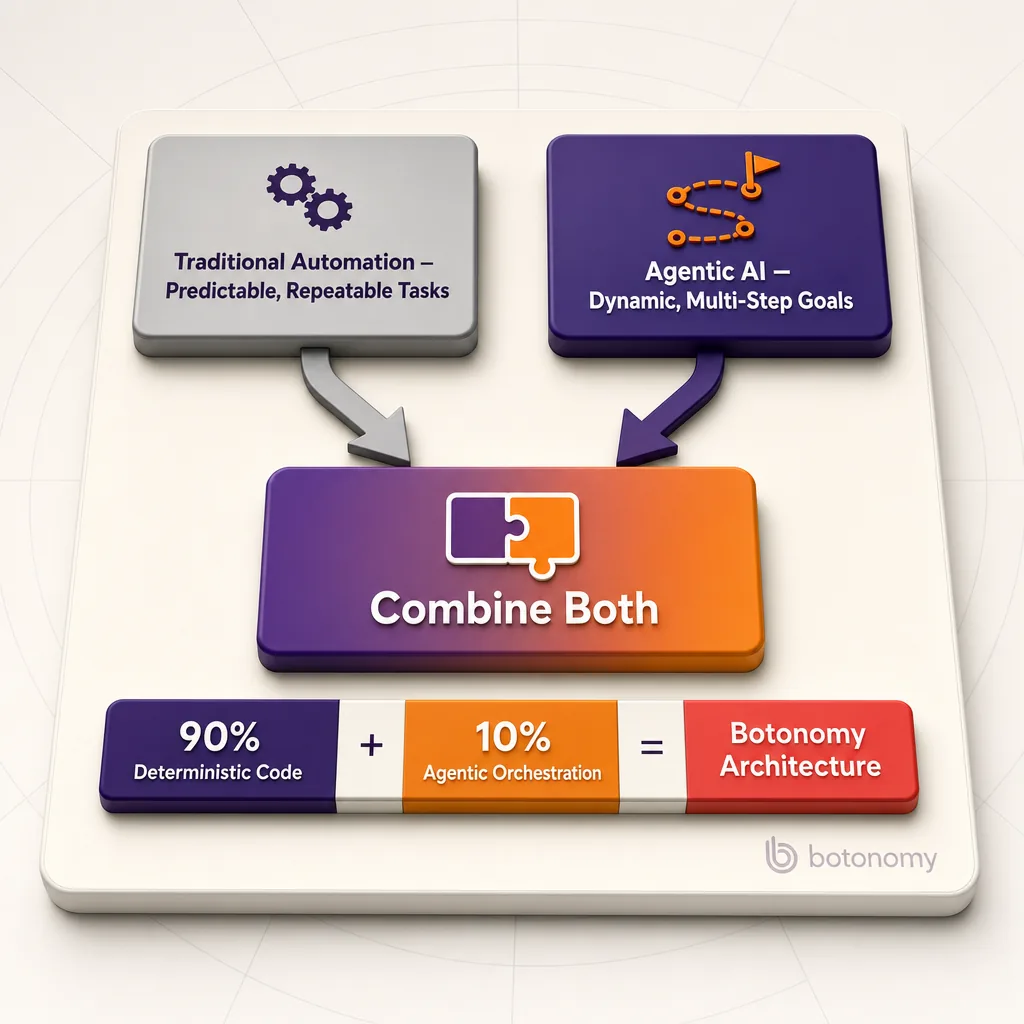
- Use traditional automation for high-volume, low-variance tasks where predictability matters — data syncs, notification triggers, scheduled reports.
- Use agentic AI when the task requires judgment, adaptation, or multi-step planning — campaign optimization, content strategy, complex customer interactions.
- Combine them for the best results: deterministic code handles the reliable plumbing, and agentic layers handle the decisions. That’s how we built Botonomy — 90% deterministic code, not prompts.
See how Botonomy AI marketing automation runs SEO, content, paid ads, and outbound end-to-end — with zero headcount required. Explore our agents or get in touch to see what autonomous marketing actually looks like.