
Martin Kelly is the founder of Botonomy AI and someone who’s spent enough years building AI systems to know which predictions age like wine and which age like milk left on a radiator.
In short
The future of AI points toward a world where autonomous systems handle scientific research, supply chains, and end-to-end business workflows, with global AI spending projected to reach 2.5 trillion dollars in 2026. Jobs defined by checklists face real displacement, while roles requiring judgment and trust are more durable. The greatest gains come from human-AI collaboration, where AI handles volume and humans handle variance.
Current State of AI in 2026: Setting the Foundation
According to Gartner, worldwide AI spending was forecast to total nearly $1.5 trillion in 2025, with projections for 2026 putting that figure closer to $2.5 trillion. Those aren’t speculative numbers from a conference keynote. That’s capital deployed — servers racked, engineers hired, contracts signed.
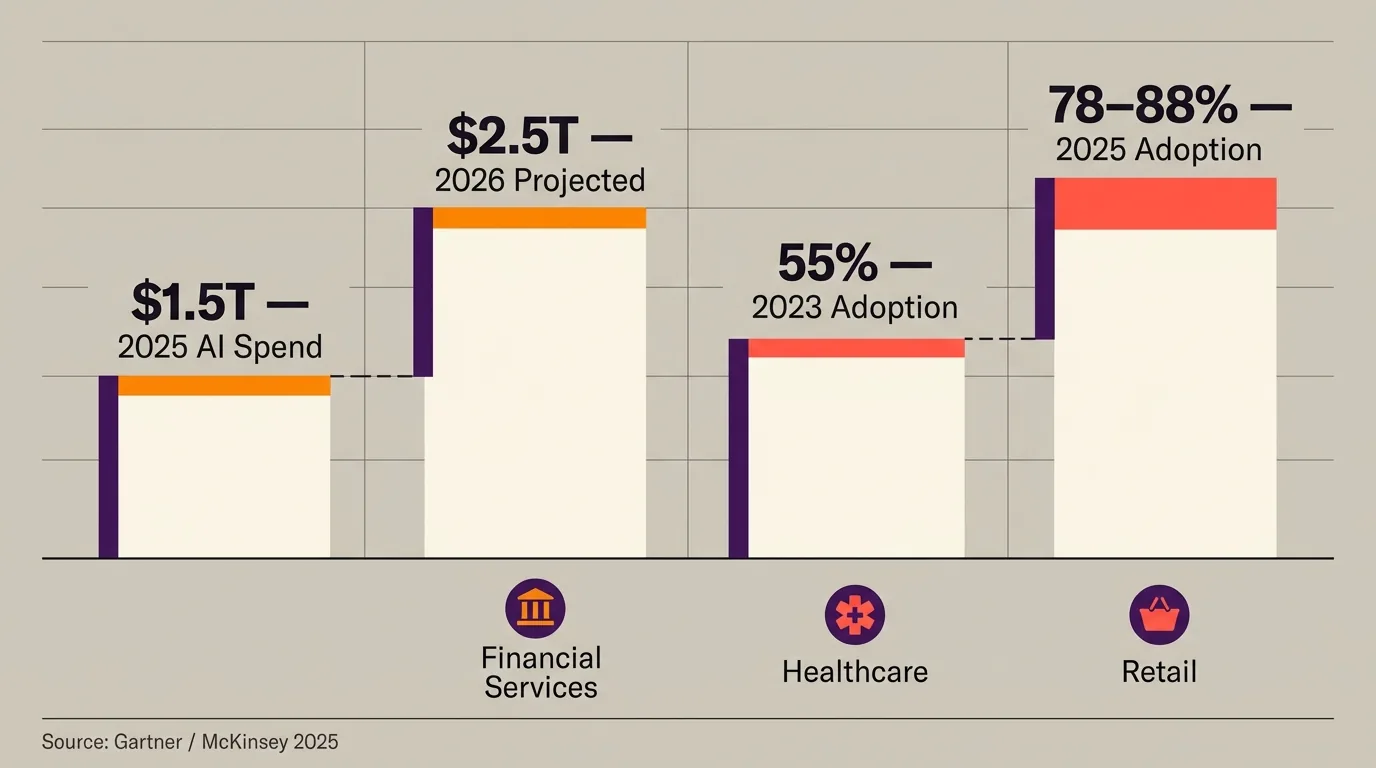
The adoption curve is no longer a curve. It’s a wall. McKinsey’s 2025 State of AI report found that a large majority of organizations — surveys suggest somewhere between 78% and 88% — now use AI in at least one business function, up from 55% in 2023. Financial services, healthcare, and retail lead adoption. Construction and agriculture trail, though both saw double-digit year-over-year growth.
What AI does well in 2026: pattern recognition at scale, language generation, image synthesis, code completion, and structured data analysis. What it still does poorly: genuine reasoning across novel domains, maintaining factual accuracy without retrieval systems, and anything requiring physical dexterity outside controlled environments.
The gap between what AI demos show and what AI deployments deliver remains wide. I’ve built enough AI content marketing systems to know the difference between a slick product video and a production pipeline that runs without catching fire at 2 AM. The technology works. The implementation is where most organizations bleed time and money.
Investment is concentrated geographically — a detail most “future of AI” articles skip entirely. That concentration shapes what gets built and for whom.
AI Future Predictions: The Next 5-10 Years
Researchers and analysts have pointed to several inflection points likely between now and 2035: autonomous scientific research agents, real-time multilingual communication without perceptible latency, and AI systems that can reliably explain their own reasoning chains.
That last one matters more than it sounds. Right now, most large language models produce outputs without transparent reasoning. They generate plausible answers, not provably correct ones. Yoshua Bengio, Turing Award recipient and professor at Université de Montréal, has argued repeatedly that interpretability isn’t a nice-to-have — it’s a prerequisite for deploying AI in domains where errors kill people.
Between 2026 and 2030, expect AI to become genuinely useful in drug discovery, not just faster at screening compounds. DeepMind’s AlphaFold achieved a major breakthrough in protein structure prediction, predicting structures with accuracy competitive with experimental methods in most cases. The next step — predicting protein interactions and designing novel molecules — is underway.
Manufacturing will see sharp productivity gains. The World Economic Forum projects that AI could increase labor productivity in developed countries by up to 40% by 2035, with some advanced economies projected to see substantial growth. That’s not robots replacing assembly lines — that’s already happened. It’s AI optimizing supply chains, predicting equipment failures before they occur, and adjusting production in real time.
For marketing and SEO specifically, the shift is from tools to systems. Individual AI tools that write a blog post or suggest keywords are table stakes. The real change is end-to-end automation — an autonomous SEO pipeline that audits, plans, produces, publishes, and measures without manual intervention at each stage. I build these for a living, so I’m biased, but the data supports the direction.
Demis Hassabis, CEO of Google DeepMind, has suggested that artificial general intelligence could arrive around 2030, warning that society has only a few years left to prepare. Other researchers — notably Gary Marcus at NYU — put the timeline much further out. The honest answer is nobody knows, and anyone who claims certainty is selling something.
Jobs AI Will Replace vs Jobs That Will Survive
Goldman Sachs estimated in 2023 that 300 million full-time jobs globally could be exposed to automation by generative AI. Two years later, the actual displacement numbers are smaller but accelerating. The U.S. Bureau of Labor Statistics projects a decline of approximately 26% in data entry keyer positions from 2022 to 2032, driven in part by automation and AI.
Roles most vulnerable by 2030: bookkeeping clerks, basic paralegal research, first-tier customer support, routine radiological screening, and junior copywriting. These aren’t predictions from a think tank whiteboard. Several of these declines are already measurable.
CRM automation has already replaced a significant chunk of what junior sales development reps used to do manually — lead scoring, follow-up sequencing, data enrichment. The reps who survived that transition are the ones who do what the system can’t: read a room, build trust over a handshake, and know when a prospect’s “maybe” means “not yet” versus “never.”
New job categories emerging: AI trainers, prompt engineers (though I suspect that title has a shelf life), AI ethics auditors, human-AI workflow designers, and synthetic media forensics specialists.
The pattern isn’t “AI replaces humans.” The pattern is “AI replaces tasks, which eliminates roles defined entirely by those tasks.” If your job description reads like a checklist, you’re exposed. If it reads like a judgment call, you have time.
AI and Human Collaboration: The Symbiotic Future
The most productive teams in 2026 aren’t all-human or all-AI. They’re hybrid configurations where AI handles volume and humans handle variance.
Harvard Business School published a study in 2023 examining 758 consultants at Boston Consulting Group. Titled “Navigating the Jagged Technological Frontier,” it found that consultants using frontier models were significantly more productive and produced higher quality work than a control group — but only on tasks within the model’s training distribution. On novel problems requiring creative restructuring, the AI-assisted group actually performed worse than the control group. They over-relied on plausible-sounding outputs that missed the point.
That study should be required reading for anyone making AI adoption decisions. The technology amplifies competence and amplifies incompetence in roughly equal measure.
Augmented intelligence — AI that extends human capability rather than replacing human judgment — is where the real returns live. Evidence from radiology and other diagnostic fields suggests that human-AI collaboration can outperform either component working alone.
In my own work, RAG and knowledge systems illustrate this principle daily. Retrieval-augmented generation lets AI pull from verified, domain-specific knowledge bases rather than hallucinating answers from training data. The human sets the knowledge boundaries. The AI operates within them. Neither is sufficient alone.
The companies getting this right treat AI as infrastructure, not as a colleague with a desk. It doesn’t attend meetings. It processes information so the people in those meetings make better decisions faster.
Risks and Challenges Facing AI Development
The EU AI Act has been rolling into force in stages: rules on prohibited AI practices applied from February 2025, provisions governing general-purpose AI models from August 2025, and full applicability from August 2026. China’s Interim Measures for Generative AI have been enforced since 2023. The United States still lacks comprehensive federal AI legislation, relying instead on a patchwork of executive orders and sector-specific guidance from agencies like the FTC, FDA, and NIST.
That regulatory fragmentation creates real problems. A company building AI for healthcare in the U.S. faces different compliance requirements in every state, plus federal guidelines that shift with each administration. The EU’s approach is clearer but more restrictive — and compliance costs disproportionately burden smaller firms.
AI safety researchers at the Center for AI Safety (CAIS) identified model autonomy as the primary near-term risk: not sentient machines with malicious intent, but AI systems optimizing for proxy metrics in ways that produce harmful outcomes. An AI trained to maximize engagement doesn’t care whether it’s engaging people with useful information or conspiracy theories. The objective function doesn’t distinguish.
Economic disruption is unevenly distributed. McKinsey Global Institute and others have projected that AI-driven productivity gains could add trillions to global GDP by 2030, but that the benefits risk accruing disproportionately to higher-income groups without deliberate policy intervention. The technology isn’t inherently inequitable. The distribution of its benefits so far absolutely is.
Concentration of AI capability among a handful of companies — OpenAI, Google DeepMind, Anthropic, Meta, and a few Chinese firms — raises questions about who controls the infrastructure that increasingly mediates economic activity. No easy answers here. Just a question worth asking before it becomes academic.
Industry-Specific AI Transformations
Healthcare will see the most consequential changes. By 2025, the FDA had cleared 295 AI/ML-enabled devices in that year alone, out of more than 1,400 total authorized through 2025. Diagnostic imaging leads, but AI-assisted surgical planning and drug interaction prediction are growing fast. Cleveland Clinic’s partnership with Dyania Health on AI-driven clinical trial matching identified 30 eligible patients in one week, compared to 14 patients found by routine recruitment methods over 90 days — a striking demonstration of what targeted AI deployment can deliver.
Fraud detection models now process transactions in milliseconds, flagging anomalies that human analysts would catch days later — if they caught them at all. JPMorgan’s COiN platform reviews commercial loan agreements in seconds that previously required 360,000 hours of lawyer and loan officer time annually.
Manufacturing and logistics are converging around predictive systems. Siemens has reported that its AI-powered predictive maintenance platform reduced unplanned downtime by 30% across its facilities. AI routing algorithms in logistics are projected to meaningfully reduce last-mile delivery costs, though confirmed results from specific pilot markets vary.
Marketing — the industry I know best — is shifting from AI-assisted to AI-operated. Social media automation platforms now handle content scheduling, audience segmentation, A/B testing, and performance reporting without daily human input. The marketer’s role is becoming strategic: deciding what to say and to whom, while AI handles the when, where, and how often.
Retail, agriculture, education, legal services — every sector has its own AI adoption curve. The common thread: the organizations that started implementation in 2023-2024 are now two years ahead of competitors still running pilots. That gap compounds.
FAQ: Common Questions About AI’s Future
What is the main future of AI?
AI’s trajectory points toward specialized autonomous systems that handle complex, multi-step tasks within defined domains — not a single general-purpose intelligence that does everything. Think hundreds of narrow AI systems working in coordination, each excellent at one thing, rather than one system that’s mediocre at everything.
What jobs will AI replace by 2050?
By 2050, most roles defined by routine cognitive tasks — data processing, basic analysis, standard document drafting, scheduling, and first-tier diagnostics — will be fully automated. Goldman Sachs estimates 300 million roles globally face significant exposure. The roles that survive will require physical adaptability in unstructured environments, complex emotional judgment, or creative synthesis across multiple disciplines.
What 5 jobs will AI not replace?
Five categories with strong long-term durability: skilled trades requiring physical problem-solving in unpredictable environments (electricians, plumbers), mental health therapists, senior strategic advisors, emergency first responders, and roles requiring genuine human connection for legal or ethical reasons (judges, clergy, elected officials). These share a common trait: the human isn’t optional, they’re the point.
Preparing for an AI-Driven Future
The single most important insight from all the data, expert interviews, and real-world deployments: AI rewards people and organizations that define clear problems before selecting tools. Everyone else buys software they don’t need to solve problems they haven’t articulated.
- Build AI literacy across your organization. Not everyone needs to code, but everyone needs to understand what AI can and cannot do. MIT’s free online AI courses are a solid starting point.
- Audit your workflows for automation candidates. Look for tasks that are high-volume, rules-based, and low-ambiguity. Start there. Leave the judgment-heavy work to humans — for now.
- Invest in the skills AI can’t replicate. Complex problem framing, cross-domain thinking, interpersonal negotiation, and ethical reasoning. These appreciate in value as AI commoditizes everything else.
Ready to implement AI automation in your business? Botonomy AI marketing automation delivers deterministic systems that produce measurable results without the guesswork. If you want to see what autonomous marketing operations look like when they actually work, start there.