
Martin Kelly is the founder of Botonomy AI and has spent 16 years on both sides of this exact fight — running traditional SEO by hand and building the AI systems that now do the heavy lifting.
I’ve managed SEO across 9+ e-commerce brands. Across those brands, the average organic traffic increase was 43%. Some of that came from traditional methods. Increasingly, most of it comes from AI-driven execution. But the conversation around “AI SEO vs traditional SEO” is still drowning in hype and false binaries.
This piece breaks down what each approach actually does, what it costs, where it fails, and when to pick one over the other. No vibes. Just the tradeoffs.
In short
AI SEO uses automated pipelines and machine learning to handle keyword research, content creation, and technical audits at scale, while traditional SEO relies on human strategists manually interpreting data. Google accepts AI-generated content as long as it is genuinely useful rather than manipulative. The strongest results in 2026 come from a hybrid approach, using AI for speed and scale while humans provide the expertise and credibility that algorithms reward.
What Is SEO? Traditional SEO Fundamentals Explained
Most people treat SEO like a single discipline. It’s three.
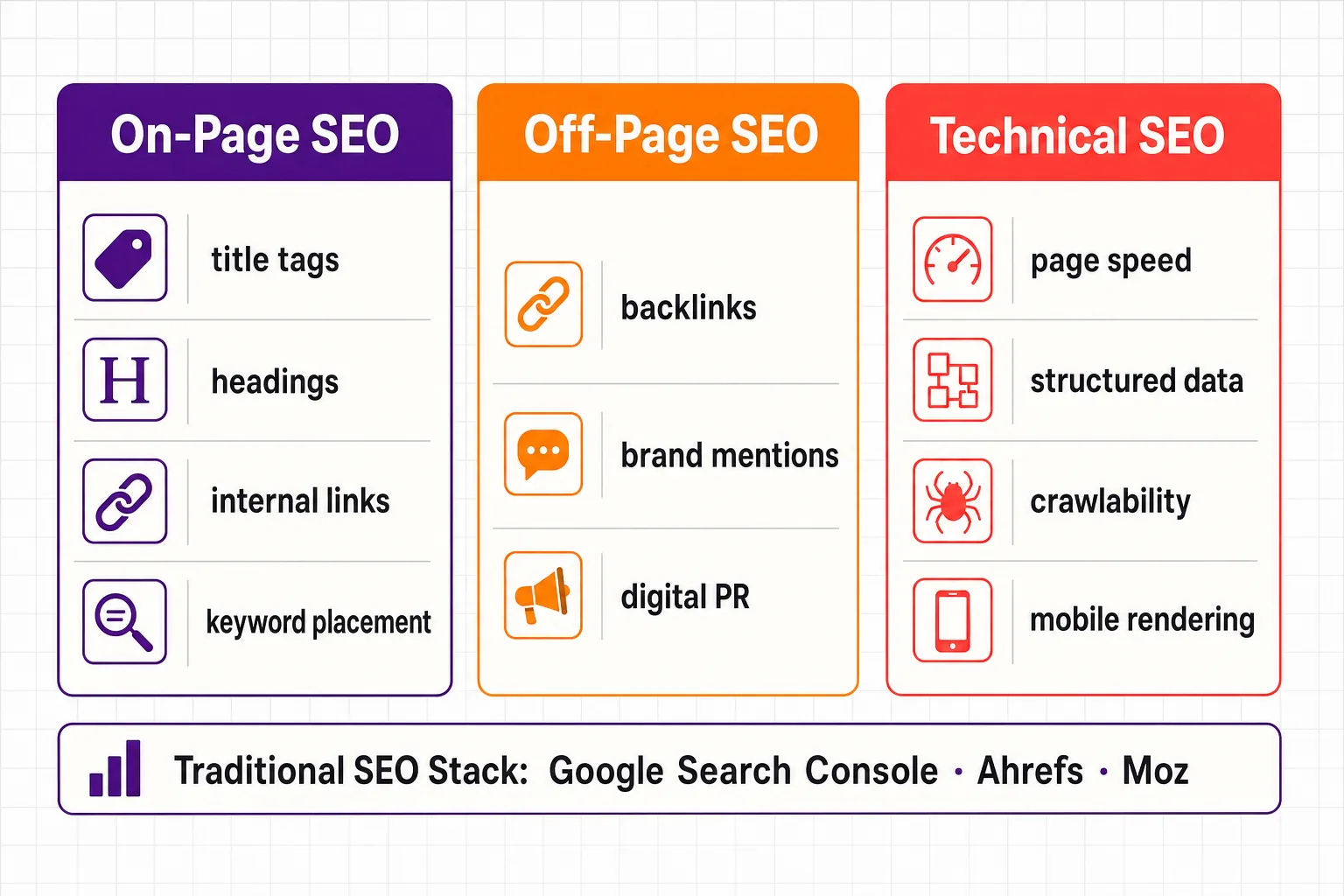
On-page SEO covers everything visitors and crawlers see on your pages — title tags, headings, internal links, content quality, keyword placement. Off-page SEO is the reputation layer — backlinks, brand mentions, digital PR. Technical SEO ensures search engines can actually find, crawl, and index your site — page speed, structured data, crawlability, mobile rendering.
Moz’s Beginner’s Guide to SEO remains one of the best free introductions to these three pillars and is worth reading even if you’ve been doing this for a decade.
Traditional SEO practitioners rely on a well-known stack: Google Search Console for indexing and performance data, Ahrefs for backlink analysis and keyword research, Moz for domain authority tracking and on-page audits. These tools require a human operator to interpret the data, make decisions, and execute changes.
Before I compare this to AI-driven approaches, here are the baseline concepts both sides share:
Search intent: The reason behind a query — informational, navigational, commercial, or transactional. Getting this wrong means ranking for traffic that never converts.
SERP analysis: Studying what currently ranks for a target query to reverse-engineer what Google rewards for that specific intent.
Backlinks: Links from external sites pointing to yours. Still a top-three ranking factor in 2026, regardless of what anyone selling an AI writing tool tells you.
Crawlability: Whether search engine bots can access and read your pages. A beautifully written page that Googlebot can’t reach ranks nowhere.
Indexing: The process of Google storing your page in its database. No index, no ranking. Period.
These fundamentals haven’t changed in a decade. What’s changed is how fast and accurately you can execute against them. That’s where an autonomous SEO pipeline enters the picture — applying the same pillars, minus the manual grind.
| Factor | Traditional SEO | AI-Powered SEO |
|---|---|---|
| Keyword Research | Manual clustering with Ahrefs/Moz; 4–8 hours per cluster | NLP-driven clustering in minutes; scales across thousands of terms |
| Content Creation | Human-written briefs and drafts; 2–3 hours per brief | AI-generated briefs in seconds; drafts in minutes with human review |
| Technical Auditing | Crawl tools + manual review; weekly or monthly cadence | Continuous automated crawls; real-time issue detection |
| Link Building | Manual outreach, relationship-driven; slow and labor-intensive | AI-assisted prospecting; outreach still requires human relationships |
| On-Page Optimization | Manual edits guided by checklists and audits | Automated scoring and suggestions; bulk implementation possible |
| Reporting & Analytics | Manual dashboard builds in Google Sheets or Data Studio | Auto-generated reports with anomaly detection and trend alerts |
AI SEO vs Traditional SEO: The Core Differences in 2026
The biggest mistake I see in every competitor article on this topic: they treat “AI SEO” as one thing. It’s two very different things.
AI-assisted SEO means a human strategist uses AI tools — Surfer SEO for content scoring, ChatGPT for draft acceleration, Semrush’s AI features for keyword gaps. The human still drives. The AI is a faster car.
Fully autonomous AI SEO means an agent-driven pipeline handles execution end-to-end — auditing, clustering, briefing, drafting, optimizing, publishing — with a human reviewing outputs rather than creating them. This is what an AI SEO agent actually looks like.
Most articles conflate these two. The cost structures, risk profiles, and outcomes are completely different.
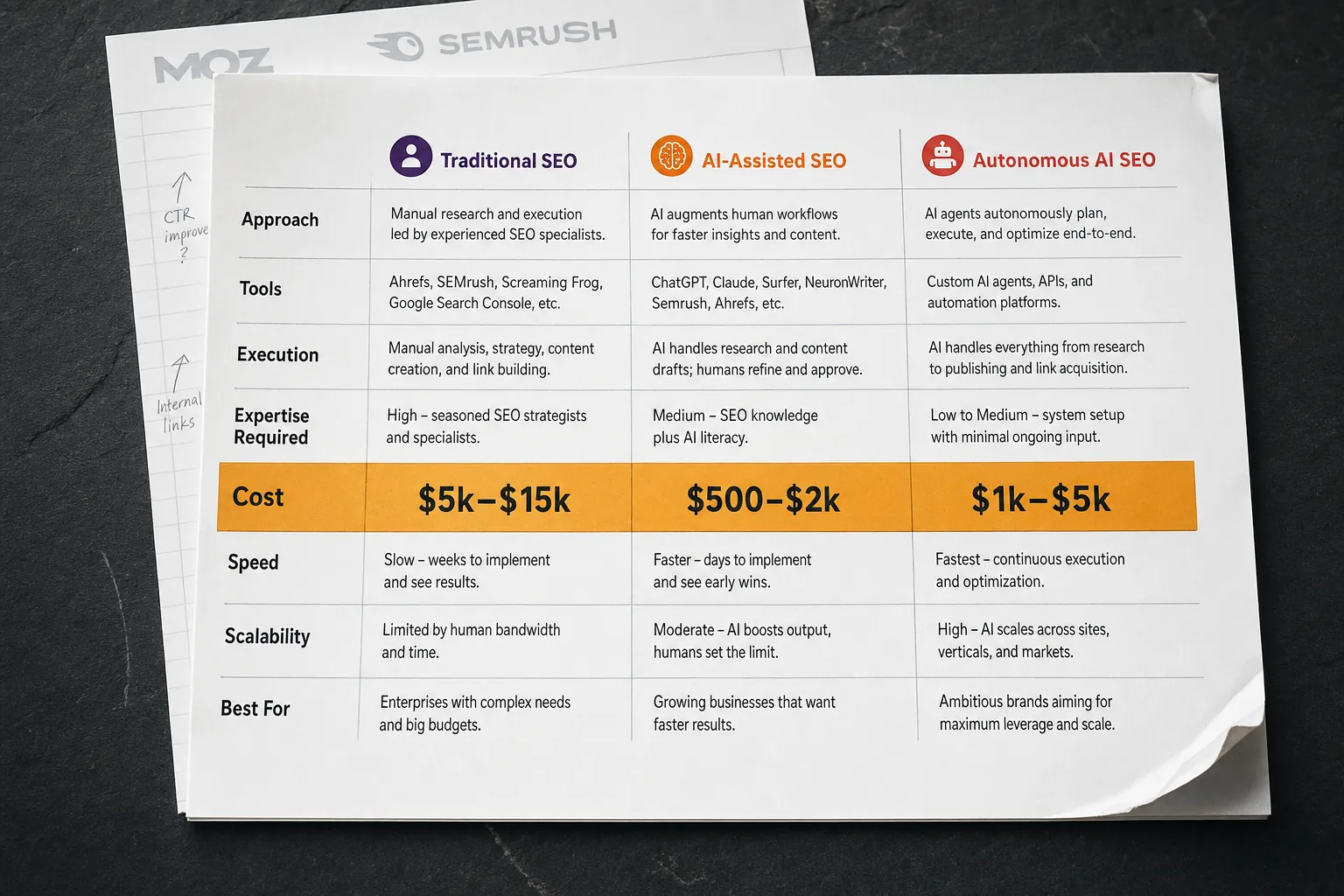
| Dimension | Traditional SEO | AI-Assisted SEO | Autonomous AI SEO |
|---|---|---|---|
| Speed of Execution | Weeks per campaign cycle | Days per cycle | Hours per cycle |
| Scalability | Linear — more output requires more people | Moderate — faster per person | High — scales without headcount |
| Cost Structure | $5k–$15k/mo agency retainer | $500–$2k/mo tools + existing team | $1k–$5k/mo platform + review time |
| Human Expertise Required | High — every step | Medium — strategy + review | Low — strategy + spot-checks |
| Algorithm Adaptability | Slow — manual process changes | Moderate — tools update, humans adjust | Fast — agents retrain on new signals |
| Content Quality Control | High — human-created | Variable — depends on review rigor | Requires explicit QA layer |
Lily Ray has been vocal about AI-only approaches lacking E-E-A-T depth — and she’s right. An AI can produce grammatically clean content at scale. It cannot produce genuine expertise or lived experience. The winning play isn’t AI or human. It’s AI for velocity, human for credibility.
Google’s Official Stance on AI-Generated Content (Updated 2026)
Google’s position: “Appropriate use of AI or automation is not against our guidelines. This means that it is not used to generate content primarily to manipulate search rankings, which is a violation of our spam policies.”
— Google Search Central, Creating helpful, reliable, people-first content
That quote is the only policy statement that matters. Everything else is interpretation.
| Google Principle | Implication for AI SEO | Implication for Traditional SEO |
|---|---|---|
| People-first content | AI drafts must be edited for reader value, not just keyword density | Already the standard; no process change needed |
| Search Essentials | Automated content must meet same technical quality bars | Same requirements apply; no advantage |
| Spam policies | Mass-produced AI content without review risks manual action | Low risk unless using PBNs or link schemes |
| E-E-A-T | AI lacks first-hand experience; human bylines and review are necessary | Naturally stronger — human authors bring credentials |
Google’s guidance on AI-generated content (current as of 2026) is clear: the method of creation doesn’t determine ranking. The usefulness of the output does. An AI content agent built to meet these quality bars is fine. One that publishes unreviewed slop at scale is not.
The short version: Google doesn’t care if a machine wrote it. Google cares if it’s useful, accurate, and worth ranking. AI workflows that skip the quality step get punished exactly the way bad human content always did — by ranking nowhere.
AI SEO Tool Pricing Comparison (2026)
Choosing an AI SEO tool in 2026 feels like buying a used car. Everyone’s quoting a different number, and the real cost shows up three months in.
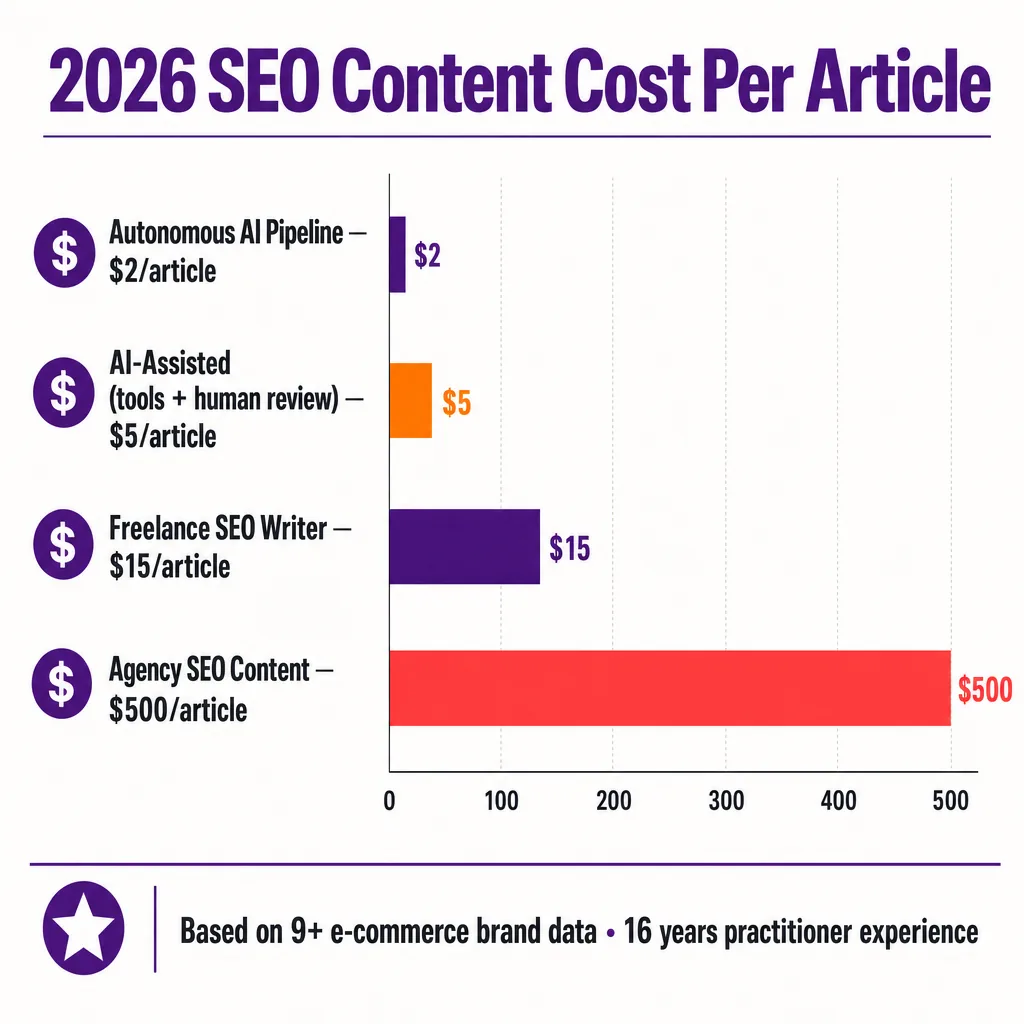
Here’s what the major platforms charge (pricing verified May 2026):
| Tool | Starting Monthly Price | Annual Discount | Key AI Features | Best For |
|---|---|---|---|---|
| Clearscope | $189/mo (Essentials) | ~15% on annual | NLP content scoring, competitor analysis, keyword discovery | Content teams optimizing existing pages |
| Surfer SEO | $99/mo (Essential) | ~17% on annual | Content editor, SERP analyzer, AI writing assistant | Writers who want real-time optimization scores |
| MarketMuse | $149/mo (Standard) | ~20% on annual | Topic modeling, content briefs, competitive gap analysis | Content strategists planning large clusters |
| Frase | $15/mo (Solo) | ~20% on annual | AI writing, SERP research, content briefs | Solo operators on a tight budget |
| Semrush (AI features) | $139.95/mo (Pro) | ~17% on annual | AI writing assistant, keyword clustering, ContentShake AI | Teams already using Semrush for traditional SEO |
Hidden Costs & Considerations
The sticker price is never the real price. Clearscope charges per seat beyond the base plan. MarketMuse limits content briefs per month — exceed the cap and you’re paying overages. Surfer’s AI writing credits run out fast on high-volume teams. Semrush locks AI features behind Pro+ tiers. And nearly every tool offers annual discounts that quietly auto-renew. Factor in 15–25% more than the listed price for realistic budgeting.
For teams wanting a full-stack approach instead of stitching five tools together, see our transparent pricing.
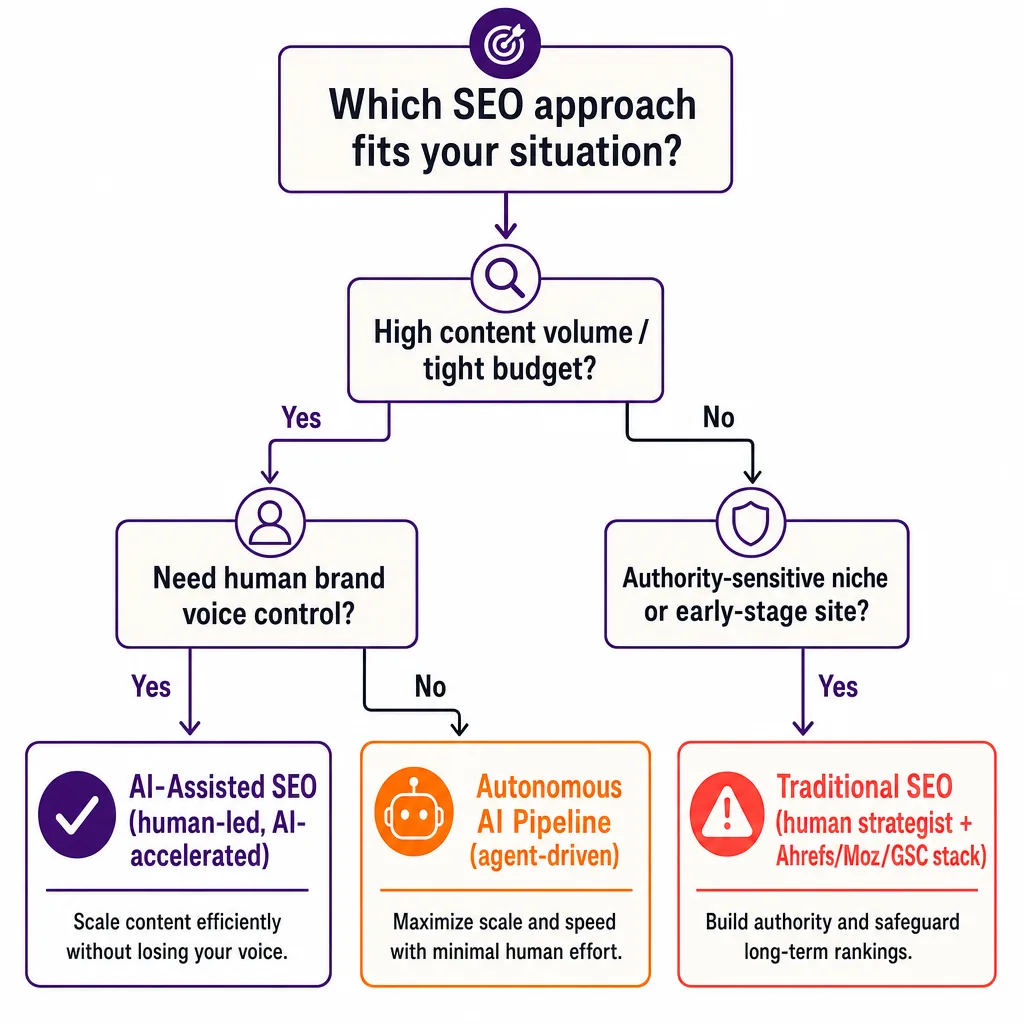
When to Use AI SEO vs Traditional SEO (Decision Framework)
The answer isn’t “always AI” or “always traditional.” It depends on five factors I’ve pressure-tested across years of running both playbooks:
| Decision Factor | AI-First | Hybrid | Traditional |
|---|---|---|---|
| Business size | Solo founder, small team | Mid-market, 10–100 employees | Enterprise with legal/compliance layers |
| Content volume | 50+ pages/month | 10–50 pages/month | <10 pages/month |
| Budget | $1k–$3k/mo for tools + review | $3k–$10k/mo for tools + people | $5k–$15k/mo for agency or in-house team |
| Competitive intensity | High — need speed to compete | Medium | Low — established domain authority |
| In-house expertise | Minimal — need AI to compensate | Some — AI augments the team | Deep — team drives strategy and execution |
Concrete scenarios: A solo founder running 50 product pages should go AI-first — there’s no budget for a full team, and an autonomous pipeline handles the repetitive work. An enterprise with 10,000 pages and regulatory compliance requirements needs human review at every stage — hybrid is the floor. A local plumber with 20 pages probably doesn’t need AI SEO tools at all; basic on-page optimization and a Google Business Profile will do more than any software.
Most teams winning in 2026 aren’t choosing one approach. They’re using AI for ai marketing automation — the repetitive, time-intensive execution work — while keeping humans on strategy, quality, and relationship-driven link building.
Risks and Limitations: What Both Approaches Get Wrong
AI SEO fails in predictable ways. Hallucinated statistics that look plausible but are fabricated. Thin content published at scale that individually ranks for nothing. Over-optimization patterns that trip algorithmic filters. E-E-A-T gaps when no human with real expertise reviews the output. And a dependency on third-party APIs that can change pricing, rate limits, or capabilities overnight.
Traditional SEO has its own failure modes. A full technical audit takes a team 2–4 weeks — by the time you implement the fixes, Google has shipped another core update. Manual content production caps at maybe 8–12 pieces per month for a single writer. That’s not fast enough in competitive verticals where AI-equipped competitors publish 50+.
A 2024 study published on arxiv.org examining AI Overviews found measurable gaps in source quality and claim fidelity when AI-generated answers lacked human verification — a finding that applies directly to AI-generated SEO content. The paper underscores what practitioners already know: unsupervised AI output drifts from accuracy.
The fix is the same in both directions. AI content needs human-in-the-loop review. Traditional workflows need AI-assisted auditing to keep pace. Neither approach survives 2026 in pure form. That’s the argument behind generative seo done responsibly — speed with guardrails.
FAQ: AI SEO vs Traditional SEO
Is AI-generated content penalized by Google?
No. Google’s current guidance (2026) judges content by quality and helpfulness, not production method. Content created with AI that meets Google Search Central’s quality standards ranks the same as human-written content. Content that’s spammy gets penalized regardless of who — or what — wrote it.
Can AI fully replace traditional SEO?
Not yet. AI handles execution at scale — keyword clustering, content drafting, technical auditing. Strategy, E-E-A-T signals, and relationship-based link building still require human judgment. The best 2026 teams treat AI as the engine and humans as the driver.
What is the cheapest AI SEO tool in 2026?
Frase starts at $15/month for its Solo plan — the lowest entry point among major AI SEO tools. See the pricing comparison table above for a full breakdown across Clearscope, Surfer SEO, MarketMuse, Frase, and Semrush.
The Bottom Line
AI SEO and traditional SEO aren’t competing approaches — they’re layers of the same system.
- Use AI for speed and scale: keyword clustering, content drafting, continuous technical audits, automated reporting.
- Use humans for judgment and trust: strategy, E-E-A-T, link building relationships, quality review.
- Budget for both: the cheapest viable AI stack starts around $15/month; the real cost is the review time you invest in making the output actually good.
The teams pulling ahead in 2026 run deterministic systems for execution and keep human expertise where it counts — on strategy and quality. See how Botonomy’s AI SEO agent runs the entire pipeline — from audit to publish — without adding headcount.
Expert sources cited in this article: Moz (Beginner’s Guide to SEO), Google Search Central (AI-generated content guidance, helpful content documentation), Lily Ray (E-E-A-T commentary), arxiv.org (AI Overviews source quality study). Tool pricing verified May 2026.