
Martin Kelly is the founder of Botonomy AI and the kind of person who automated his own SEO audits — then spent two years making sure the machines did them better than he ever could.
In short
An AI SEO audit is an automated, machine-learning-driven evaluation of a website covering technical health, content quality, backlinks, and LLM visibility, completing in minutes what a manual consultant audit takes weeks to finish. Unlike free tools that catch only surface-level issues, a proper AI audit runs deterministic checks across hundreds of signals and prioritizes findings by estimated traffic impact, including generative search readiness for AI Overview citation.
What Is an AI SEO Audit?
Most SEO audits take days. Some take weeks. An AI SEO audit takes minutes.
An AI SEO audit is an automated, machine-learning-driven evaluation of a website’s search performance. It covers technical health, content quality, backlink profile, and — critically in 2026 — LLM visibility. The entire process runs through an autonomous SEO pipeline that replaces manual checklists with deterministic, repeatable analysis across hundreds of ranking signals.
The contrast with traditional manual audits is stark. A consultant might spend 20–40 hours reviewing a site, checking pages one by one, applying their own judgment. The output varies by who does the work. An AI audit runs the same checks every time, at the same depth, with zero variance. Speed: minutes vs. days. Scope: hundreds of signals vs. a consultant’s top-of-mind checklist. Consistency: deterministic vs. human.
Can ChatGPT do an SEO audit? Partially — but it can’t crawl your site, measure server response times, or validate structured data. More on that in the FAQ.
Any credible AI SEO audit uses Google’s Core Web Vitals thresholds as a baseline standard: LCP under 2.5 seconds, INP under 200 milliseconds, CLS below 0.1. If your audit tool doesn’t check these, it’s not a real audit.
What Does an AI SEO Audit Actually Include?
A comprehensive AI SEO audit covers far more than broken links and missing meta tags. Here’s what should be included:
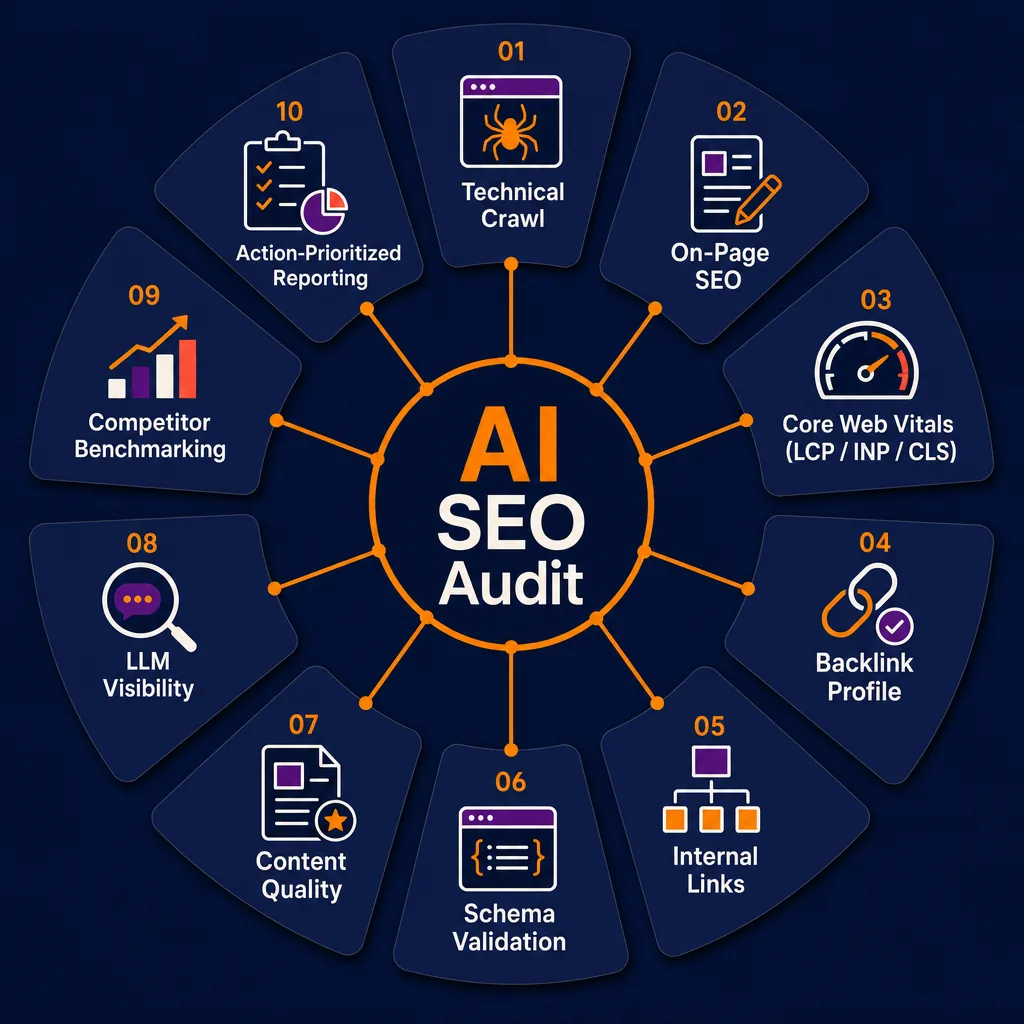
- Technical crawl — HTTP status codes, redirect chains, canonical tags
- On-page SEO analysis — title tags, meta descriptions, heading hierarchy, keyword usage
- Core Web Vitals assessment — LCP, INP, and CLS scoring
- Backlink profile analysis — referring domains, toxic links, anchor text distribution
- Internal link structure mapping — orphan pages, link equity flow, crawl depth
- Schema and structured data validation — product, FAQ, article, and breadcrumb markup
- Content quality and gap analysis — semantic relevance scoring, thin content flags
- LLM visibility and AEO readiness checks — citation probability in AI Overviews
- Competitor benchmarking — SERP overlap, content gaps, authority comparison
- Action-prioritized reporting — findings ranked by estimated traffic impact
That last point matters more than most people realize. A good seo audit report doesn’t just list 347 errors. It tells you which five fixes will move the needle.
In 2026, leading AI audit tools now include generative-search readiness checks. These evaluate whether your content is structured for AI Overview citation — not just traditional blue-link ranking. This is a fundamental shift. An AI SEO agent that only checks traditional ranking factors is already behind.
Aleyda Solis’s crawl-budget research has long established that wasted crawl resources on redirect chains and parameter URLs directly hurt indexation. John Mueller has repeatedly emphasized that structured data must be accurate and complete to qualify for rich results — partial implementation is worse than none. These aren’t optional components. They’re the foundation.
The best AI audit systems also score content against E-E-A-T signals: authorship clarity, source citations, first-hand experience markers, and topical depth. Surface-level content gets flagged. Thin pages get deprioritized or marked for consolidation.
How Does an AI SEO Audit Work?
The typical process follows a clear sequence, and understanding it helps you evaluate whether a tool is doing real work or running a superficial scan.
Step 1: URL input and crawl. You submit a domain or URL set. A headless browser crawls the site, rendering JavaScript just like Googlebot would. This catches issues that server-side-only crawlers miss entirely.
Step 2: Parallel module analysis. The system splits the crawl data across technical, content, and off-page analysis modules. HTTP headers, schema markup, CWV metrics, and link graphs are processed simultaneously — not sequentially.
Step 3: NLP-based content scoring. AI layers on semantic analysis. It evaluates topical coverage, keyword intent alignment, content depth relative to competing pages, and readability. This is where LLM prompts add value — roughly 10% of the logic. The other 90% is deterministic: status code checks, schema validation, CWV threshold comparisons.
Step 4: Live SERP comparison. The best systems pull live SERP data and competitor pages in real time. Cached snapshots miss ranking shifts and new entrants. Real-time data means your audit reflects the competitive landscape right now.
Step 5: Prioritized report generation. Findings are ranked by estimated traffic impact. Not error severity — traffic impact. A missing H1 on your highest-traffic page matters more than 50 broken links on archived blog posts.
Screaming Frog remains an industry benchmark for crawl accuracy in seo site audits. If an AI tool can’t match its crawl fidelity, the downstream analysis is compromised.
Can you do your own SEO audit? Yes. Free tools cover the basics. But a comprehensive audit — one that evaluates LLM citation readiness and competitive positioning — requires AI-powered tooling or deep technical expertise.
AI SEO Audit vs. Manual Audit vs. Free Tools
Free seo audit tools catch about 20% of what matters. That’s not a knock — it’s a scope limitation.
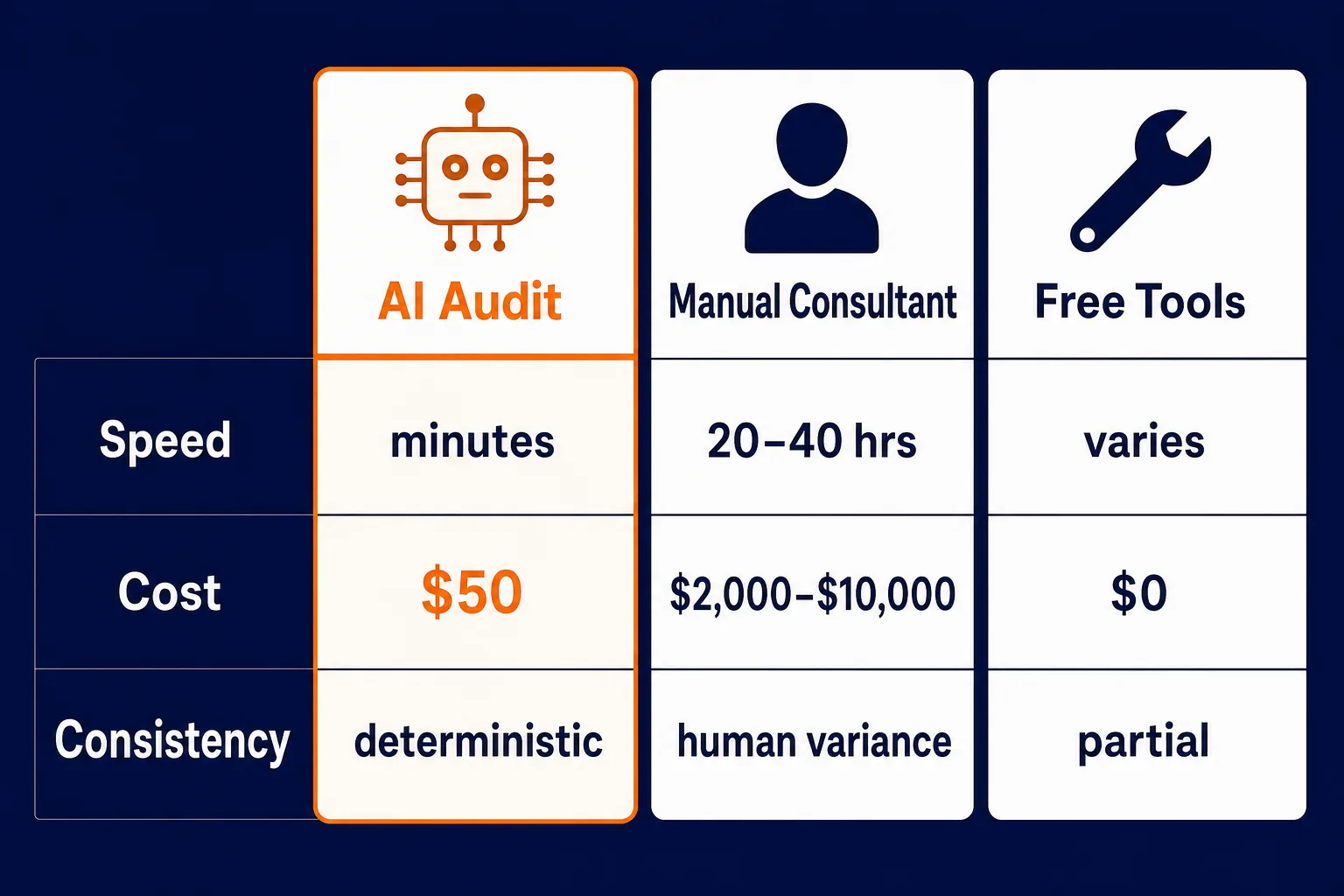
| Factor | Free Tools (SEOptimer, AIOSEO) | Manual Consultant Audit | AI SEO Audit |
|---|---|---|---|
| Speed | Seconds | 1–4 weeks | Minutes |
| Depth | Surface-level | Deep (varies by consultant) | Deep + consistent |
| Cost | $0 | $2,000–$10,000+ | $50–$500/month |
| Accuracy | Basic checks only | High (human-dependent) | High (deterministic) |
| Actionability | Low — generic tips | High — custom recommendations | High — prioritized by impact |
| LLM readiness checks | None | Rare | Standard in 2026 |
Free website audit tools flag missing meta descriptions and broken links. Useful, but incomplete. They don’t analyze content depth, competitor positioning, or whether your pages are structured for generative seo citation.
Manual audits deliver custom, expert-level insight. The tradeoff is time and cost. At $2K–$10K per audit, most companies can’t afford to run them quarterly — let alone monthly.
What are the top 5 SEO audit tools? The categories matter more than specific names: free crawlers (Screaming Frog’s free tier, AIOSEO Analyzer), enterprise platforms (Semrush Site Audit, Ahrefs Site Audit), and AI-native systems that run audits and execute fixes autonomously. In 2026, the gap between free and AI-powered audits has widened significantly as generative search requirements have added layers of complexity that simple crawlers can’t evaluate.
Who Benefits Most from an AI SEO Audit in 2026?
Different teams need different things from a seo audit tool — but every team needs speed.
SaaS marketers need technical depth paired with content gap analysis. Their sites are often complex (JavaScript-heavy, multi-language, gated content), and manual audits miss rendering issues that tank organic performance.
Content-led companies need semantic scoring and internal link optimization. A site with 500 blog posts and no internal linking strategy is leaving traffic on the table. AI audits map link equity flow and flag orphan content instantly.
Growth agencies need scalable, white-label reporting across client portfolios. Running manual audits for 30 clients isn’t viable. An AI audit system processes them in parallel and outputs branded reports.
E-commerce brands need CWV optimization and product schema validation. Across 9+ e-commerce brands, systematic AI-driven audits contributed to a 43% average organic traffic increase by surfacing issues manual reviews consistently missed — broken product schema, slow LCP on category pages, missing breadcrumb markup.
The audit feeds the strategy. The strategy feeds the content pipeline — often powered by an AI content agent. The pipeline feeds growth. That’s the loop.
What Makes a Good AI SEO Audit Report?
A score out of 100 with no context is a vanity metric. It tells you nothing actionable.
A good seo audit report prioritizes findings by estimated revenue impact — not error count. Fixing 200 low-priority warnings won’t move organic traffic. Fixing three critical issues on your top-revenue pages might double it.
Watch for these red flags in any audit tool:
- No crawl-depth control — the tool only checks your homepage and a handful of pages
- No competitor comparison — your audit exists in a vacuum
- No structured data validation — schema issues go undetected
- No LLM visibility analysis — generative search readiness is ignored
- No historical tracking — you can’t measure progress between audits
Lily Ray’s E-E-A-T research has established clear benchmarks for what content-quality scoring should evaluate: demonstrated expertise, cited sources, author transparency, and first-hand experience signals. If your audit tool doesn’t assess these, it’s evaluating a 2019 version of SEO.
The best systems don’t produce a PDF you file and forget. They output a prioritized action list that feeds directly into execution workflows — connecting audit findings to ai marketing automation systems that implement fixes without manual handoff.
FAQ: AI SEO Audit Questions Answered
Can ChatGPT do an SEO audit?
Partially. ChatGPT can analyze content you paste in and suggest improvements to structure, readability, and keyword usage. But it cannot crawl a live site, check server response codes, measure Core Web Vitals, validate structured data, or pull backlink profiles. It’s a content advisor — not a site auditor. Dedicated AI SEO audit tools handle the full technical and competitive scope.
Is there an AI tool for SEO?
Multiple exist in 2026. They range from free analyzers (AIOSEO, SEOptimer) to enterprise platforms (Semrush Site Audit, Ahrefs) to autonomous AI agents that run audits and execute fixes without human intervention. The right choice depends on your scale, budget, and whether you need a report or a system that acts on the findings.
Can I do my own SEO audit?
Yes. Free tools cover basics like broken links, missing titles, and simple CWV checks. But a comprehensive audit — one evaluating LLM citation readiness, semantic content gaps, and competitive positioning — requires either AI-powered tooling or significant technical SEO expertise. For most teams, an AI seo audit delivers better coverage at a fraction of the time investment.
Conclusion
An AI SEO audit in 2026 isn’t a nice-to-have — it’s the minimum viable starting point for any serious organic growth strategy.
- Demand prioritized reporting — fixes ranked by traffic impact, not error count
- Require LLM visibility checks — generative search readiness is now table stakes
- Connect audit findings to execution — a report without action is just a document
Want an AI SEO audit that actually feeds into execution — not a PDF that collects dust? See how Botonomy’s autonomous SEO pipeline runs the full cycle from audit to action, without adding headcount. Or get in touch for a free audit consultation.