
Martin Kelly is the founder of Botonomy AI and has personally red-lined enough AI drafts to develop a Pavlovian twitch every time he reads the word “delve.”
I watched a 12-article content sprint tank last year because every piece read like the same ChatGPT default — same cadence, same filler words, same nothing. Identical rhythm across all twelve. The client’s bounce rate hit 74%. Rankings flatlined. The content wasn’t bad, exactly. It was worse than bad. It was forgettable.
That experience forced me to build an actual system for turning AI drafts into content that reads like a human wrote it — because a human did finish it. This guide is that system, compressed into 15 practices I’ve tested across 200+ client articles.
In short
To make AI writing sound more human, vary sentence rhythm, strip filler words like "delve" and "utilize," and inject specific first-person anecdotes at roughly one per 500 words. Setting tone and banned words in your prompt before generating anything, layering in original data for E-E-A-T signals, and running a multi-pass edit combining AI drafts with human polish are the highest-impact practices, since humanizer tools reduce detection scores but add no expertise or personality.
TL;DR: How to Make AI Writing More Human in 2026
- Vary sentence rhythm — alternate short punches with longer explanatory lines to break AI monotone
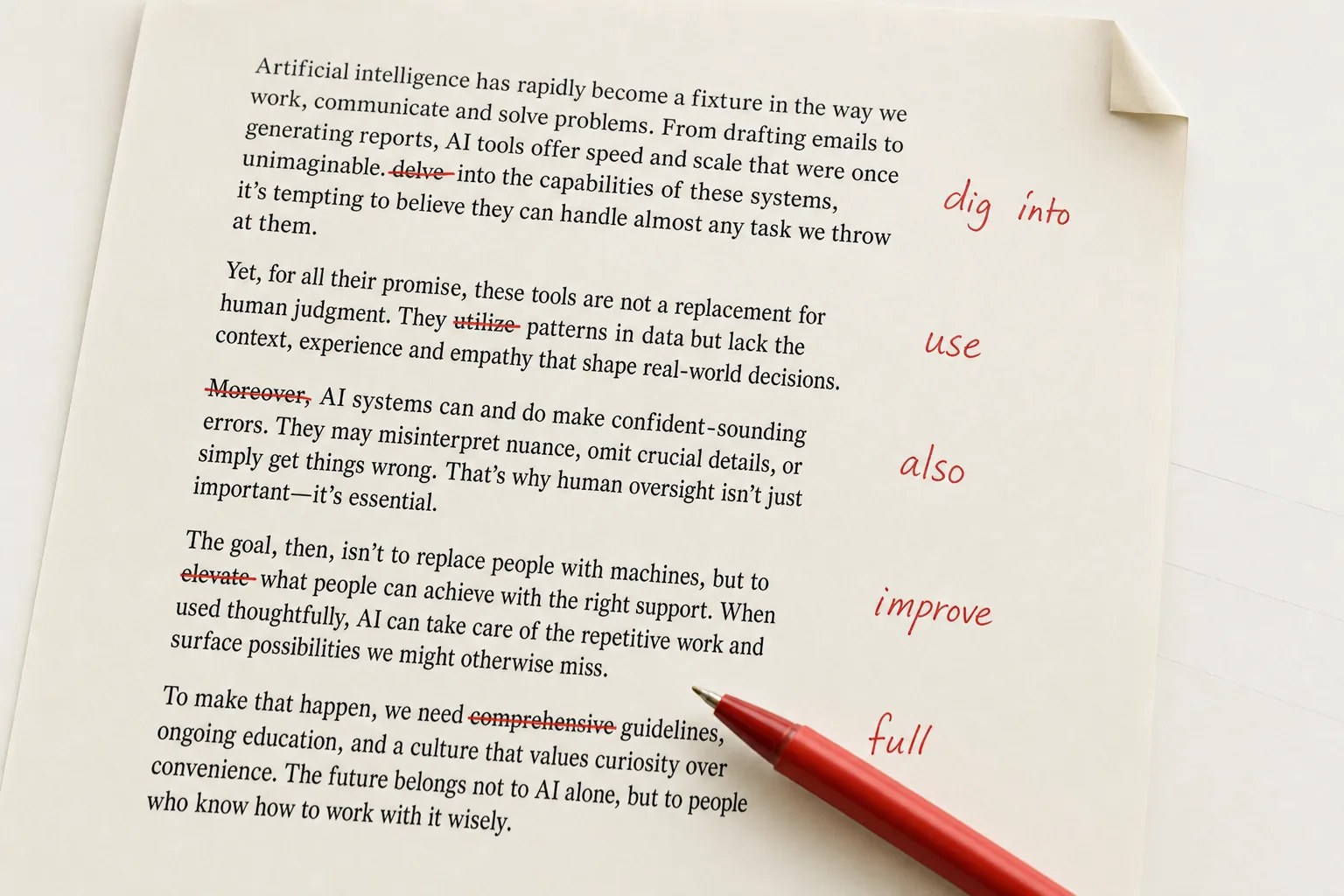
- Kill filler words — strip “delve,” “moreover,” “utilize,” and 40+ other AI tells on every draft
- Inject first-person stories — one specific anecdote per 500 words adds experience signals no AI can fake
- Prompt for tone — set voice, banned words, and sentence-length rules before generating a single word
- Layer original data — your analytics, your case studies, your quotes. This is where E-E-A-T lives
- Run a multi-pass edit — AI draft → human substantive edit → AI grammar pass → final human polish
- Use humanizer tools as a finishing step, not a strategy — they reduce detection flags but add zero expertise
Why Humanizing AI Content Matters in 2026
63% of consumers say they trust content less when they suspect AI wrote it, according to the 2025 Edelman Trust Barometer. That number has climbed every year since 2023. Readers can smell the default.
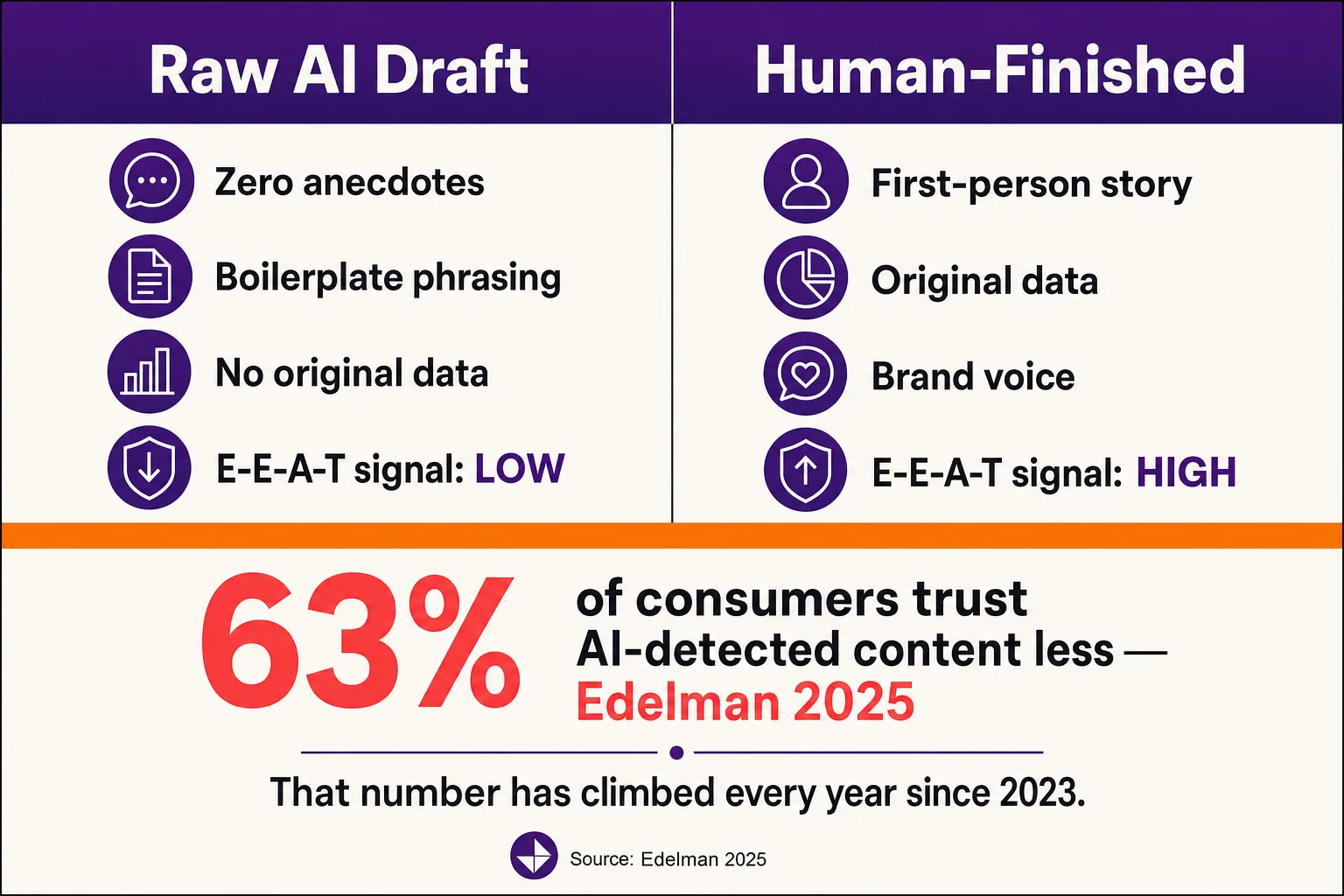
Google’s helpful content system — now fully integrated into core ranking — doesn’t penalize AI-generated text by origin. It penalizes lazy content. Google’s official guidance on AI-generated content is explicit: people-first content is the standard, regardless of how it was produced. The E-E-A-T framework rewards demonstrated experience and expertise. A ChatGPT draft with zero personal anecdotes, no original data, and boilerplate phrasing fails the experience signal entirely.
The market reality is simple. GPT-4o, Claude, and Gemini have made generative content essentially free to produce. Every competitor in your space can generate 50 blog posts this afternoon. The prose will all sound the same. Brand differentiation now lives in the human layer — the stories, the opinions, the data that only you own.
That’s not a vibes argument. That’s a ranking signal argument.
15 Best Practices to Make AI Writing Sound Human
1. Vary Sentence Length and Rhythm
AI defaults to 15–20 word sentences, stacked one after another. The result reads like a metronome.
Before: “AI writing tools can help you create content faster. They can also help you scale your content production. They are becoming more popular in 2026.”
After: “AI writing tools are fast. They’ll get you a draft in four minutes that used to take four hours — and that speed is exactly why every blog on page one sounds identical right now.”
Mix 5-word punches with 25-word explanations. Break the pattern.
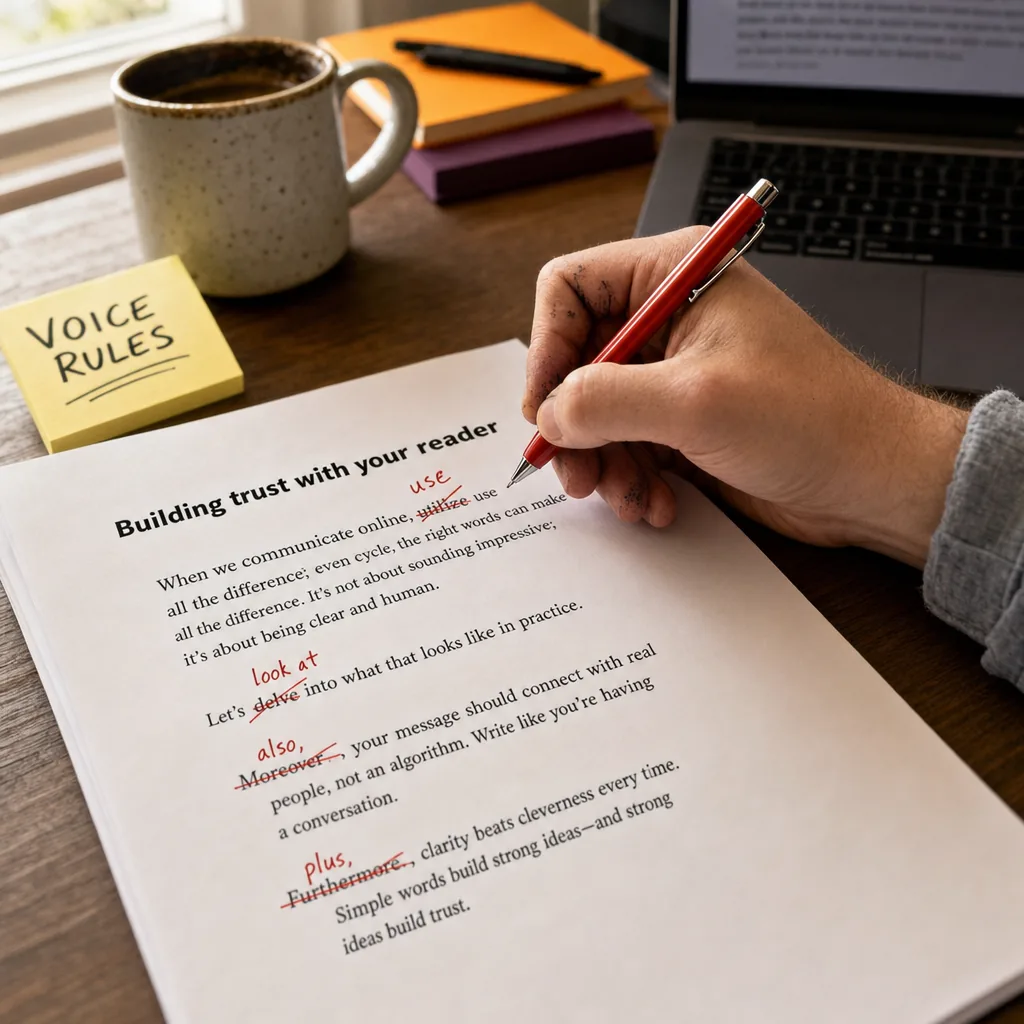
2. Replace AI Filler Words
| AI Default | Human Replacement |
|---|---|
| Delve | Dig into, explore, look at |
| Landscape | Market, space, field |
| Utilize | Use |
| Facilitate | Help, enable, run |
| Moreover | Also, and |
| Furthermore | On top of that, plus |
| In conclusion | So, here’s the point |
| It’s important to note | (Delete it. Just state the thing.) |
| Elevate | Improve, raise |
| Comprehensive | Full, complete, thorough |
Before: “It’s important to note that utilizing AI tools can facilitate a more comprehensive content strategy.”
After: “AI tools speed up your content production. That’s all they do until a human touches the output.”
3. Inject First-Person Anecdotes
One specific story per 500 words. Not “many marketers find…” — that’s nobody talking. Say what happened to you, your client, your project. Name the number. Name the outcome.
4. Set Voice and Tone in Your Prompt
Don’t generate a word until you’ve told the model how to write. Include banned words, target reading level, sentence-length rules, and a tone descriptor. (See section 5 below for copy-paste templates.)
5. Layer in Original Data, Quotes, or Expert Opinions
ChatGPT can’t cite your Google Analytics. Claude doesn’t know your client’s conversion rate. Original data is the single strongest E-E-A-T signal you can add. Pull a screenshot, quote a colleague, reference a metric from your own work.
6. Fact-Check and Remove Hallucinations
GPT-4o and Claude still hallucinate citations, statistics, and product features. Every AI draft needs a verification pass. I run a three-step check: verify every named statistic, confirm every URL resolves, and cross-reference any quoted expert against the original source. Budget 15 minutes per 1,000 words.
7. Read Aloud and Edit for Cadence
If you stumble reading a sentence out loud, your reader will stumble silently. Reading aloud catches three things a screen scan misses: awkward rhythm, unnatural phrasing, and repeated sentence structures.
8. Add Rhetorical Questions and Conversational Transitions
Does your draft sound like a textbook? That’s probably because every paragraph starts with a declarative statement. Questions break the pattern and pull the reader forward.
9. Use Contractions and Informal Phrasing
“Do not” → “don’t.” “It is” → “it’s.” “They will” → “they’ll.” AI models default to formal register. Contractions alone won’t fix a robotic draft, but their absence guarantees one.
10. Break Predictable Paragraph Structures
AI loves three-sentence paragraphs. Every time. Vary between one and five sentences. A single-line paragraph hits harder than three medium ones stacked in a row.
11. Insert Sensory or Emotional Language
“The client was dissatisfied” is AI writing. “The client called at 6 AM, furious” is human writing. Specificity creates feeling. Feeling creates trust.
12. Contextualize with 2026 References
Mention current events, recent data, this quarter’s algorithm update. Temporal specificity signals freshness and real-world awareness — two things AI drafts consistently lack.
13. Run a Multi-Pass Editing Workflow
This is the system I use for every piece we publish:
- AI draft — generated via an AI content agent with voice parameters locked in
- Human substantive edit — restructure arguments, add anecdotes, inject data, cut filler
- AI grammar pass — Grammarly or Claude for punctuation, typos, consistency
- Final human polish — read aloud, tighten rhythm, confirm tone
Four passes. Non-negotiable. Skipping the human layers is how you end up with content that ranks for three weeks and then disappears.
14. Use Humanizer and Detection Tools Strategically
These tools are a band-aid. They reduce detection scores. They don’t add expertise, personality, or data. Use them as a finishing step after your human edits — never as a substitute.
15. Prompt-Engineer for Human Tone
Before (default prompt): “Write a blog post about email marketing.”
After (engineered prompt): “Write as a marketing director with 12 years of experience. Use short punchy sentences mixed with one longer sentence per paragraph. Never use the words delve, landscape, utilize, or furthermore. Include one specific failure story. Tone: direct, slightly sarcastic, no corporate speak.”
The difference between these two prompts is the difference between forgettable and publishable.
AI Humanizer and Detection Tools Compared (2026)
Most “ai to human text converter free” searches lead to tools that do one thing: swap words to dodge an ai detector. That’s not a content strategy. That’s a spell-checker with marketing.
| Tool | Function | Free Tier | 2026 Pricing | Best For |
|---|---|---|---|---|
| ChatGPT “Humanize” | Humanizer (built-in) | Yes (Plus) | $20/mo (Plus) | Quick rewrites in-platform |
| Undetectable AI | Humanizer | Limited | From $10/mo | Bulk detection bypass |
| StealthWriter | Humanizer | Limited | From $15/mo | Academic-style content |
| WriteHuman AI | Humanizer | Limited trial | From $8/mo | Budget teams, short-form |
| Humanize AI | Humanizer | Limited | From $9/mo | Simple paraphrasing |
| GPTZero | Detector | Yes | From $10/mo | Content auditing |
| Originality.ai | Detector | No | From $15/mo | Agency-scale scanning |
| Copyleaks | Detector | Limited | Custom pricing | Enterprise compliance |
My honest take: WriteHuman AI and Undetectable AI reduce detection flags effectively. They also strip personality, flatten rhythm, and produce prose that passes detection because it reads like nothing. GPTZero and Originality.ai are useful for auditing your own output before publishing — I use Originality.ai on every client draft.
The AI SEO agent we built at Botonomy runs content quality checks programmatically — not just detection scores, but readability, E-E-A-T signal density, and keyword integration. Detection tools tell you if content sounds robotic. They don’t tell you why or fix it. The 15 practices above are the fix.
5 Copy-Paste Prompts That Make AI Write Like a Human
These work across ChatGPT, Claude, and Gemini. Copy them directly. Modify the brackets.
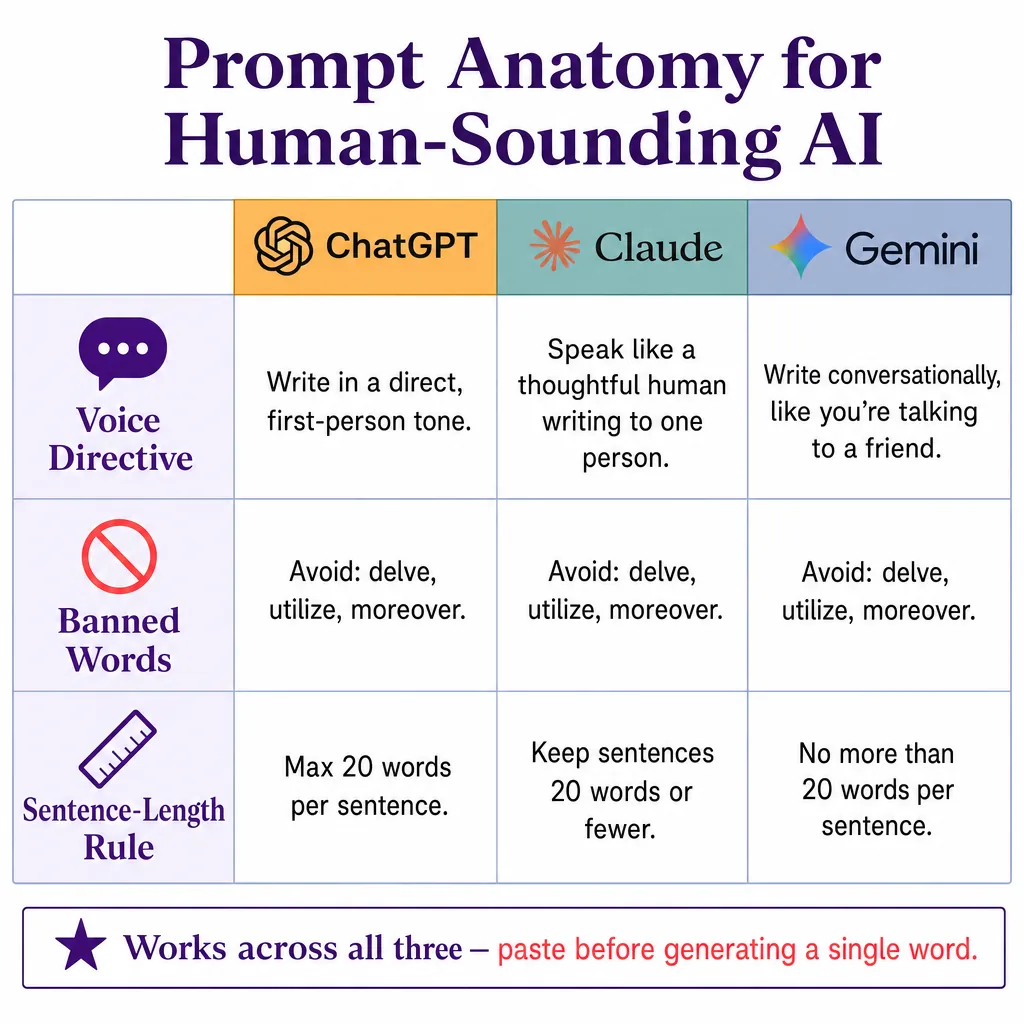
Prompt 1 — Role + Experience (Blog posts, articles)
Write as a [role] with [X] years of experience in [industry]. Use short punchy sentences mixed with one longer explanatory sentence per paragraph. Never use the words delve, landscape, utilize, moreover, or furthermore. Include one specific anecdote from your professional experience.
Prompt 2 — Storytelling (Case studies, narrative content)
Tell the story of [situation] from the first-person perspective of the practitioner who solved it. Start with the problem — make it concrete and specific. Use sensory details. End with the measurable outcome.
Prompt 3 — Contrarian / Opinionated (Thought pieces, social posts)
Take a strong position on [topic]. State your argument in the first sentence. Back it with 2–3 specific data points. Acknowledge the strongest counterargument in one sentence, then dismantle it. Tone: confident, slightly impatient, zero corporate speak.
Prompt 4 — Data-First (Landing pages, reports)
Open with the single most surprising statistic about [topic]. Build every paragraph around a specific number, percentage, or measurable outcome. No adjectives without data to support them. If you can’t quantify a claim, cut it.
Prompt 5 — Conversational / Informal (Emails, newsletters)
Write like you’re explaining [topic] to a smart friend over coffee. Use contractions. Ask rhetorical questions. Keep paragraphs to 2 sentences max. If a sentence sounds like it belongs in a press release, rewrite it.
Each of these ties back to Practice 4 (set voice/tone) and Practice 15 (prompt-engineering for human tone). The prompt is where humanization starts. If you skip it, you’re editing uphill. For teams producing content at scale, AI content marketing systems like ours bake these prompt structures into the pipeline so every draft starts closer to publishable.
FAQ: Common Questions About Humanizing AI Writing
Can Google detect AI writing?
Google’s systems evaluate content quality, not origin. Their helpful content system rewards people-first content regardless of how it was produced. Low-effort AI content that lacks experience signals and original data will underperform — not because it’s AI-generated, but because it’s thin.
Do AI humanizer tools actually work?
They reduce detection scores. They don’t add expertise, anecdotes, or original data. Treat them as a final polish step, not a strategy. A humanizer tool can’t turn a generic draft into a piece with authority — only a human edit can do that.
What words make AI writing obvious?
The top offenders: delve, landscape, utilize, moreover, furthermore, facilitate, it’s important to note, in today’s digital age, in conclusion, and comprehensive. See the comparison table in Practice 2 above for human replacements.
How do I maintain brand voice when using AI?
Set explicit voice parameters in every prompt. Include a banned-word list, sentence-length rules, tone descriptors, and an example paragraph in your target voice. Reference Practice 4 and the 5 copy-paste prompts above. Without these guardrails, every AI model defaults to the same polished-but-personality-free register.
Quick-Reference Checklist: 15 Steps to Human-Sounding AI Content
- Vary sentence rhythm — alternate 5-word and 20-word sentences to break the AI monotone
- Replace AI filler words — strip “delve,” “utilize,” “moreover,” and 40+ tells from every draft
- Inject first-person anecdotes — one specific story per 500 words minimum
- Set voice/tone in your prompt — banned words, reading level, and tone descriptor before generating
- Layer original data — your numbers, your quotes, your screenshots
- Fact-check hallucinations — 15 minutes per 1,000 words, every time
- Read aloud — if you stumble, rewrite
- Add rhetorical questions — break the declarative monotone
- Use contractions — “don’t” instead of “do not,” always
- Break paragraph patterns — vary between 1 and 5 sentences
- Insert sensory language — specificity creates feeling
- Add 2026 references — temporal signals prove freshness
- Run a multi-pass edit — AI draft → human edit → AI grammar → human polish
- Use humanizer tools last — they’re a finishing step, not the strategy
- Prompt-engineer for tone — the prompt is where humanization starts
Bookmark this page and run through it before publishing any AI-assisted content.
The single most important thing I can tell you: AI writes the draft. Humans make it worth reading. Those are different jobs, and conflating them is how you end up with a blog that sounds like every other blog.
- Automate the draft layer so you stop spending hours on first passes
- Systematize the human layer — anecdotes, data, voice — so quality stays consistent at scale
- Treat humanizer tools as spell-check, not strategy
The best AI content pipeline automates the draft and systematizes the human layer. That’s what we built at Botonomy — deterministic systems that handle SEO, content, and distribution so you can focus on the part machines can’t fake: your expertise. See how it works →