
Martin Kelly is the founder of Botonomy AI and has spent 16 years wiring up marketing automation systems — long enough to remember when “AI-powered” meant a basic if/then rule and a prayer.
Last updated: June 2026
In short
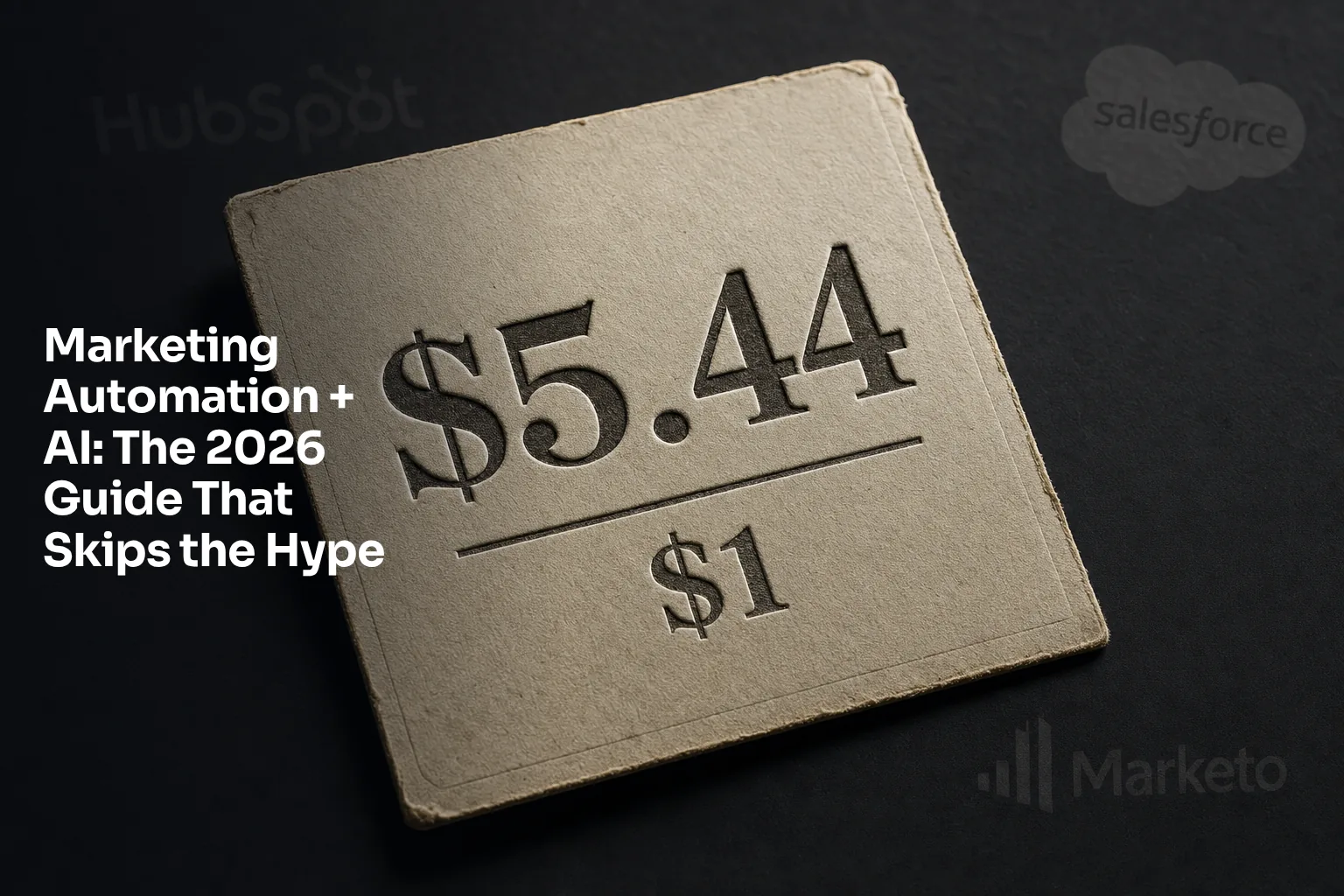
Marketing automation AI is software that uses generative AI, predictive analytics, and real-time personalization to orchestrate the entire customer journey without manual rule configuration at every step. Nucleus Research puts the return at $5.44 per dollar invested, and platforms like HubSpot Breeze AI and Marketo Engage handle content creation, lead scoring, and campaign execution, though GDPR, CCPA, and the EU AI Act create real legal exposure for AI-driven personalization.
What Is Marketing Automation? Definition for 2026
Marketing automation is the use of software and AI to automate repetitive marketing tasks — including email campaigns, lead nurturing, ad management, and customer segmentation — enabling businesses to deliver personalized experiences at scale while improving efficiency and ROI.
That’s the textbook version. The reality in 2026 is messier and more interesting. HubSpot’s original definition focused on email workflows and lead nurturing. That was accurate — in 2018. Today, marketing automation platforms ship with generative content engines, predictive lead scoring models, and autonomous AI agents that execute multi-step campaigns without a human touching a button. The scope has expanded from “send emails on a schedule” to “orchestrate the entire customer journey with machine intelligence.”
Article summary:
- Marketing automation in 2026 means AI-augmented workflows, not just timed email sequences
- The three pillars of AI marketing automation are generative AI, predictive analytics, and hyper-personalization
- Nucleus Research pegs the return at $5.44 for every $1 spent on marketing automation
- HubSpot Breeze AI, Salesforce Einstein, and Marketo Engage lead the platform race — each with distinct strengths and pricing traps
- GDPR Article 22, the EU AI Act, and a wave of US state privacy laws create real legal exposure for AI-driven personalization
- 90% of effective marketing automation is still deterministic logic — AI amplifies what already works
How Marketing Automation Works: The Core Workflow
Every platform runs a variation of the same six-step loop:
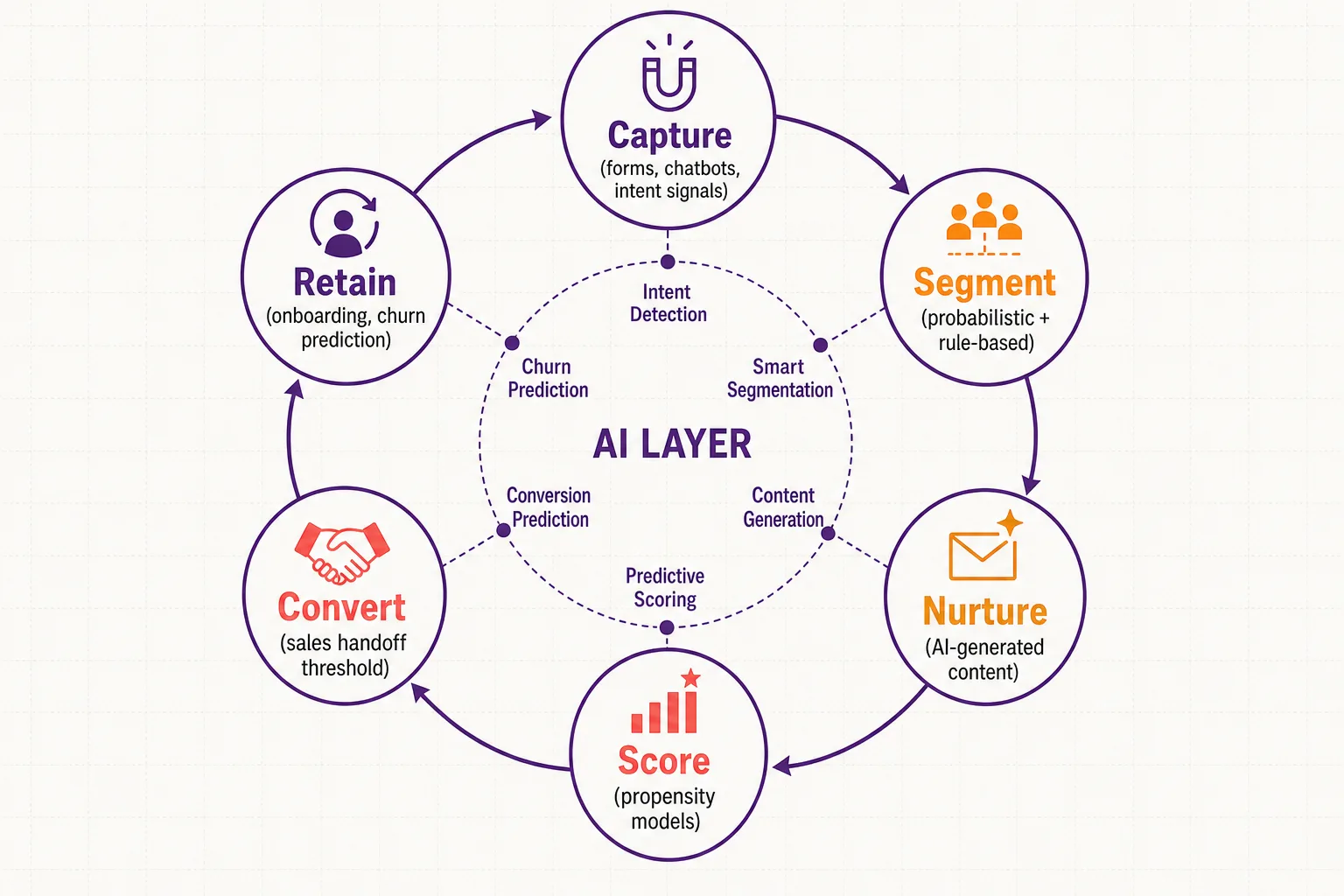
- Capture — Collect leads via forms, chatbots, ad clicks, or intent signals
- Segment — Group contacts by behavior, demographics, firmographics, or predictive score
- Nurture — Deliver sequenced content (email, SMS, ads, in-app) matched to segment and stage
- Score — Assign and update lead scores based on engagement, fit, and predictive models
- Convert — Trigger handoff to sales when a lead crosses a scoring threshold
- Retain — Post-sale automation: onboarding flows, upsell campaigns, churn prediction alerts
The AI layer in 2026 touches every step. Segmentation is probabilistic, not just rule-based. Nurture content is generated on the fly. Scoring uses propensity models trained on your closed-won data. The loop is the same. The intelligence inside it is not.
Marketing Automation vs. CRM vs. Email Marketing
These three categories overlap enough to confuse anyone evaluating tools. Here’s how they actually differ:
| Feature | Marketing Automation | CRM | Email Marketing |
|---|---|---|---|
| Primary function | Multi-channel campaign orchestration & lead nurturing | Contact/deal management & sales pipeline tracking | Sending and tracking email campaigns |
| Scope | Full funnel: awareness → retention | Mid-to-bottom funnel: pipeline → close | Top/mid funnel: broadcast & drip |
| AI capabilities (2026) | Generative content, predictive scoring, agentic workflows | Deal forecasting, conversation intelligence, contact enrichment | Send-time optimization, subject line generation |
| Example tools | HubSpot Marketing Hub, Marketo Engage, ActiveCampaign | Salesforce Sales Cloud, HubSpot Smart CRM, Pipedrive | Mailchimp, Klaviyo, ConvertKit |
Most businesses need pieces of all three. The question is whether you buy them bundled or stitched together. If you’re evaluating CRM automation as part of the stack, start with the handoff between marketing-qualified and sales-qualified leads — that’s where most integrations break.
What Is Marketing Automation AI? Definition & Core Capabilities in 2026
Marketing automation AI is the application of generative AI, predictive analytics, and hyper-personalization models within marketing automation platforms — enabling machines to create content, forecast buyer behavior, and adapt customer experiences in real time without manual rule configuration.
That’s the definition. Here’s what it means in practice across the three pillars.
Generative AI in Marketing Automation
Generative AI inside marketing platforms does the creative grunt work: drafting email copy, producing ad variations, building landing pages, writing blog outlines. HubSpot’s Breeze AI Content Agent generates full blog posts and social captions inside the CMS. Salesforce Einstein GPT embeds generative capabilities across Marketing Cloud. Adobe GenStudio connects creative asset production to campaign workflows. Jasper operates as a standalone layer that plugs into multiple platforms.
The output isn’t perfect. I’ve seen plenty of AI-generated email copy that reads like a press release written by someone who’s never bought anything. But as a first-draft engine that a human editor refines, it cuts content production time by 40–60% in most teams I’ve worked with. An AI content agent handles the volume; a human handles the judgment.
Predictive Analytics for Lead Scoring & Churn
Predictive lead scoring replaces the old “10 points for opening an email” model with propensity scores derived from historical conversion data. Marketo Engage runs predictive audiences that cluster contacts by likelihood to convert. Salesforce Einstein Lead Scoring surfaces deals most likely to close. 6sense layers intent data on top of firmographic scoring to identify accounts before they fill out a form.
Churn prediction works the same way in reverse — flag customers showing disengagement patterns before they cancel. The models aren’t magic. They’re logistic regressions and gradient-boosted trees trained on your data. The more closed-loop data you feed them, the sharper they get.
AI-Driven Personalization at Scale
Real personalization means the content a visitor sees adapts based on who they are and what they’ve done — across channels, in real time. Dynamic Yield (now part of Mastercard) and Adobe Target handle web and app personalization. Braze and Iterable orchestrate cross-channel messaging with real-time behavioral triggers.
The gap between “personalization” and “creepy” is about three data points wide. The platforms that do this well let you set guardrails. The ones that don’t end up in a GDPR complaint.
Traditional Marketing Automation vs. AI-Powered Marketing Automation
| Capability | Traditional Approach | AI Approach |
|---|---|---|
| Segmentation | Static lists, manual rules | Dynamic clusters, lookalike modeling |
| Content creation | Human-written, single version | AI-drafted, multi-variant, human-edited |
| Send-time optimization | A/B test two times | Per-contact optimal send time |
| Lead scoring | Point-based, manual thresholds | Propensity models, continuous learning |
| A/B testing | Two variants, manual analysis | Multi-armed bandit, auto-winner selection |
| Customer journey mapping | Fixed branching logic | Adaptive paths based on real-time behavior |
| Churn prediction | None or lagging indicators | Predictive models flagging at-risk accounts |
The shift from rule-based to model-based automation accelerated in 2024–2025 with the integration of GPT-4o and Claude into major marketing automation platforms. Agentic workflows — where an AI agent plans, executes, and iterates on a campaign without human intervention between steps — are the current frontier.
TL;DR: Marketing automation AI replaces static rules with adaptive models across content creation, scoring, and personalization. It’s not a feature toggle — it’s a different architecture.
Marketing Automation AI ROI: Case Studies & Revenue Uplift Data
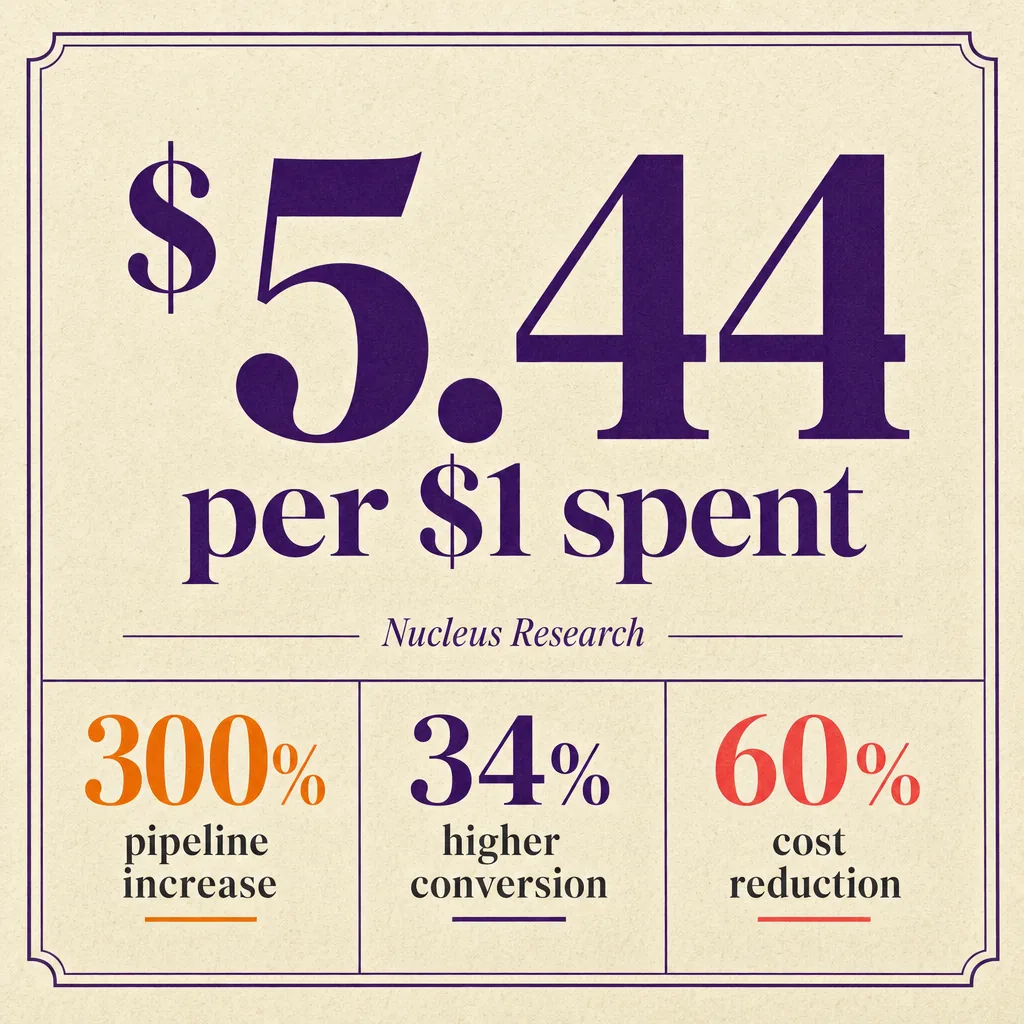
Nucleus Research found that marketing automation returns $5.44 for every $1 invested — and that number predates the current generation of AI tools. McKinsey estimates generative AI could recapture up to 15% of total marketing spend through productivity gains. Forrester’s Total Economic Impact studies for HubSpot and Marketo consistently show 3-year ROI above 300%.
Here’s what that looks like in specific deployments:
B2B SaaS, 200 employees — Replaced manual lead scoring with Salesforce Einstein. Lead-to-opportunity conversion rate increased 34%. Sales cycle shortened by 12 days.
E-commerce, DTC brand — Implemented Braze with predictive churn modeling. Reduced churn by 18% in 90 days. Recovered $420K in annual recurring revenue.
Financial services, enterprise — Deployed Marketo Engage with predictive audiences. Marketing-qualified lead volume increased 27% with the same ad spend. Cost per MQL dropped 22%.
Mid-market agency — Built an autonomous SEO pipeline alongside email automation. Content production time dropped 55%. Organic traffic grew 41% in six months.
Average ROI Benchmarks for Marketing Automation AI in 2026
| Metric | Average Improvement | Source |
|---|---|---|
| Email revenue per recipient | +20–30% | Forrester TEI, 2025 |
| Lead-to-close rate | +25–40% | Nucleus Research, 2024 |
| Cost per lead | −15–25% | Gartner, 2025 |
| Sales cycle length | −10–20% | Salesforce State of Marketing, 2025 |
| Content production time | −40–60% | McKinsey, 2024 |
How to Calculate Your Own Marketing Automation ROI
The formula is simple. The discipline to use it is not.
ROI = (Revenue Attributed to Automation − Total Cost of Automation) / Total Cost × 100
Three steps to make it real:
- Define your attribution model — first-touch, last-touch, multi-touch, or time-decay. Pick one and stick with it for at least two quarters.
- Isolate automation-influenced pipeline — tag every lead, opportunity, and closed deal that touched an automated workflow. If your CRM can’t do this, your CRM is the problem.
- Benchmark against pre-automation baseline — compare the same metrics from the six months before deployment. Without a baseline, your ROI number is fiction.
HubSpot AI Features for Marketing in 2026: Breeze AI, Campaign Assistant & Content Assistant
HubSpot has shipped more AI features in the last 18 months than in the previous five years combined. The challenge isn’t feature count — it’s knowing which ones actually work and which tier locks them behind a paywall.
Generative AI Content Tools
| Feature | What It Does | Hub/Tier Required | Status |
|---|---|---|---|
| Content Assistant (blog) | Generates blog drafts, outlines, titles | Content Hub Starter+ | GA |
| Content Assistant (email) | Writes email body copy, subject lines | Marketing Hub Starter+ | GA |
| Content Assistant (social) | Drafts social posts from prompts | Marketing Hub Pro+ | GA |
| Landing page generation | Builds landing pages from text descriptions | Content Hub Pro+ | GA |
| Campaign Assistant | Generates multi-asset campaigns from a brief | Marketing Hub Pro+ | GA |
AI Agents & Copilots
Breeze Copilot lives inside the HubSpot UI as a conversational assistant — think ChatGPT that knows your CRM data. The Content Agent drafts and publishes blog content autonomously. The Social Agent schedules and adapts social posts. The Prospecting Agent identifies and sequences outbound targets. These are agents in the functional sense: they take a goal and execute multi-step tasks.
Breeze Intelligence handles contact enrichment, buyer intent scoring, and form shortening — reducing friction at the capture step.
Predictive & Analytics AI
Predictive lead scoring, deal forecasting, and attribution reporting all sit in Marketing Hub Enterprise. The scoring model trains on your historical close data and updates weekly.
For a deeper comparison of how these stack up across platforms, I wrote a more detailed breakdown on ai marketing automation.
HubSpot AI vs. Salesforce Einstein vs. Marketo Sensei: Feature Parity in 2026
| Capability | HubSpot Breeze | Salesforce Einstein | Marketo (Adobe Sensei) |
|---|---|---|---|
| Generative content | Blog, email, social, landing pages | Email, ads, SMS | Email subject lines, limited copy |
| Predictive scoring | Enterprise tier | All Sales/Marketing Cloud editions | Prime+ tiers |
| Autonomous agents | Content, Social, Prospecting | Einstein Copilot, SDR Agent | Limited (workflow automation) |
| Minimum pricing tier for AI | Pro ($800/mo+) | Enterprise ($1,250/mo+) | Prime (custom quote) |
Marketo Engage Pricing in 2026: Tiers, Features & What You Actually Pay
Adobe does not publish Marketo list prices. That’s intentional. Here’s what I’ve seen across dozens of client evaluations and analyst reports:
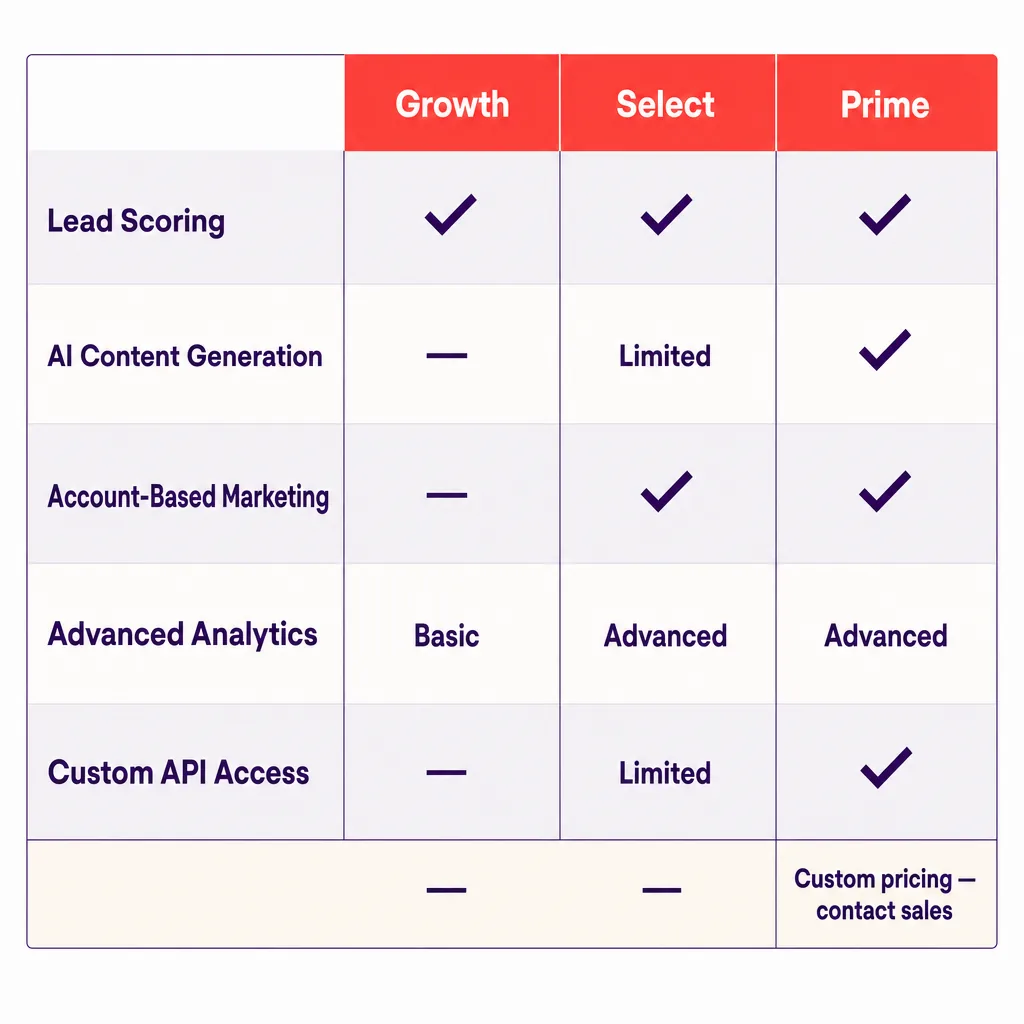
| Tier | Estimated Price Range | Contact Limit | Key Features | AI Features |
|---|---|---|---|---|
| Growth | $895–$1,295/mo | ~20K contacts | Email, nurture, basic reporting | Minimal |
| Select | $1,795–$2,495/mo | ~50K contacts | A/B testing, advanced segmentation | Predictive content |
| Prime | $2,795–$3,195+/mo | ~75K+ contacts | Advanced analytics, Marketo Measure | Predictive audiences |
| Ultimate | Custom | Custom | Full suite, sandbox, advanced attribution | Full Adobe Sensei |
Add-ons inflate the number fast. Marketo Measure (formerly Bizible) for multi-touch attribution can add $1,500+/mo. Sandbox environments, advanced journey analytics, and additional API calls all carry separate line items.
Marketo Engage vs. HubSpot vs. Klaviyo vs. ActiveCampaign: 2026 Pricing Comparison
| Platform | Starting Price | AI Features Included | Best For |
|---|---|---|---|
| Marketo Engage | ~$895/mo | Limited at base tier | Enterprise B2B |
| HubSpot Marketing Hub | ~$800/mo (Pro) | Generative + predictive at Pro | Mid-market B2B/B2C |
| Klaviyo | ~$20/mo (scales with contacts) | Predictive analytics, AI subject lines | E-commerce, DTC |
| ActiveCampaign | ~$49/mo | Basic AI, send-time optimization | SMB, startups |
How to get an accurate Marketo quote: (1) Define your database size and 12-month growth projection. (2) List every add-on you need — Marketo Measure, sandbox, advanced journey analytics. (3) Request multi-year pricing; Adobe discounts 15–25% for 2–3 year commits. (4) Benchmark the total against HubSpot Enterprise and Salesforce MCAE before signing.
If opaque enterprise pricing makes you twitchy, I get it. We publish transparent pricing because I think hiding costs is a terrible way to start a relationship.
Privacy, Consent & Legal Risks of AI-Powered Marketing Automation (GDPR, CCPA, AI Act)
AI personalization creates unique privacy exposure because predictive models infer sensitive attributes, automated decisions trigger regulatory obligations, and cross-channel data aggregation multiplies compliance surface area. Ignore this and the fines write themselves.

GDPR Implications for AI Personalization
Article 22 of GDPR gives individuals the right not to be subject to decisions based solely on automated processing that produce legal or similarly significant effects. Predictive lead scoring that determines pricing, credit offers, or service eligibility falls squarely into this. You need a lawful basis — legitimate interest or explicit consent — and a Data Protection Impact Assessment for any predictive model touching personal data. The right to explanation means you need to be able to tell a customer why your model scored them the way it did.
CCPA/CPRA & US State Privacy Laws
California’s CPRA grants consumers the right to opt out of automated decision-making technology. Texas, Colorado, and Connecticut have enacted similar provisions. If your marketing automation scores or profiles US consumers, you need opt-out mechanisms that actually work — not a buried settings page nobody can find.
EU AI Act 2025–2026 Obligations for Marketing AI
The EU AI Act’s phased enforcement began in 2025. Recommendation engines and personalization systems currently sit in the “limited risk” category, which means transparency obligations: disclose when content is AI-generated, maintain documentation of your models, and ensure human oversight for decisions with significant impact. The classification could tighten. Build for stricter rules than today’s.
Practical Compliance Checklist
- Deploy a consent management platform (OneTrust, Cookiebot, or equivalent)
- Apply data minimization to model training — don’t feed the model data it doesn’t need
- Build right-to-explanation workflows for predictive scoring decisions
- Review vendor Data Processing Agreements annually
- Implement cookie-less tracking alternatives for browsers dropping third-party cookies
- Disclose AI-generated content where required by the EU AI Act
- Maintain model audit trails — document training data, features, and decision logic
- Use approved cross-border transfer mechanisms (SCCs, adequacy decisions) for international data flows
- Monitor enforcement: CNIL fined multiple companies for AI profiling violations in 2025; the ICO issued updated guidance on AI and data protection in early 2026; NOYB continues filing complaints across EU member states
How to Get Started With Marketing Automation AI in 2026
Three steps. No fluff.
- Audit your current stack. Map every manual workflow — email sends, lead routing, reporting, content creation. Identify which ones are repetitive, rule-based, and time-consuming. Those are your automation targets.
- Start with one high-impact use case. Predictive lead scoring, email personalization, or content generation. Pick the one closest to revenue. Deploy it. Measure it.
- Measure ruthlessly. Set a 90-day ROI benchmark before you scale anything. If the numbers don’t work in 90 days, the tool is wrong or the implementation is wrong. Either way, you need to know.
Here’s the thing I keep telling clients: 90% of effective marketing automation is deterministic logic — if this, then that. The AI layer amplifies what’s already working. If your workflows are broken, AI just breaks them faster and more creatively.
The single most important thing about marketing automation AI: it’s a multiplier, not a replacement for strategy.
- Calculate what your manual workflows actually cost before you evaluate any platform
- Start with one use case tied directly to pipeline revenue, not a shiny feature demo
- Set a 90-day ROI benchmark and kill anything that doesn’t hit it
If you’d rather skip the build entirely, Botonomy AI marketing automation runs SEO, content, paid ads, and outbound as autonomous systems — no headcount required. That’s the pitch. The math is on the pricing page.