

In short
An agentic operating system is a software layer where a large language model acts as the kernel, scheduling tasks, calling tools through MCP, and running agents autonomously. Pricing runs on tokens, context size, seats, and sandbox compute. Microsoft’s Agent 365 is a control plane for observing, governing, and securing AI agents across an organization, not an agentic operating system. installaos.com lists a $1,000 install price and an About page from “Mario”, but the operator’s full identity and the pricing were not independently verified.
Get AI marketing insights every week.
Martin Kelly, Founder of Botonomy, runs his marketing on an agentic operating system and treats the LLM like a kernel he’s always patching. He swaps models in and out, kills runaway agent loops, and reads token bills the way other people read sports scores.
Last updated: November 5, 2026. Model prices verified November 5, 2026. I keep this page maintained because two Gemini price increases land within the next eight weeks.
Every vendor with a chatbot and a pitch deck now sells an “agentic operating system.” Most of them are a prompt in a trench coat. I run Botonomy’s marketing on an actual one: four specialist pipelines for SEO, content, paid ads and outbound, all wired through one orchestrator.
The part that makes it work is boring. About 90% of the logic is code, not prompts. This guide covers what the term means, what it costs in 2026, where seat-based agents fall over, and how I’d decide whether you need one at all.
What Is an Agentic Operating System?
An agentic operating system is a software layer where a large language model acts as the kernel. It schedules tasks, allocates context-window memory, calls tools through protocols like MCP, retrieves knowledge from vector stores, and runs agents in sandboxed, isolated processes so they can complete multi-step work autonomously.
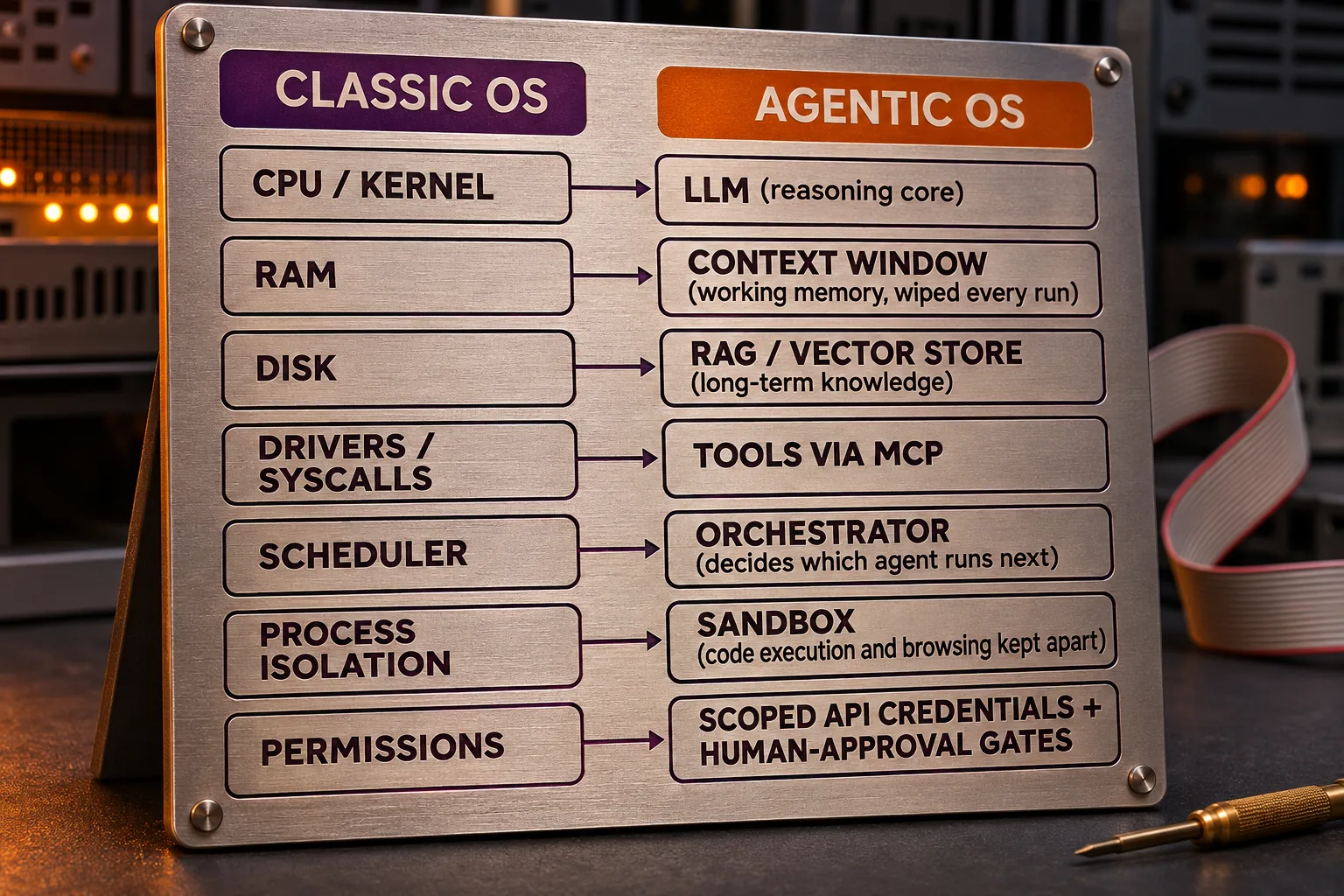
That framing matches the OS Protocol specification, which I treat as the protocol reference. The mapping from a classic OS to the agentic version:
- CPU / kernel → LLM (the reasoning core)
- RAM → context window (working memory, wiped every run)
- Disk → RAG / vector store (long-term knowledge)
- Drivers / syscalls → tools via the Model Context Protocol (MCP)
- Scheduler → orchestrator (decides which agent runs next)
- Process isolation → sandbox (code execution and browsing kept apart)
- Permissions → scoped API credentials and human-approval gates
Define agentic: the system picks its own next step instead of waiting for a prompt. A chatbot waits for you to type something. A fixed automation follows a flow somebody drew in advance. An agentic system looks at the state of the work and decides what to do next, which is also why it can decide wrong. I covered how agentic AI differs from traditional automation in more depth separately.
None of this is new. In 2023, Andrej Karpathy popularized the “LLM OS” framing, and Trademark applications using the word ‘agentic’ have risen sharply, from two in 2023 to 513 in the first seven months of 2026, but there is no evidence of filings specifically on an ‘LLM OS’ framing.
Today’s kernels are Claude Opus 5.5, Claude Sonnet 5.5, GPT-6.1 Sol, GPT-6 Astra and Gemini 4 Argon. A proper agentic OS is model-agnostic. If you can’t swap the kernel without rewriting everything, you’ve bought a vendor lock-in with a nice logo, not an operating system.
One distinction matters here. Microsoft is building agentic features directly into Windows, such as Agent Workspace and Copilot Actions, and promoting the result as an ‘agentic OS’. If you searched “agentic OS Microsoft” for the enterprise version, the one you want is Microsoft Agent 365, the governance layer described in Microsoft Learn’s Agent 365 service description.
Agentic Operating System Pricing in 2026
Most agentic OS pricing pages tell you less than a restaurant menu with no prices on it. My rule for this table is simple. I don’t repeat vendor prices from memory, and I don’t estimate. If I couldn’t confirm a number on the vendor’s own page, the cell says so.
| Product | Vendor | Pricing model | Entry price | What’s metered | Source (status as of Nov 2026) |
|---|---|---|---|---|---|
| AOS | Operator not confirmed | Not confirmed | Not confirmed | Not confirmed | installaos.com, no readable text extracted |
| Workspace agents / ChatGPT Business | OpenAI | Per-seat (Standard $20/month annual or $25 monthly; Premium $100 or $125), with workspace agents included; extra usage can be bought as credits, and API usage is billed separately. | Confirm on vendor page | ChatGPT Business is priced per seat (Standard or Premium), with optional workspace credits for extra usage; API usage is billed separately from the workspace. | openai.com/business/workspace-agents |
| Microsoft Agent 365 | Microsoft | Enterprise licensing | Contact sales | See Microsoft Learn service description | Microsoft Learn |
| Agent OS | PwC | Enterprise engagement | Contact sales | Not published | PwC product page |
| Agentic OS | ibl.ai | Marketplace listing | See AWS Marketplace listing | Per listing terms | AWS Marketplace |
| n8n | n8n | Free self-hosted community edition; paid cloud plans | Community edition: free | Cloud: workflow executions; self-hosted: your own infrastructure | n8n.io |
| OSP-based / open-source projects | Community | Free / self-hosted | $0 licence | You pay compute + model tokens | osprotocol.dev |
Who makes AOS? I couldn’t verify the operating entity from installaos.com as of November 2026, so I’m not naming one. For the same reason, I’m not describing AOS’s security model, specialist agents or token calculator secondhand. If the site publishes readable details, they’ll go in this table.
How agentic OS pricing works
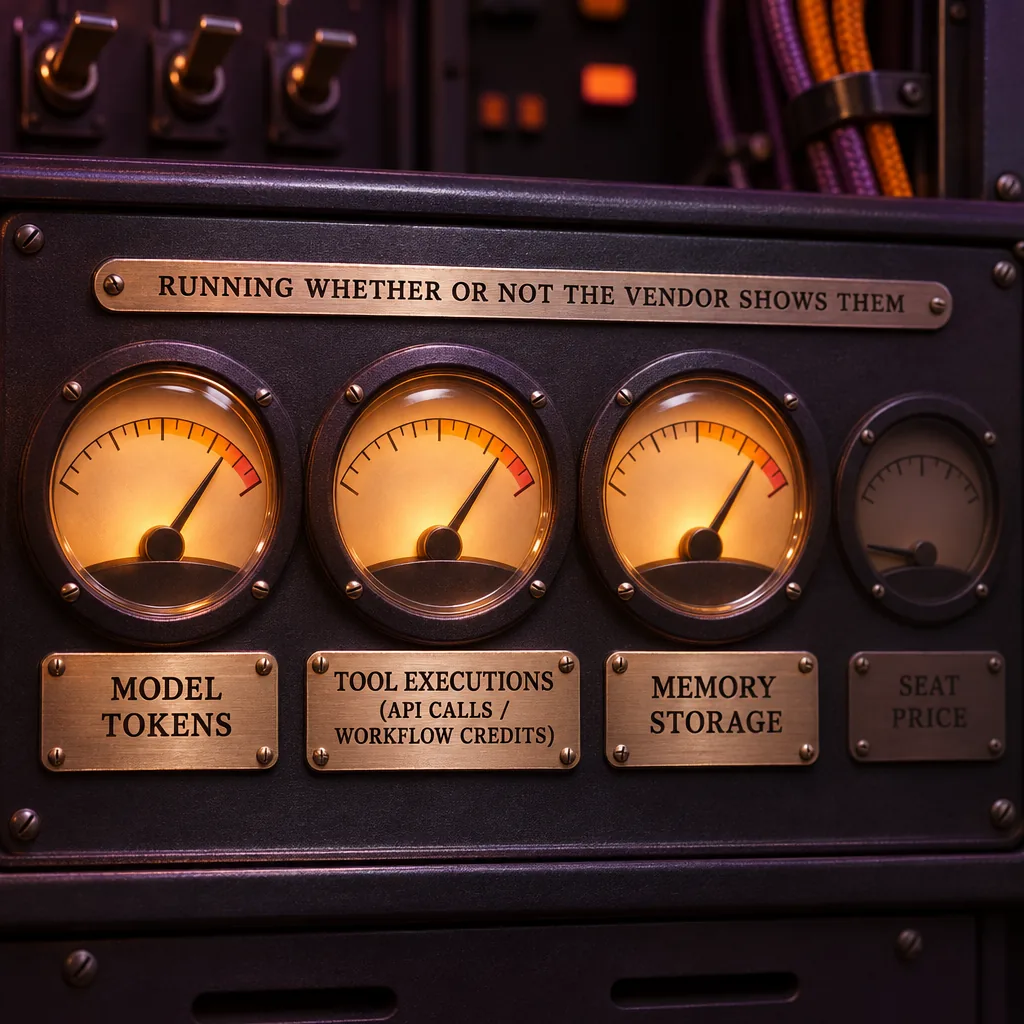
Several cost meters typically run underneath agentic OS products, such as model tokens, tool executions (API calls or workflow credits) and memory storage, whether or not the vendor shows them.
- Inference tokens. Input and output are priced separately. Claude Sonnet 5.5 costs $2.00 in / $10.00 out per 1M tokens. GPT-6 Luna costs $0.10 in / $0.50 out.
- Context size. Bigger prompts cost more on every single run. Stuff 150k tokens of “background” into each call and you pay for it every time.
- Per-agent or specialist fees. Some vendors charge per agent on top of tokens.
- Per-seat bundles. Predictable, and blind to how much autonomous work actually runs.
- Sandbox compute. Code execution and browsing burn compute separately from the model.
Budgets built today will change on a schedule. Gemini 4 Argon is $2.00 / $10.00 through November 30, 2026, then $4.00 / $20.00 from December 1, 2026. Gemini 3.8 Flash is $0.75 / $3.75 through December 31, 2026, then $1.50 / $7.50 from January 1, 2027. Both double. If your cost model hardcodes either rate, it’s already wrong.
OpenAI Workspace Agents vs Dedicated Agentic OS: 2026 Pricing
GPT-6 Astra output costs $50.00 per 1M tokens. GPT-6 Luna output costs $0.50. That 100× gap is the entire case for running your own orchestrator instead of buying seats.
OpenAI’s workspace agents page is the source of record for which plans include agents. Plan prices change, so I’m sending you to the live page instead of printing a number that might be stale by Friday.
| ChatGPT plan | Built for | Seat price | Workspace agents |
|---|---|---|---|
| Free | Individuals testing | Confirm on openai.com | Confirm on openai.com |
| Plus | Individual power users | Confirm on openai.com | Confirm on openai.com |
| Pro | Heavy individual use | Confirm on openai.com | Confirm on openai.com |
| Business (formerly Team) | Teams | Confirm on openai.com | Confirm on openai.com |
| Enterprise | Large organizations | Contact sales | Confirm on openai.com |
Custom agents built on the API bill per token, separately from seats. These are the current list rates:
| API model | Input / 1M tokens | Output / 1M tokens |
|---|---|---|
| GPT-6 Astra | $10.00 | $50.00 |
| GPT-6.1 Sol | $2.00 | $10.00 |
| GPT-6.1 Terra | $1.00 | $5.00 |
| GPT-6 Luna | $0.10 | $0.50 |
When to use ChatGPT agents vs an agentic OS. Bundled seats suit knowledge workers running ad-hoc agents inside one vendor. You get predictable cost and zero infrastructure. An orchestrator suits always-on pipelines that cross tools. That means routing models across vendors, deterministic code paths for anything that must not vary, and per-run cost control. If a human kicks off every task, buy seats. If the work runs at 3am without anyone asking, build or buy an orchestrator. My breakdown of when it actually makes sense to build a multi-agent system goes further.
My verdict. Seat-based agents broke for me on a weekly cross-channel report. The job was to pull Search Console data, match it against paid spend and flag pages losing both. It worked fine on Monday. By Thursday it had quietly renamed a column, and I had no per-run cost line to show what the retries were burning. A pipeline with a validation step catches that in milliseconds. A chat seat just apologizes nicely.
How We Run Marketing on an Agentic Operating System
Our stack maps one-to-one onto the OS layers from the first section. Nothing about it is exotic. It’s just strict.
- Scheduler → orchestrator. Code decides which specialist runs, in what order, with what inputs.
- Processes → specialist agents. These cover SEO, content, paid ads and outbound. Our autonomous AI SEO agent is one of them.
- Syscalls → MCP tool connections. These link to the CRM, ad platforms, the CMS and Search Console.
- Disk → RAG memory. It holds brand guidelines, past briefs and performance history.
- Permissions → human-approval gates. A human approves anything that spends money or publishes.
90% of the logic is code, not prompts. Deterministic code handles routing, schema validation, data pulls, deduplication and QA checks. The LLM kernel gets called for two things only: judgment and language. Asking a model to do arithmetic or remember an API schema is how you end up debugging vibes at midnight.
Model routing per task
- Classification and extraction: Claude Haiku 5.5 or GPT-6 Luna, both at $0.10 / $0.50. Haiku 5.5 is priced at $0.10 in / $0.50 out per 1M tokens for prompts up to 100k tokens; longer prompts are still accepted but cost more ($0.50 in / $2.50 out).
- Drafting: Claude Sonnet 5.5 or GPT-6.1 Sol, both at $2.00 / $10.00.
- Hard reasoning and strategy: Claude Opus 5.5 ($4.00 / $20.00) or Gemini 4 Argon. Argon’s rate doubles on December 1, 2026, so the router reweights on that date.
Token calculator
Cost per run = (input tokens ÷ 1,000,000 × input rate) + (output tokens ÷ 1,000,000 × output rate)
Here’s an illustrative run, not pulled from a specific log. A content-brief step uses 200k input and 40k output tokens:
- Claude Sonnet 5.5: (200,000 ÷ 1,000,000 × $2.00) + (40,000 ÷ 1,000,000 × $10.00) = $0.40 + $0.40 = $0.80
- GPT-6 Luna, same token load, classification only: $0.02 + $0.02 = $0.04
That’s a 20× difference for the same token volume. Note that a 200k input fits within Haiku 5.5’s 1M context window, but it exceeds the 100k threshold, so it is billed at the higher long-prompt rate., which is exactly why the router sends that job to Luna. Getting this wrong across a few thousand runs a month is a pain in the ass you only notice on the invoice.
The figure I’ll stand behind: across 9+ e-commerce brands since 2024, my client work averages a 43% organic traffic increase. I’m not crediting the agents with all of it. The agents removed the manual grind, so the judgment calls actually got made on time.
Is an Agentic Operating System Worth It? Security, Governance and Cost Risks
The most common mistake I see is buying an agent platform before reading its security page. Here’s the checklist I run on any agentic OS:
- Process isolation between agents
- Sandboxed tool execution for code and browsing
- Scoped credentials (per agent, least privilege)
- Data retention and model-training opt-out policies
- Encryption in transit and at rest
- Audit logs for every tool call
- Human approval for spend and publishing
- A SOC 2 report, accepted only if the vendor actually publishes it
AOS against the checklist: I couldn’t extract readable security, privacy or terms content from installaos.com, so I can’t score it. Treat that as a finding. If a buyer can’t read the security posture, procurement can’t either.
For governance, Microsoft Agent 365 (per Microsoft Learn) and PwC’s agent OS show how enterprises approach the problem. The neutral standard is the NIST AI Risk Management Framework, which I’d map controls to Some vendor compliance badges reflect marketing spend or minimal requirements rather than rigorous audits, so verify the underlying certification before trusting any vendor’s badge..
Cost risks tend to be dull and expensive. Runaway agent loops retry forever. Context bloat can silently multiply per-run cost; in one test, full-context agents cost almost three times as much as memory-based approaches. And the scheduled Gemini increases on December 1, 2026 and January 1, 2027 will hit any budget that assumed today’s rates. The fixes are equally dull: hard budget caps per run, max-step limits, and routing cheap tasks to cheap models.
Verdict: an agentic OS is worth it when the work is recurring, multi-step and crosses tools. For one-off tasks that a single chat seat handles, it’s an expensive hobby.
Agentic OS Pricing FAQ
Is there a free agentic OS?
Yes. Open-source and OSP-based projects are free to run, and so is n8n’s self-hosted community edition. “Free” covers the licence only. You still pay for servers, sandbox compute and every model token your agents burn, and an always-on pipeline can cost more than a seat plan if you route badly.
How are tokens billed?
Input and output tokens are priced separately per 1M tokens. Output costs roughly 5× input on current Anthropic, OpenAI and Gemini 4 Argon list prices. Quick calc: 1M input plus 1M output on GPT-6.1 Sol costs $2.00 + $10.00 = $12.00. Trim output length first, because that’s where the money goes.
Per-seat vs usage pricing?
Seats give predictable cost when humans drive the agents. Usage pricing scales with autonomous runs, so it can be cheaper or brutal depending on volume and model choice. Most marketing ops end up hybrid: seats for the team’s ad-hoc work, usage billing for the pipelines that run unattended.
What to Do Next
An agentic operating system pays off when code does the routine work and the model only handles judgment.
- Define the workload. It should be recurring, multi-step and cross-tool, or you don’t need one.
- Cost it with the formula above. Then re-run the numbers at the December 2026 and January 2027 Gemini rates.
- Check vendor security pages, then decide. Choose seats for ad-hoc human work and an orchestrator for always-on pipelines.
Want marketing that runs on an agentic OS without hiring the team to build it? Botonomy runs SEO, content, paid ads and outbound as deterministic agent pipelines, where 90% of the logic is code, not prompts. Book a 30-minute ops review and we’ll map your workflows to agents and show the per-run cost before you commit.
Book a 30-minute ops review →